1910 · CLOSE READING
The Equinox (Volume I, Number III)
The Equinox (Volume I, Number III) (1910), PDF p. 92
Original page
Enlarge ↗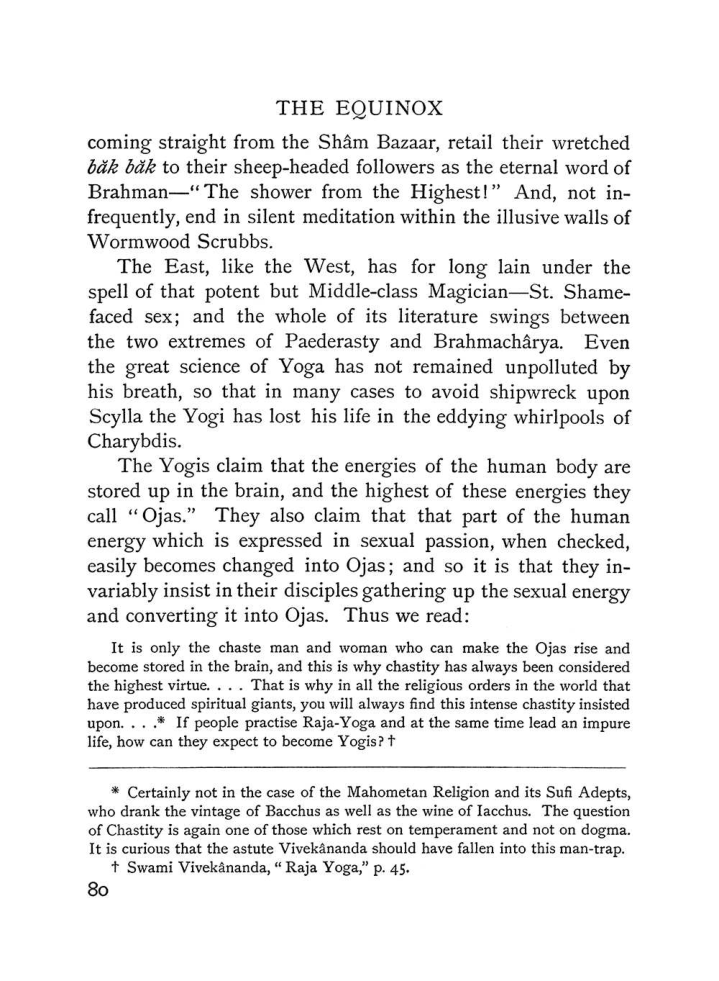
Highlights use the original PDF text layer. OCR-only matches may not be visible on the scan.
Transcription
Download text ↓raw extractionoriginal embedded textReview: unreviewed
THE EQUINOX
coming straight from the Sham Bazaar, retail their wretched
bak bak to their sheep-headed followers as the eternal word of
Brahman—“
The shower from the Highest!” And, not in-
frequently, end in silent meditation within the illusive walls of
Wormwood Scrubbs.
The East, like the West, has for long lain under the
spell of that potent but Middle-class Magician—St. Shame-
faced sex; and the whole of its literature swings between
the two extremes of Paederasty and Brahmacharya. Even
the great science of Yoga has not remained unpolluted by
his breath, so that in many cases to avoid shipwreck upon
Scylla the Yogi has lost his life in the eddying whirlpools of
Charybdis.
The Yogis claim that the energies of the human body are
stored up in the brain, and the highest of these energies they
call “Ojas.” They also claim that that part of the human
energy which is expressed in sexual passion, when checked,
easily becomes changed into Ojas; and so it is that they in-
variably insist in their disciples gathering up the sexual energy
and converting it into Ojas. Thus we read:
It is only the chaste man and woman who can make the Ojas rise and
become stored in the brain, and this is why chastity has always been considered
the highest virtue. . . . That is why in all the religious orders in the world that
have produced spiritual giants, you will always find this intense chastity insisted
upon... .* If people practise Raja-Yoga and at the same time lead an impure
life, how can they expect to become Yogis? t
* Certainly not in the case of the Mahometan Religion and its Sufi Adepts,
who drank the vintage of Bacchus as well as the wine of Iacchus. The question
of Chastity is again one of those which rest on temperament and not on dogma.
It is curious that the astute Vivekananda should have fallen into this man-trap.
+t Swami Vivekananda, “ Raja Yoga,” p. 45.
80
Page provenance & review flags
Stable page ID: d1f23c8ca1536b365e6ad0ea:p00092
Line breaks are preserved. Reading order and OCR accuracy may need review.
Printed page label has not been verified.
- No automated review flags. This does not establish transcription accuracy.