1910 · CLOSE READING
The Equinox (Volume I, Number III)
The Equinox (Volume I, Number III) (1910), PDF p. 91
Original page
Enlarge ↗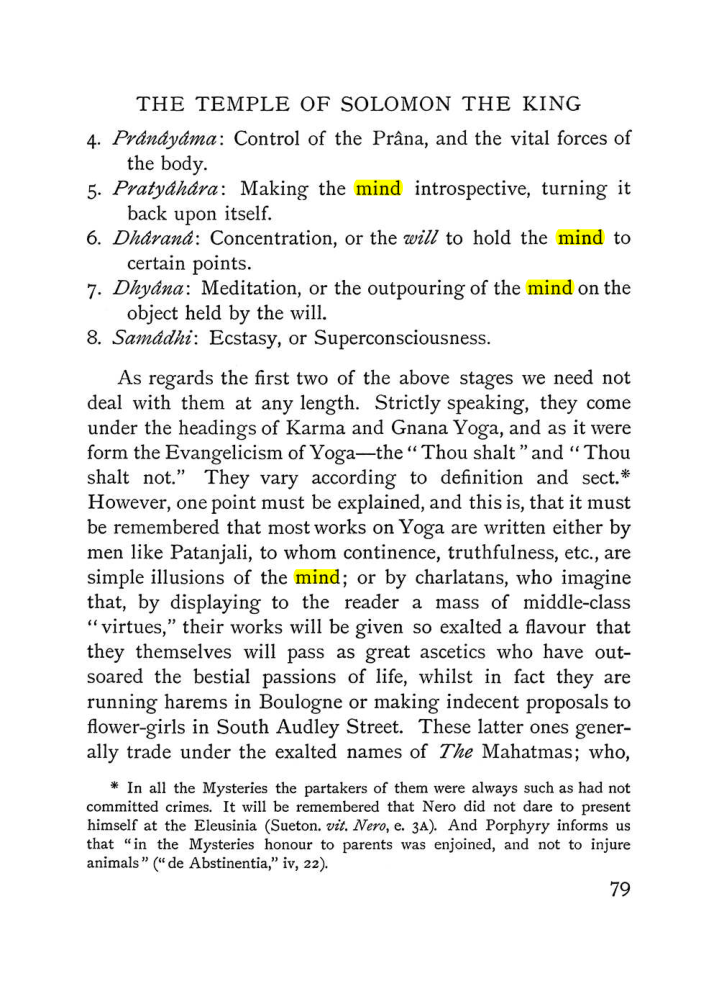
Highlights use the original PDF text layer. OCR-only matches may not be visible on the scan.
Transcription
Download text ↓raw extractionoriginal embedded textReview: unreviewed
THE TEMPLE OF SOLOMON THE KING
4. Prénéyéma: Control of the Prana, and the vital forces of
the body.
5. Pratyéhévra: Making the mind introspective, turning it
back upon itself.
6. Dhévané: Concentration, or the wi// to hold the mind to
certain points.
7. Dhydéna: Meditation, or the outpouring of the mind on the
object held by the will.
8. Samadhi: Ecstasy, or Superconsciousness.
As regards the first two of the above stages we need not
deal with them at any length. Strictly speaking, they come
under the headings of Karma and Gnana Yoga, and as it were
form the Evangelicism of Yoga—the “Thou shalt” and “ Thou
shalt not.” They vary according to definition and sect.*
However, one point must be explained, and this is, that it must
be remembered that most works on Yoga are written either by
men like Patanjali, to whom continence, truthfulness, etc., are
simple illusions of the mind; or by charlatans, who imagine
that, by displaying to the reader a mass of middle-class
“virtues,” their works will be given so exalted a flavour that
they themselves will pass as great ascetics who have out-
soared the bestial passions of life, whilst in fact they are
running harems in Boulogne or making indecent proposals to
flower-girls in South Audley Street. These latter ones gener-
ally trade under the exalted names of Ze Mahatmas; who,
* In all the Mysteries the partakers of them were always such as had not
committed crimes. It will be remembered that Nero did not dare to present
himself at the Eleusinia (Sueton. vzt, Vero, e. 3A). And Porphyry informs us
that “in the Mysteries honour to parents was enjoined, and not to injure
animals” (“de Abstinentia,” iv, 22).
79
Page provenance & review flags
Stable page ID: d1f23c8ca1536b365e6ad0ea:p00091
Line breaks are preserved. Reading order and OCR accuracy may need review.
Printed page label has not been verified.
- No automated review flags. This does not establish transcription accuracy.