1904 · CLOSE READING
The Sword of Song
The Sword of Song (1904), PDF p. 67
Original page
Enlarge ↗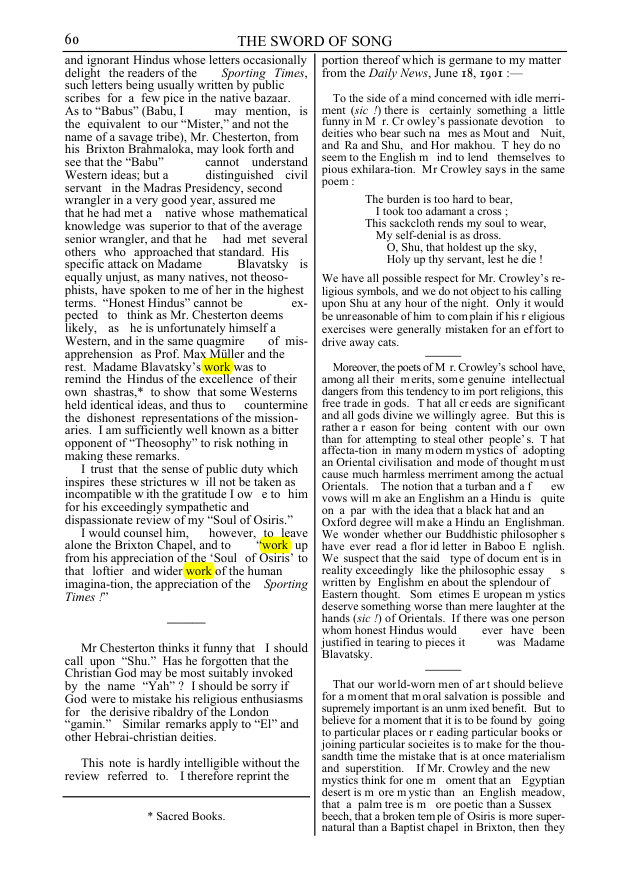
Highlights use the original PDF text layer. OCR-only matches may not be visible on the scan.
Transcription
Download text ↓raw extractionoriginal embedded textReview: unreviewed
THE SWORD OF SONG
60
and ignorant Hindus whose letters occasionally
delight the readers of the
Sporting Times,
such letters being usually written by public
scribes for a few pice in the native bazaar.
As to “Babus” (Babu, I
may mention, is
the equivalent to our “Mister,” and not the
name of a savage tribe), Mr. Chesterton, from
his Brixton Brahmaloka, may look forth and
see that the “Babu”
cannot understand
Western ideas; but a
distinguished civil
servant in the Madras Presidency, second
wrangler in a very good year, assured me
that he had met a native whose mathematical
knowledge was superior to that of the average
senior wrangler, and that he
had met several
others who approached that standard. His
specific attack on Madame
Blavatsky is
equally unjust, as many natives, not theoso-
phists, have spoken to me of her in the highest
terms. “Honest Hindus” cannot be
ex-
pected to think as Mr. Chesterton deems
likely, as he is unfortunately himself a
Western, and in the same quagmire
of mis-
apprehension as Prof. Max Müller and the
rest. Madame Blavatsky’s work was to
remind the Hindus of the excellence of their
own shastras,* to show that some Westerns
held identical ideas, and thus to
countermine
the dishonest representations of the mission-
aries. I am sufficiently well known as a bitter
opponent of “Theosophy” to risk nothing in
making these remarks.
I trust that the sense of public duty which
inspires these strictures w ill not be taken as
incompatible w ith the gratitude I ow e to him
for his exceedingly sympathetic and
dispassionate review of my “Soul of Osiris.”
I would counsel him,
however, to leave
alone the Brixton Chapel, and to
“work up
from his appreciation of the ‘Soul of Osiris’ to
that loftier and wider work of the human
imagina-tion, the appreciation of the Sporting
Times !”
Mr Chesterton thinks it funny that I should
call upon “Shu.” Has he forgotten that the
Christian God may be most suitably invoked
by the name “Yah” ? I should be sorry if
God were to mistake his religious enthusiasms
for the derisive ribaldry of the London
“gamin.” Similar remarks apply to “El” and
other Hebrai-christian deities.
This note is hardly intelligible without the
review referred to. I therefore reprint the
* Sacred Books.
portion thereof which is germane to my matter
from the Daily News, June 18, 1901 :—
To the side of a mind concerned with idle merri-
ment (sic !) there is certainly something a little
funny in M r. Cr owley’s passionate devotion to
deities who bear such na mes as Mout and Nuit,
and Ra and Shu, and Hor makhou. T hey do no
seem to the English m ind to lend themselves to
pious exhilara-tion. Mr Crowley says in the same
poem :
The burden is too hard to bear,
I took too adamant a cross ;
This sackcloth rends my soul to wear,
My self-denial is as dross.
O, Shu, that holdest up the sky,
Holy up thy servant, lest he die !
We have all possible respect for Mr. Crowley’s re-
ligious symbols, and we do not object to his calling
upon Shu at any hour of the night. Only it would
be unreasonable of him to complain if his r eligious
exercises were generally mistaken for an effort to
drive away cats.
Moreover, the poets of M r. Crowley’s school have,
among all their merits, some genuine intellectual
dangers from this tendency to im port religions, this
free trade in gods. T hat all cr eeds are significant
and all gods divine we willingly agree. But this is
rather a r eason for being content with our own
than for attempting to steal other people’s. T hat
affecta-tion in many modern mystics of adopting
an Oriental civilisation and mode of thought must
cause much harmless merriment among the actual
Orientals. The notion that a turban and a f
ew
vows will m ake an Englishm an a Hindu is quite
on a par with the idea that a black hat and an
Oxford degree will make a Hindu an Englishman.
We wonder whether our Buddhistic philosopher s
have ever read a flor id letter in Baboo E nglish.
We suspect that the said type of docum ent is in
reality exceedingly like the philosophic essay
s
written by Englishm en about the splendour of
Eastern thought. Som etimes E uropean m ystics
deserve something worse than mere laughter at the
hands (sic !) of Orientals. If there was one person
whom honest Hindus would
ever have been
justified in tearing to pieces it
was Madame
Blavatsky.
That our world-worn men of ar t should believe
for a moment that moral salvation is possible and
supremely important is an unm ixed benefit. But to
believe for a moment that it is to be found by going
to particular places or r eading particular books or
joining particular socieites is to make for the thou-
sandth time the mistake that is at once materialism
and superstition. If Mr. Crowley and the new
mystics think for one m
oment that an Egyptian
desert is m ore m ystic than an English meadow,
that a palm tree is m
ore poetic than a Sussex
beech, that a broken temple of Osiris is more super-
natural than a Baptist chapel in Brixton, then they
Page provenance & review flags
Stable page ID: cdd842c2ae8f5d9753c40b33:p00067
Line breaks are preserved. Reading order and OCR accuracy may need review.
Printed page label has not been verified.
- legacy text differs review