1904 · CLOSE READING
The Sword of Song
The Sword of Song (1904), PDF p. 66
Original page
Enlarge ↗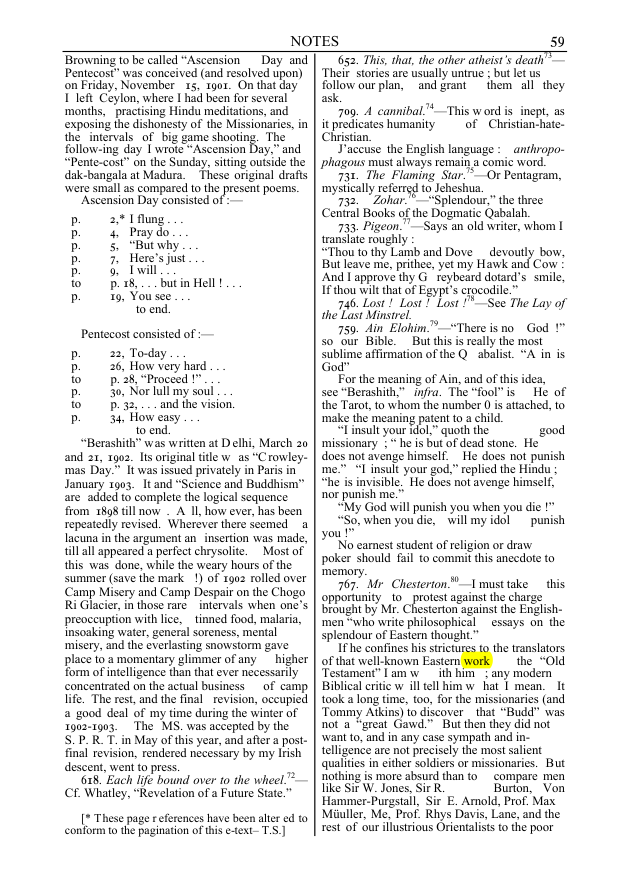
Highlights use the original PDF text layer. OCR-only matches may not be visible on the scan.
Transcription
Download text ↓raw extractionoriginal embedded textReview: unreviewed
NOTES
59
Browning to be called “Ascension
Day and
Pentecost” was conceived (and resolved upon)
on Friday, November 15, 1901. On that day
I left Ceylon, where I had been for several
months, practising Hindu meditations, and
exposing the dishonesty of the Missionaries, in
the intervals of big game shooting. The
follow-ing day I wrote “Ascension Day,” and
“Pente-cost” on the Sunday, sitting outside the
dak-bangala at Madura. These original drafts
were small as compared to the present poems.
Ascension Day consisted of :—
p.
2,* I flung . . .
p.
4, Pray do . . .
p.
5, “But why . . .
p.
7, Here’s just . . .
p.
9, I will . . .
to
p. 18, . . . but in Hell ! . . .
p.
19, You see . . .
to end.
Pentecost consisted of :—
p.
22, To-day . . .
p.
26, How very hard . . .
to
p. 28, “Proceed !” . . .
p.
30, Nor lull my soul . . .
to
p. 32, . . . and the vision.
p.
34, How easy . . .
to end.
“Berashith” was written at D elhi, March 20
and 21, 1902. Its original title w as “Crowley-
mas Day.” It was issued privately in Paris in
January 1903. It and “Science and Buddhism”
are added to complete the logical sequence
from 1898 till now . A ll, how ever, has been
repeatedly revised. Wherever there seemed
a
lacuna in the argument an insertion was made,
till all appeared a perfect chrysolite. Most of
this was done, while the weary hours of the
summer (save the mark !) of 1902 rolled over
Camp Misery and Camp Despair on the Chogo
Ri Glacier, in those rare intervals when one’s
preoccuption with lice, tinned food, malaria,
insoaking water, general soreness, mental
misery, and the everlasting snowstorm gave
place to a momentary glimmer of any
higher
form of intelligence than that ever necessarily
concentrated on the actual business
of camp
life. The rest, and the final revision, occupied
a good deal of my time during the winter of
1902-1903. The MS. was accepted by the
S. P. R. T. in May of this year, and after a post-
final revision, rendered necessary by my Irish
descent, went to press.
618. Each life bound over to the wheel.72—
Cf. Whatley, “Revelation of a Future State.”
[* These page r eferences have been alter ed to
conform to the pagination of this e-text– T.S.]
652. This, that, the other atheists death73—
Their stories are usually untrue ; but let us
follow our plan,
and grant
them all they
ask.
709. A cannibal.74—This w ord is inept, as
it predicates humanity
of Christian-hate-
Christian.
J’accuse the English language : anthropo-
phagous must always remain a comic word.
731. The Flaming Star.75—Or Pentagram,
mystically referred to Jeheshua.
732.
Zohar.76—“Splendour,” the three
Central Books of the Dogmatic Qabalah.
733. Pigeon.77—Says an old writer, whom I
translate roughly :
“Thou to thy Lamb and Dove
devoutly bow,
But leave me, prithee, yet my Hawk and Cow :
And I approve thy G reybeard dotard’s smile,
If thou wilt that of Egypt’s crocodile.”
746. Lost ! Lost ! Lost !78—See The Lay of
the Last Minstrel.
759. Ain Elohim.79—“There is no God !”
so our Bible. But this is really the most
sublime affirmation of the Q
abalist. “A in is
God”
For the meaning of Ain, and of this idea,
see “Berashith,” infra. The “fool” is
He of
the Tarot, to whom the number 0 is attached, to
make the meaning patent to a child.
“I insult your idol,” quoth the
good
missionary ; “ he is but of dead stone. He
does not avenge himself. He does not punish
me.” “I insult your god,” replied the Hindu ;
“he is invisible. He does not avenge himself,
nor punish me.”
“My God will punish you when you die !”
“So, when you die, will my idol
punish
you !”
No earnest student of religion or draw
poker should fail to commit this anecdote to
memory.
767. Mr Chesterton.80—I must take
this
opportunity to protest against the charge
brought by Mr. Chesterton against the English-
men “who write philosophical
essays on the
splendour of Eastern thought.”
If he confines his strictures to the translators
of that well-known Eastern work
the “Old
Testament” I am w
ith him ; any modern
Biblical critic w ill tell him w hat I mean. It
took a long time, too, for the missionaries (and
Tommy Atkins) to discover that “Budd” was
not a “great Gawd.” But then they did not
want to, and in any case sympath and in-
telligence are not precisely the most salient
qualities in either soldiers or missionaries. But
nothing is more absurd than to
compare men
like Sir W. Jones, Sir R.
Burton, Von
Hammer-Purgstall, Sir E. Arnold, Prof. Max
Müuller, Me, Prof. Rhys Davis, Lane, and the
rest of our illustrious Orientalists to the poor
Page provenance & review flags
Stable page ID: cdd842c2ae8f5d9753c40b33:p00066
Line breaks are preserved. Reading order and OCR accuracy may need review.
Printed page label has not been verified.
- legacy text differs review