1944 · CLOSE READING
The Book of Thoth
The Book of Thoth (1944), PDF p. 16
Original page
Enlarge ↗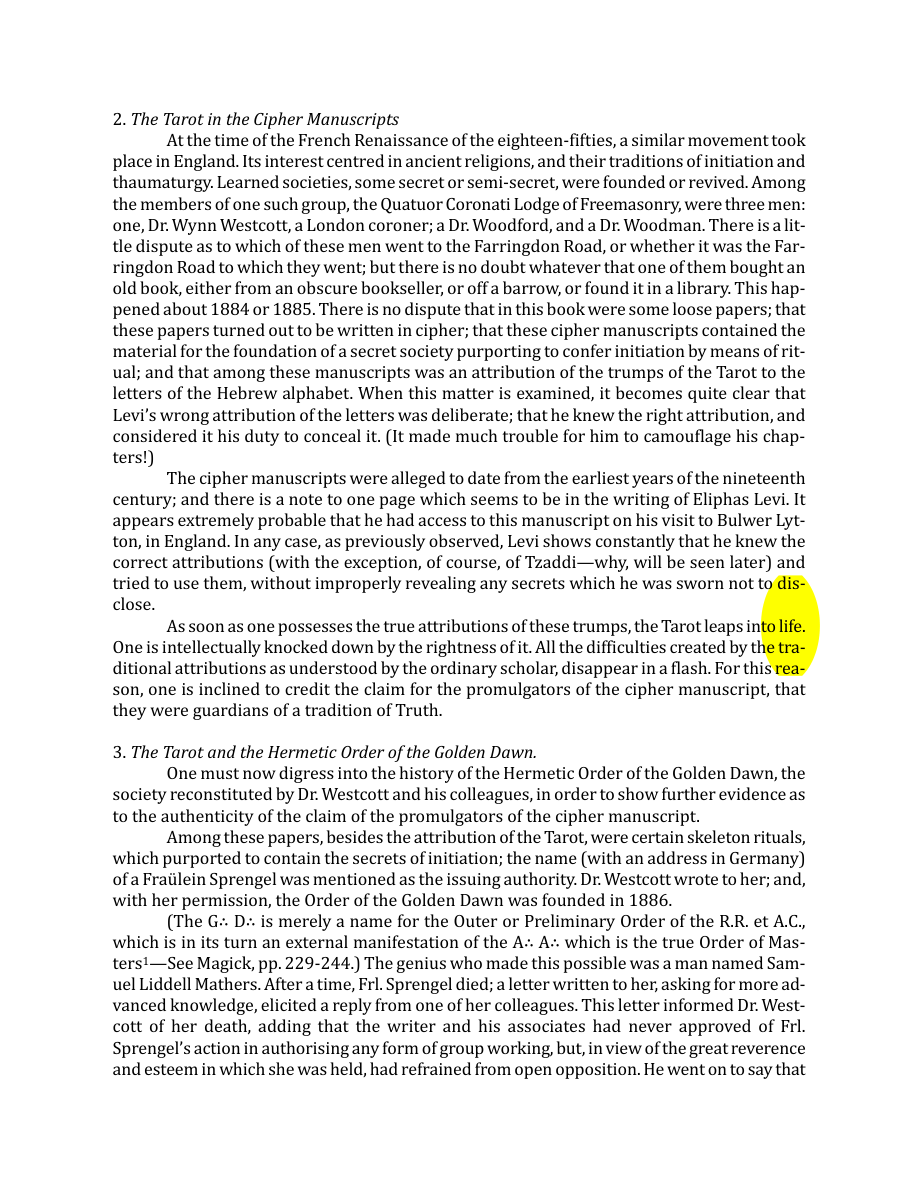
Highlights use the original PDF text layer. OCR-only matches may not be visible on the scan.
Transcription
Download text ↓raw extractionoriginal embedded textReview: unreviewed
2. The Tarot in the Cipher Manuscripts
At the time of the French Renaissance of the eighteen‐fifties, a similar movement took
place in England. Its interest centred in ancient religions, and their traditions of initiation and
thaumaturgy. Learned societies, some secret or semi‐secret, were founded or revived. Among
the members of one such group, the Quatuor Coronati Lodge of Freemasonry, were three men:
one, Dr. Wynn Westcott, a London coroner; a Dr. Woodford, and a Dr. Woodman. There is a lit‐
tle dispute as to which of these men went to the Farringdon Road, or whether it was the Far‐
ringdon Road to which they went; but there is no doubt whatever that one of them bought an
old book, either from an obscure bookseller, or off a barrow, or found it in a library. This hap‐
pened about 1884 or 1885. There is no dispute that in this book were some loose papers; that
these papers turned out to be written in cipher; that these cipher manuscripts contained the
material for the foundation of a secret society purporting to confer initiation by means of rit‐
ual; and that among these manuscripts was an attribution of the trumps of the Tarot to the
letters of the Hebrew alphabet. When this matter is examined, it becomes quite clear that
Levi’s wrong attribution of the letters was deliberate; that he knew the right attribution, and
considered it his duty to conceal it. (It made much trouble for him to camouflage his chap‐
ters!)
The cipher manuscripts were alleged to date from the earliest years of the nineteenth
century; and there is a note to one page which seems to be in the writing of Eliphas Levi. It
appears extremely probable that he had access to this manuscript on his visit to Bulwer Lyt‐
ton, in England. In any case, as previously observed, Levi shows constantly that he knew the
correct attributions (with the exception, of course, of Tzaddi—why, will be seen later) and
tried to use them, without improperly revealing any secrets which he was sworn not to dis‐
close.
As soon as one possesses the true attributions of these trumps, the Tarot leaps into life.
One is intellectually knocked down by the rightness of it. All the difficulties created by the tra‐
ditional attributions as understood by the ordinary scholar, disappear in a flash. For this rea‐
son, one is inclined to credit the claim for the promulgators of the cipher manuscript, that
they were guardians of a tradition of Truth.
3. The Tarot and the Hermetic Order of the Golden Dawn.
One must now digress into the history of the Hermetic Order of the Golden Dawn, the
society reconstituted by Dr. Westcott and his colleagues, in order to show further evidence as
to the authenticity of the claim of the promulgators of the cipher manuscript.
Among these papers, besides the attribution of the Tarot, were certain skeleton rituals,
which purported to contain the secrets of initiation; the name (with an address in Germany)
of a Fraülein Sprengel was mentioned as the issuing authority. Dr. Westcott wrote to her; and,
with her permission, the Order of the Golden Dawn was founded in 1886.
(The G D is merely a name for the Outer or Preliminary Order of the R.R. et A.C.,
which is in its turn an external manifestation of the A A which is the true Order of Mas‐
ters1—See Magick, pp. 229‐244.) The genius who made this possible was a man named Sam‐
uel Liddell Mathers. After a time, Frl. Sprengel died; a letter written to her, asking for more ad‐
vanced knowledge, elicited a reply from one of her colleagues. This letter informed Dr. West‐
cott of her death, adding that the writer and his associates had never approved of Frl.
Sprengel’s action in authorising any form of group working, but, in view of the great reverence
and esteem in which she was held, had refrained from open opposition. He went on to say that
Page provenance & review flags
Stable page ID: c2293fa5b8d18e0cf1f666dc:p00016
Line breaks are preserved. Reading order and OCR accuracy may need review.
Printed page label has not been verified.
- No automated review flags. This does not establish transcription accuracy.