1929 · CLOSE READING
Confessions of Aleister Crowley
Confessions of Aleister Crowley (1929), PDF p. 61
Original page
Enlarge ↗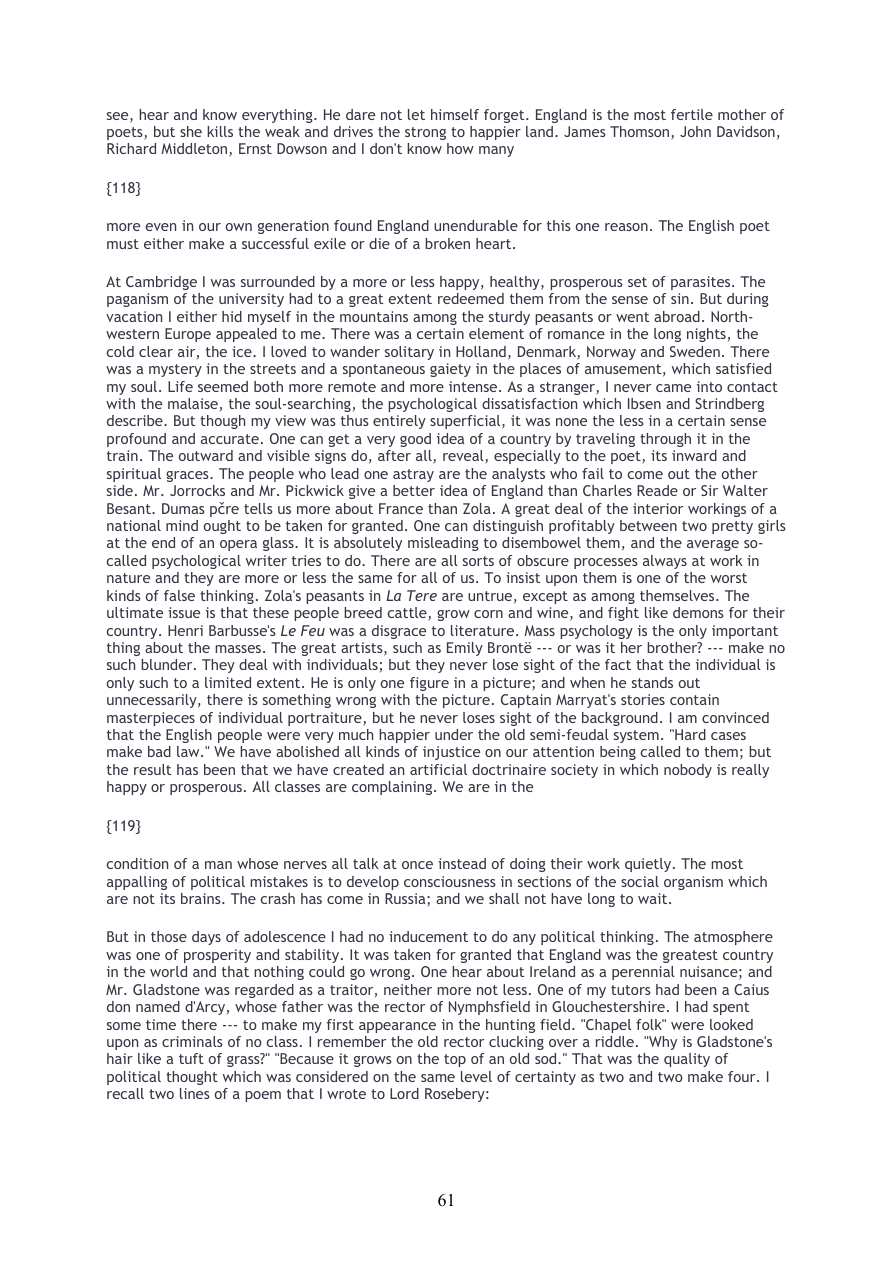
Highlights use the original PDF text layer. OCR-only matches may not be visible on the scan.
Transcription
Download text ↓raw extractionoriginal embedded textReview: unreviewed
61
see, hear and know everything. He dare not let himself forget. England is the most fertile mother of
poets, but she kills the weak and drives the strong to happier land. James Thomson, John Davidson,
Richard Middleton, Ernst Dowson and I don't know how many
{118}
more even in our own generation found England unendurable for this one reason. The English poet
must either make a successful exile or die of a broken heart.
At Cambridge I was surrounded by a more or less happy, healthy, prosperous set of parasites. The
paganism of the university had to a great extent redeemed them from the sense of sin. But during
vacation I either hid myself in the mountains among the sturdy peasants or went abroad. North-
western Europe appealed to me. There was a certain element of romance in the long nights, the
cold clear air, the ice. I loved to wander solitary in Holland, Denmark, Norway and Sweden. There
was a mystery in the streets and a spontaneous gaiety in the places of amusement, which satisfied
my soul. Life seemed both more remote and more intense. As a stranger, I never came into contact
with the malaise, the soul-searching, the psychological dissatisfaction which Ibsen and Strindberg
describe. But though my view was thus entirely superficial, it was none the less in a certain sense
profound and accurate. One can get a very good idea of a country by traveling through it in the
train. The outward and visible signs do, after all, reveal, especially to the poet, its inward and
spiritual graces. The people who lead one astray are the analysts who fail to come out the other
side. Mr. Jorrocks and Mr. Pickwick give a better idea of England than Charles Reade or Sir Walter
Besant. Dumas pčre tells us more about France than Zola. A great deal of the interior workings of a
national mind ought to be taken for granted. One can distinguish profitably between two pretty girls
at the end of an opera glass. It is absolutely misleading to disembowel them, and the average so-
called psychological writer tries to do. There are all sorts of obscure processes always at work in
nature and they are more or less the same for all of us. To insist upon them is one of the worst
kinds of false thinking. Zola's peasants in La Tere are untrue, except as among themselves. The
ultimate issue is that these people breed cattle, grow corn and wine, and fight like demons for their
country. Henri Barbusse's Le Feu was a disgrace to literature. Mass psychology is the only important
thing about the masses. The great artists, such as Emily Brontë --- or was it her brother? --- make no
such blunder. They deal with individuals; but they never lose sight of the fact that the individual is
only such to a limited extent. He is only one figure in a picture; and when he stands out
unnecessarily, there is something wrong with the picture. Captain Marryat's stories contain
masterpieces of individual portraiture, but he never loses sight of the background. I am convinced
that the English people were very much happier under the old semi-feudal system. "Hard cases
make bad law." We have abolished all kinds of injustice on our attention being called to them; but
the result has been that we have created an artificial doctrinaire society in which nobody is really
happy or prosperous. All classes are complaining. We are in the
{119}
condition of a man whose nerves all talk at once instead of doing their work quietly. The most
appalling of political mistakes is to develop consciousness in sections of the social organism which
are not its brains. The crash has come in Russia; and we shall not have long to wait.
But in those days of adolescence I had no inducement to do any political thinking. The atmosphere
was one of prosperity and stability. It was taken for granted that England was the greatest country
in the world and that nothing could go wrong. One hear about Ireland as a perennial nuisance; and
Mr. Gladstone was regarded as a traitor, neither more not less. One of my tutors had been a Caius
don named d'Arcy, whose father was the rector of Nymphsfield in Glouchestershire. I had spent
some time there --- to make my first appearance in the hunting field. "Chapel folk" were looked
upon as criminals of no class. I remember the old rector clucking over a riddle. "Why is Gladstone's
hair like a tuft of grass?" "Because it grows on the top of an old sod." That was the quality of
political thought which was considered on the same level of certainty as two and two make four. I
recall two lines of a poem that I wrote to Lord Rosebery:
Page provenance & review flags
Stable page ID: 5ef44b98d8f9c4af5f6f86e1:p00061
Line breaks are preserved. Reading order and OCR accuracy may need review.
Printed page label has not been verified.
- No automated review flags. This does not establish transcription accuracy.