1929 · CLOSE READING
Confessions of Aleister Crowley
Confessions of Aleister Crowley (1929), PDF p. 355
Original page
Enlarge ↗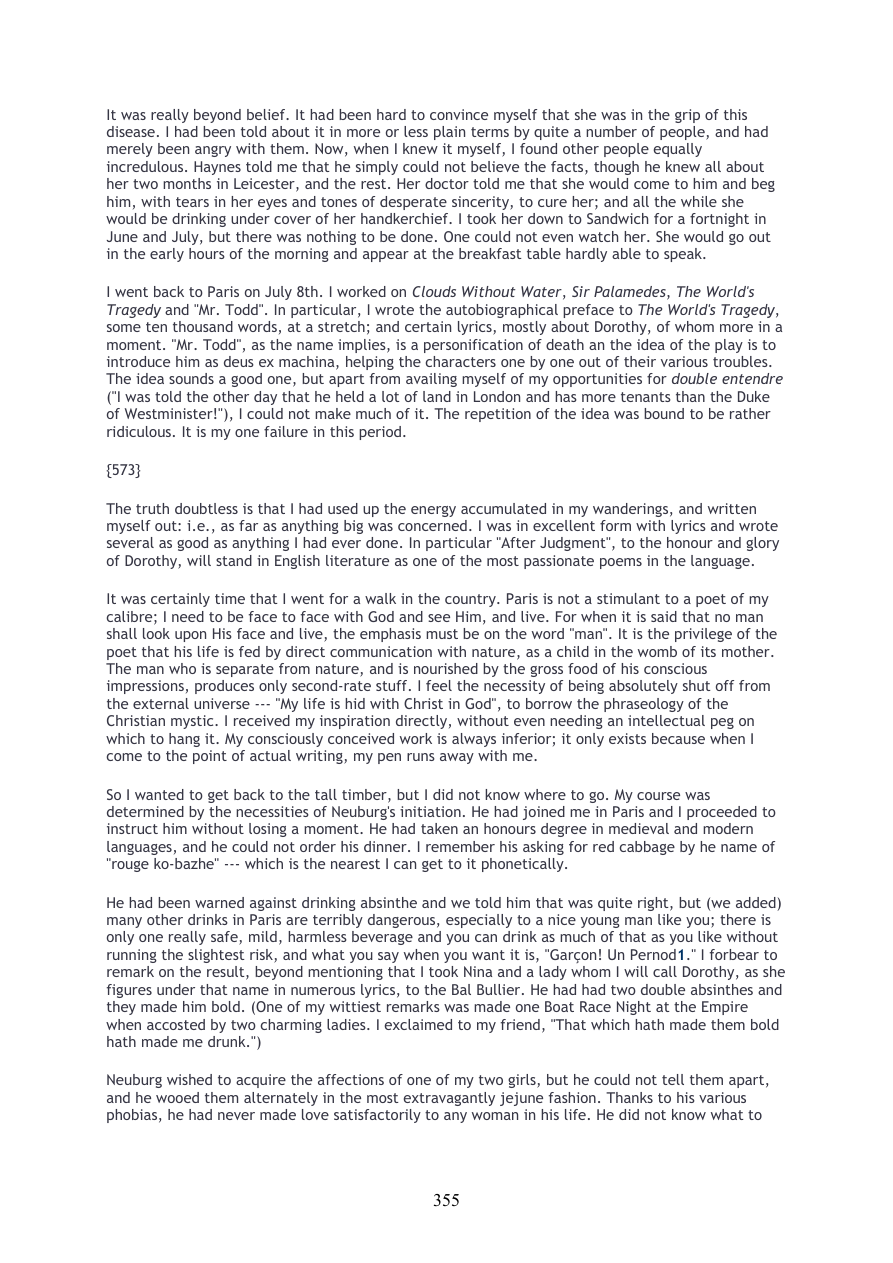
Highlights use the original PDF text layer. OCR-only matches may not be visible on the scan.
Transcription
Download text ↓raw extractionoriginal embedded textReview: unreviewed
355
It was really beyond belief. It had been hard to convince myself that she was in the grip of this
disease. I had been told about it in more or less plain terms by quite a number of people, and had
merely been angry with them. Now, when I knew it myself, I found other people equally
incredulous. Haynes told me that he simply could not believe the facts, though he knew all about
her two months in Leicester, and the rest. Her doctor told me that she would come to him and beg
him, with tears in her eyes and tones of desperate sincerity, to cure her; and all the while she
would be drinking under cover of her handkerchief. I took her down to Sandwich for a fortnight in
June and July, but there was nothing to be done. One could not even watch her. She would go out
in the early hours of the morning and appear at the breakfast table hardly able to speak.
I went back to Paris on July 8th. I worked on Clouds Without Water, Sir Palamedes, The World's
Tragedy and "Mr. Todd". In particular, I wrote the autobiographical preface to The World's Tragedy,
some ten thousand words, at a stretch; and certain lyrics, mostly about Dorothy, of whom more in a
moment. "Mr. Todd", as the name implies, is a personification of death an the idea of the play is to
introduce him as deus ex machina, helping the characters one by one out of their various troubles.
The idea sounds a good one, but apart from availing myself of my opportunities for double entendre
("I was told the other day that he held a lot of land in London and has more tenants than the Duke
of Westminister!"), I could not make much of it. The repetition of the idea was bound to be rather
ridiculous. It is my one failure in this period.
{573}
The truth doubtless is that I had used up the energy accumulated in my wanderings, and written
myself out: i.e., as far as anything big was concerned. I was in excellent form with lyrics and wrote
several as good as anything I had ever done. In particular "After Judgment", to the honour and glory
of Dorothy, will stand in English literature as one of the most passionate poems in the language.
It was certainly time that I went for a walk in the country. Paris is not a stimulant to a poet of my
calibre; I need to be face to face with God and see Him, and live. For when it is said that no man
shall look upon His face and live, the emphasis must be on the word "man". It is the privilege of the
poet that his life is fed by direct communication with nature, as a child in the womb of its mother.
The man who is separate from nature, and is nourished by the gross food of his conscious
impressions, produces only second-rate stuff. I feel the necessity of being absolutely shut off from
the external universe --- "My life is hid with Christ in God", to borrow the phraseology of the
Christian mystic. I received my inspiration directly, without even needing an intellectual peg on
which to hang it. My consciously conceived work is always inferior; it only exists because when I
come to the point of actual writing, my pen runs away with me.
So I wanted to get back to the tall timber, but I did not know where to go. My course was
determined by the necessities of Neuburg's initiation. He had joined me in Paris and I proceeded to
instruct him without losing a moment. He had taken an honours degree in medieval and modern
languages, and he could not order his dinner. I remember his asking for red cabbage by he name of
"rouge ko-bazhe" --- which is the nearest I can get to it phonetically.
He had been warned against drinking absinthe and we told him that was quite right, but (we added)
many other drinks in Paris are terribly dangerous, especially to a nice young man like you; there is
only one really safe, mild, harmless beverage and you can drink as much of that as you like without
running the slightest risk, and what you say when you want it is, "Garçon! Un Pernod1." I forbear to
remark on the result, beyond mentioning that I took Nina and a lady whom I will call Dorothy, as she
figures under that name in numerous lyrics, to the Bal Bullier. He had had two double absinthes and
they made him bold. (One of my wittiest remarks was made one Boat Race Night at the Empire
when accosted by two charming ladies. I exclaimed to my friend, "That which hath made them bold
hath made me drunk.")
Neuburg wished to acquire the affections of one of my two girls, but he could not tell them apart,
and he wooed them alternately in the most extravagantly jejune fashion. Thanks to his various
phobias, he had never made love satisfactorily to any woman in his life. He did not know what to
Page provenance & review flags
Stable page ID: 5ef44b98d8f9c4af5f6f86e1:p00355
Line breaks are preserved. Reading order and OCR accuracy may need review.
Printed page label has not been verified.
- No automated review flags. This does not establish transcription accuracy.