1929 · CLOSE READING
Confessions of Aleister Crowley
Confessions of Aleister Crowley (1929), PDF p. 354
Original page
Enlarge ↗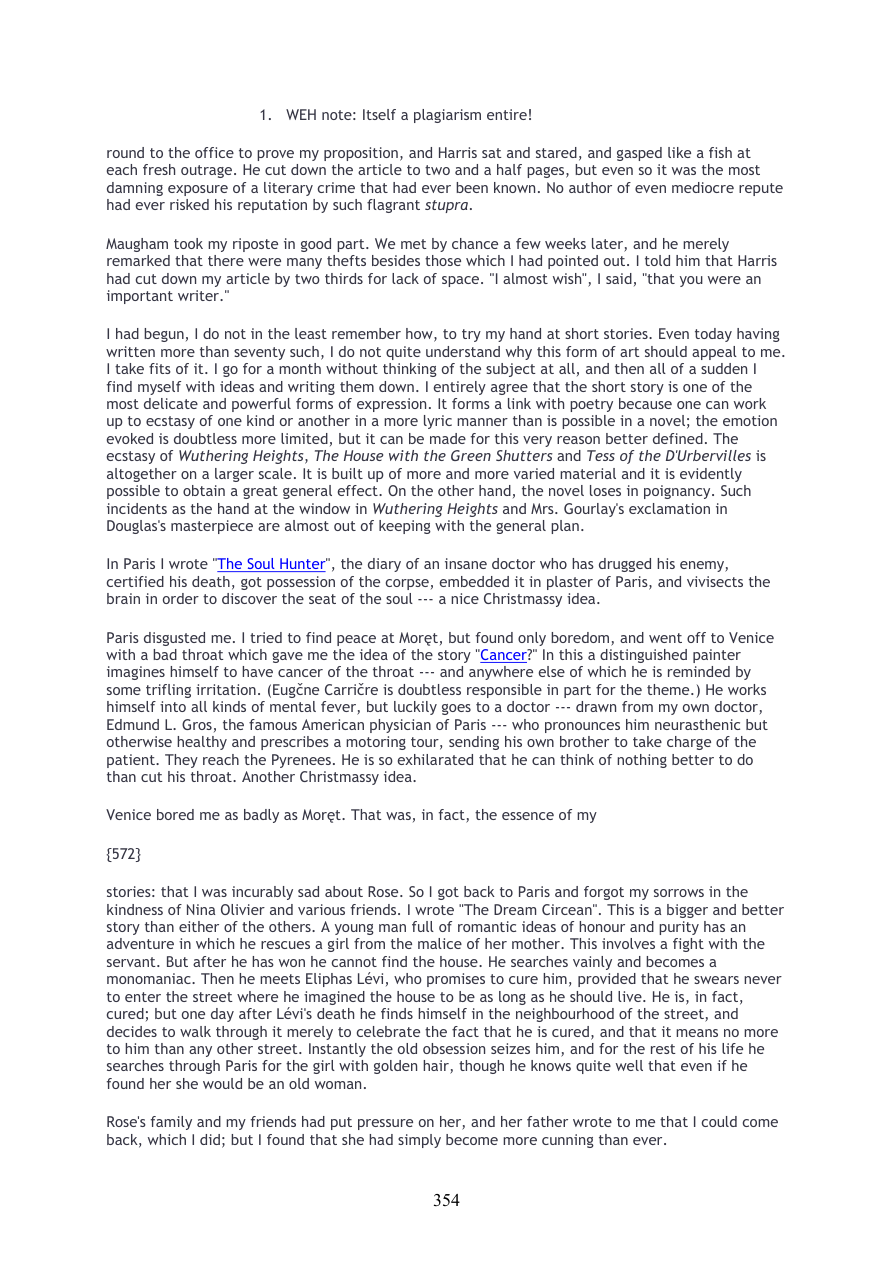
Highlights use the original PDF text layer. OCR-only matches may not be visible on the scan.
Transcription
Download text ↓raw extractionoriginal embedded textReview: unreviewed
354
1. WEH note: Itself a plagiarism entire!
round to the office to prove my proposition, and Harris sat and stared, and gasped like a fish at
each fresh outrage. He cut down the article to two and a half pages, but even so it was the most
damning exposure of a literary crime that had ever been known. No author of even mediocre repute
had ever risked his reputation by such flagrant stupra.
Maugham took my riposte in good part. We met by chance a few weeks later, and he merely
remarked that there were many thefts besides those which I had pointed out. I told him that Harris
had cut down my article by two thirds for lack of space. "I almost wish", I said, "that you were an
important writer."
I had begun, I do not in the least remember how, to try my hand at short stories. Even today having
written more than seventy such, I do not quite understand why this form of art should appeal to me.
I take fits of it. I go for a month without thinking of the subject at all, and then all of a sudden I
find myself with ideas and writing them down. I entirely agree that the short story is one of the
most delicate and powerful forms of expression. It forms a link with poetry because one can work
up to ecstasy of one kind or another in a more lyric manner than is possible in a novel; the emotion
evoked is doubtless more limited, but it can be made for this very reason better defined. The
ecstasy of Wuthering Heights, The House with the Green Shutters and Tess of the D'Urbervilles is
altogether on a larger scale. It is built up of more and more varied material and it is evidently
possible to obtain a great general effect. On the other hand, the novel loses in poignancy. Such
incidents as the hand at the window in Wuthering Heights and Mrs. Gourlay's exclamation in
Douglas's masterpiece are almost out of keeping with the general plan.
In Paris I wrote "The Soul Hunter", the diary of an insane doctor who has drugged his enemy,
certified his death, got possession of the corpse, embedded it in plaster of Paris, and vivisects the
brain in order to discover the seat of the soul --- a nice Christmassy idea.
Paris disgusted me. I tried to find peace at Moręt, but found only boredom, and went off to Venice
with a bad throat which gave me the idea of the story "Cancer?" In this a distinguished painter
imagines himself to have cancer of the throat --- and anywhere else of which he is reminded by
some trifling irritation. (Eugčne Carričre is doubtless responsible in part for the theme.) He works
himself into all kinds of mental fever, but luckily goes to a doctor --- drawn from my own doctor,
Edmund L. Gros, the famous American physician of Paris --- who pronounces him neurasthenic but
otherwise healthy and prescribes a motoring tour, sending his own brother to take charge of the
patient. They reach the Pyrenees. He is so exhilarated that he can think of nothing better to do
than cut his throat. Another Christmassy idea.
Venice bored me as badly as Moręt. That was, in fact, the essence of my
{572}
stories: that I was incurably sad about Rose. So I got back to Paris and forgot my sorrows in the
kindness of Nina Olivier and various friends. I wrote "The Dream Circean". This is a bigger and better
story than either of the others. A young man full of romantic ideas of honour and purity has an
adventure in which he rescues a girl from the malice of her mother. This involves a fight with the
servant. But after he has won he cannot find the house. He searches vainly and becomes a
monomaniac. Then he meets Eliphas Lévi, who promises to cure him, provided that he swears never
to enter the street where he imagined the house to be as long as he should live. He is, in fact,
cured; but one day after Lévi's death he finds himself in the neighbourhood of the street, and
decides to walk through it merely to celebrate the fact that he is cured, and that it means no more
to him than any other street. Instantly the old obsession seizes him, and for the rest of his life he
searches through Paris for the girl with golden hair, though he knows quite well that even if he
found her she would be an old woman.
Rose's family and my friends had put pressure on her, and her father wrote to me that I could come
back, which I did; but I found that she had simply become more cunning than ever.
Page provenance & review flags
Stable page ID: 5ef44b98d8f9c4af5f6f86e1:p00354
Line breaks are preserved. Reading order and OCR accuracy may need review.
Printed page label has not been verified.
- No automated review flags. This does not establish transcription accuracy.