1929 · CLOSE READING
Confessions of Aleister Crowley
Confessions of Aleister Crowley (1929), PDF p. 300
Original page
Enlarge ↗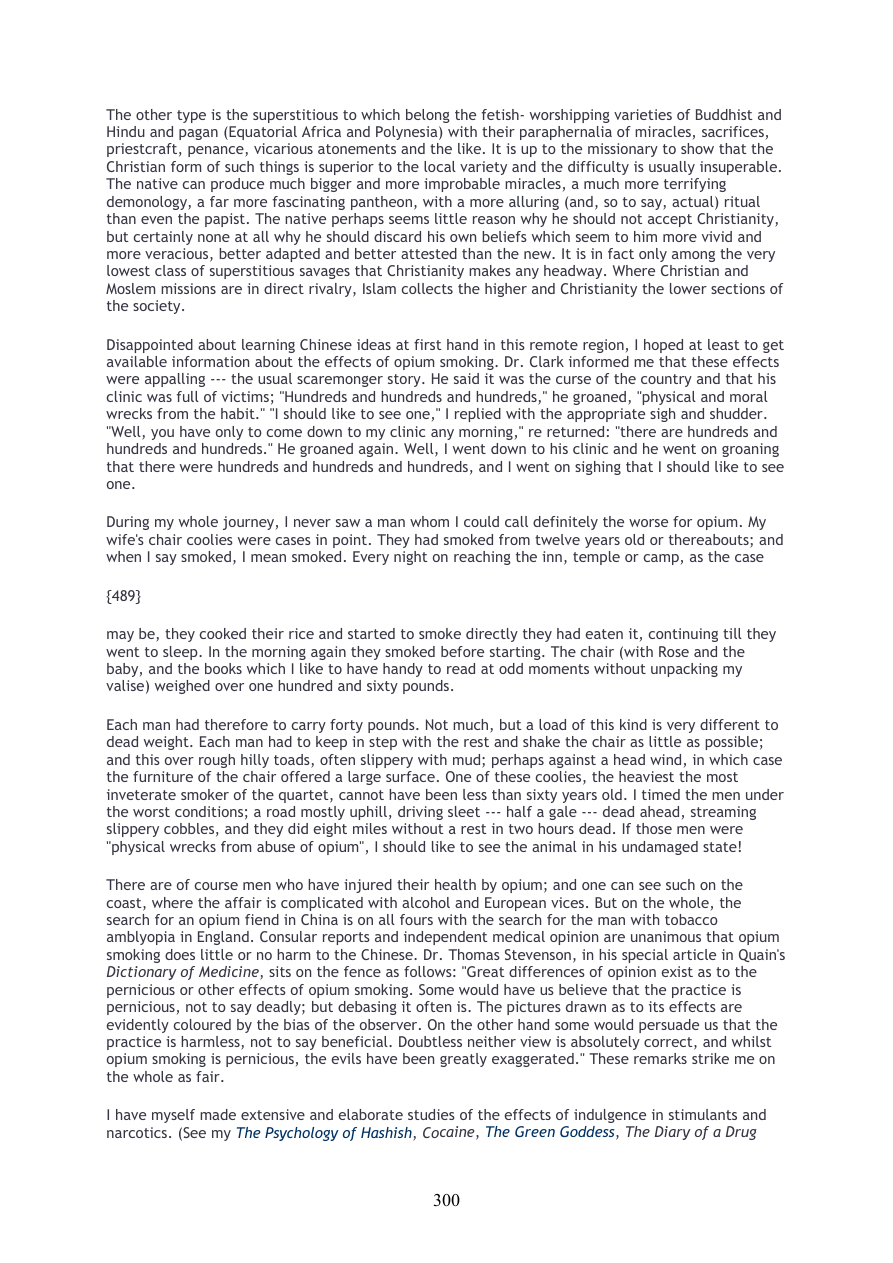
Highlights use the original PDF text layer. OCR-only matches may not be visible on the scan.
Transcription
Download text ↓raw extractionoriginal embedded textReview: unreviewed
300
The other type is the superstitious to which belong the fetish- worshipping varieties of Buddhist and
Hindu and pagan (Equatorial Africa and Polynesia) with their paraphernalia of miracles, sacrifices,
priestcraft, penance, vicarious atonements and the like. It is up to the missionary to show that the
Christian form of such things is superior to the local variety and the difficulty is usually insuperable.
The native can produce much bigger and more improbable miracles, a much more terrifying
demonology, a far more fascinating pantheon, with a more alluring (and, so to say, actual) ritual
than even the papist. The native perhaps seems little reason why he should not accept Christianity,
but certainly none at all why he should discard his own beliefs which seem to him more vivid and
more veracious, better adapted and better attested than the new. It is in fact only among the very
lowest class of superstitious savages that Christianity makes any headway. Where Christian and
Moslem missions are in direct rivalry, Islam collects the higher and Christianity the lower sections of
the society.
Disappointed about learning Chinese ideas at first hand in this remote region, I hoped at least to get
available information about the effects of opium smoking. Dr. Clark informed me that these effects
were appalling --- the usual scaremonger story. He said it was the curse of the country and that his
clinic was full of victims; "Hundreds and hundreds and hundreds," he groaned, "physical and moral
wrecks from the habit." "I should like to see one," I replied with the appropriate sigh and shudder.
"Well, you have only to come down to my clinic any morning," re returned: "there are hundreds and
hundreds and hundreds." He groaned again. Well, I went down to his clinic and he went on groaning
that there were hundreds and hundreds and hundreds, and I went on sighing that I should like to see
one.
During my whole journey, I never saw a man whom I could call definitely the worse for opium. My
wife's chair coolies were cases in point. They had smoked from twelve years old or thereabouts; and
when I say smoked, I mean smoked. Every night on reaching the inn, temple or camp, as the case
{489}
may be, they cooked their rice and started to smoke directly they had eaten it, continuing till they
went to sleep. In the morning again they smoked before starting. The chair (with Rose and the
baby, and the books which I like to have handy to read at odd moments without unpacking my
valise) weighed over one hundred and sixty pounds.
Each man had therefore to carry forty pounds. Not much, but a load of this kind is very different to
dead weight. Each man had to keep in step with the rest and shake the chair as little as possible;
and this over rough hilly toads, often slippery with mud; perhaps against a head wind, in which case
the furniture of the chair offered a large surface. One of these coolies, the heaviest the most
inveterate smoker of the quartet, cannot have been less than sixty years old. I timed the men under
the worst conditions; a road mostly uphill, driving sleet --- half a gale --- dead ahead, streaming
slippery cobbles, and they did eight miles without a rest in two hours dead. If those men were
"physical wrecks from abuse of opium", I should like to see the animal in his undamaged state!
There are of course men who have injured their health by opium; and one can see such on the
coast, where the affair is complicated with alcohol and European vices. But on the whole, the
search for an opium fiend in China is on all fours with the search for the man with tobacco
amblyopia in England. Consular reports and independent medical opinion are unanimous that opium
smoking does little or no harm to the Chinese. Dr. Thomas Stevenson, in his special article in Quain's
Dictionary of Medicine, sits on the fence as follows: "Great differences of opinion exist as to the
pernicious or other effects of opium smoking. Some would have us believe that the practice is
pernicious, not to say deadly; but debasing it often is. The pictures drawn as to its effects are
evidently coloured by the bias of the observer. On the other hand some would persuade us that the
practice is harmless, not to say beneficial. Doubtless neither view is absolutely correct, and whilst
opium smoking is pernicious, the evils have been greatly exaggerated." These remarks strike me on
the whole as fair.
I have myself made extensive and elaborate studies of the effects of indulgence in stimulants and
narcotics. (See my The Psychology of Hashish, Cocaine, The Green Goddess, The Diary of a Drug
Page provenance & review flags
Stable page ID: 5ef44b98d8f9c4af5f6f86e1:p00300
Line breaks are preserved. Reading order and OCR accuracy may need review.
Printed page label has not been verified.
- No automated review flags. This does not establish transcription accuracy.