1929 · CLOSE READING
Confessions of Aleister Crowley
Confessions of Aleister Crowley (1929), PDF p. 170
Original page
Enlarge ↗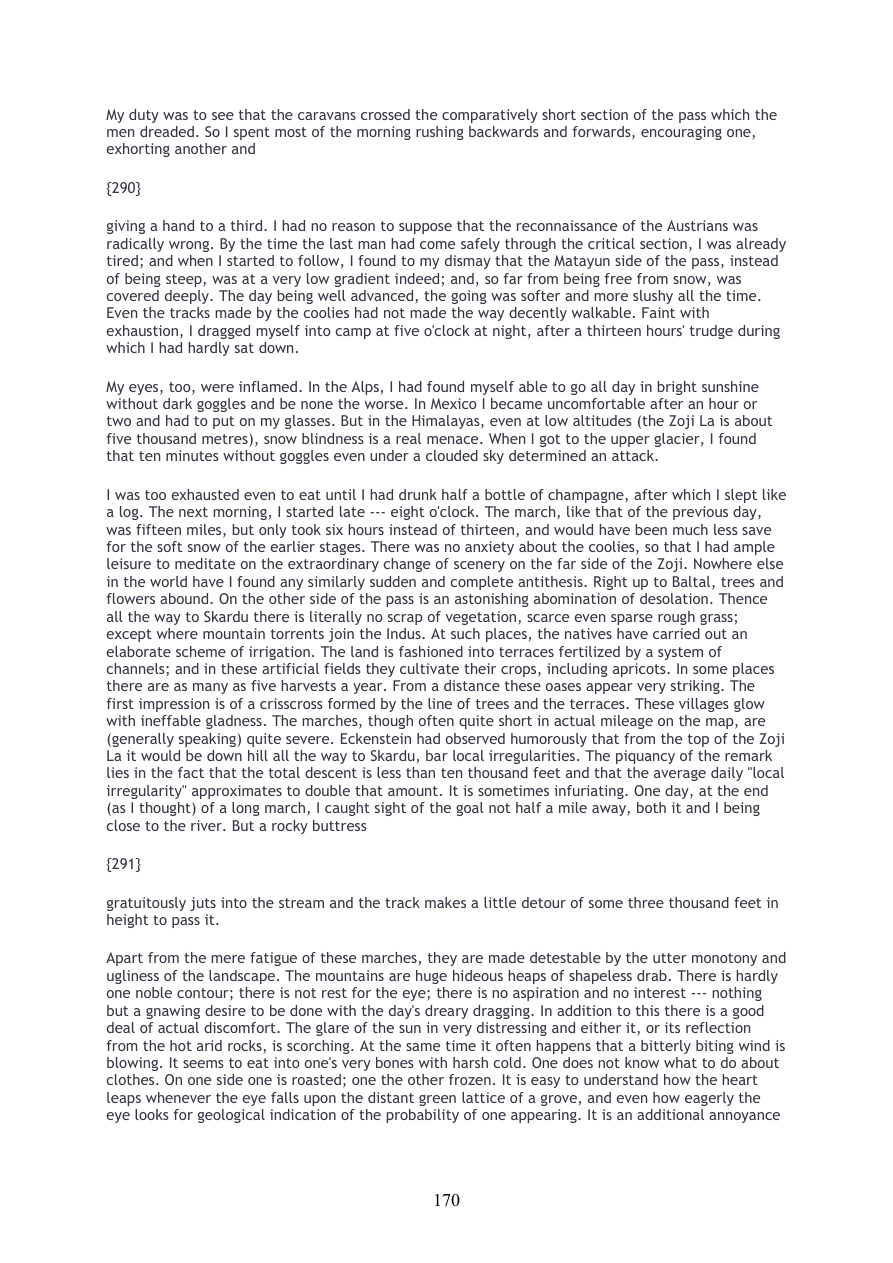
Highlights use the original PDF text layer. OCR-only matches may not be visible on the scan.
Transcription
Download text ↓raw extractionoriginal embedded textReview: unreviewed
170
My duty was to see that the caravans crossed the comparatively short section of the pass which the
men dreaded. So I spent most of the morning rushing backwards and forwards, encouraging one,
exhorting another and
{290}
giving a hand to a third. I had no reason to suppose that the reconnaissance of the Austrians was
radically wrong. By the time the last man had come safely through the critical section, I was already
tired; and when I started to follow, I found to my dismay that the Matayun side of the pass, instead
of being steep, was at a very low gradient indeed; and, so far from being free from snow, was
covered deeply. The day being well advanced, the going was softer and more slushy all the time.
Even the tracks made by the coolies had not made the way decently walkable. Faint with
exhaustion, I dragged myself into camp at five o'clock at night, after a thirteen hours' trudge during
which I had hardly sat down.
My eyes, too, were inflamed. In the Alps, I had found myself able to go all day in bright sunshine
without dark goggles and be none the worse. In Mexico I became uncomfortable after an hour or
two and had to put on my glasses. But in the Himalayas, even at low altitudes (the Zoji La is about
five thousand metres), snow blindness is a real menace. When I got to the upper glacier, I found
that ten minutes without goggles even under a clouded sky determined an attack.
I was too exhausted even to eat until I had drunk half a bottle of champagne, after which I slept like
a log. The next morning, I started late --- eight o'clock. The march, like that of the previous day,
was fifteen miles, but only took six hours instead of thirteen, and would have been much less save
for the soft snow of the earlier stages. There was no anxiety about the coolies, so that I had ample
leisure to meditate on the extraordinary change of scenery on the far side of the Zoji. Nowhere else
in the world have I found any similarly sudden and complete antithesis. Right up to Baltal, trees and
flowers abound. On the other side of the pass is an astonishing abomination of desolation. Thence
all the way to Skardu there is literally no scrap of vegetation, scarce even sparse rough grass;
except where mountain torrents join the Indus. At such places, the natives have carried out an
elaborate scheme of irrigation. The land is fashioned into terraces fertilized by a system of
channels; and in these artificial fields they cultivate their crops, including apricots. In some places
there are as many as five harvests a year. From a distance these oases appear very striking. The
first impression is of a crisscross formed by the line of trees and the terraces. These villages glow
with ineffable gladness. The marches, though often quite short in actual mileage on the map, are
(generally speaking) quite severe. Eckenstein had observed humorously that from the top of the Zoji
La it would be down hill all the way to Skardu, bar local irregularities. The piquancy of the remark
lies in the fact that the total descent is less than ten thousand feet and that the average daily "local
irregularity" approximates to double that amount. It is sometimes infuriating. One day, at the end
(as I thought) of a long march, I caught sight of the goal not half a mile away, both it and I being
close to the river. But a rocky buttress
{291}
gratuitously juts into the stream and the track makes a little detour of some three thousand feet in
height to pass it.
Apart from the mere fatigue of these marches, they are made detestable by the utter monotony and
ugliness of the landscape. The mountains are huge hideous heaps of shapeless drab. There is hardly
one noble contour; there is not rest for the eye; there is no aspiration and no interest --- nothing
but a gnawing desire to be done with the day's dreary dragging. In addition to this there is a good
deal of actual discomfort. The glare of the sun in very distressing and either it, or its reflection
from the hot arid rocks, is scorching. At the same time it often happens that a bitterly biting wind is
blowing. It seems to eat into one's very bones with harsh cold. One does not know what to do about
clothes. On one side one is roasted; one the other frozen. It is easy to understand how the heart
leaps whenever the eye falls upon the distant green lattice of a grove, and even how eagerly the
eye looks for geological indication of the probability of one appearing. It is an additional annoyance
Page provenance & review flags
Stable page ID: 5ef44b98d8f9c4af5f6f86e1:p00170
Line breaks are preserved. Reading order and OCR accuracy may need review.
Printed page label has not been verified.
- No automated review flags. This does not establish transcription accuracy.