1929 · CLOSE READING
Confessions of Aleister Crowley
Confessions of Aleister Crowley (1929), PDF p. 159
Original page
Enlarge ↗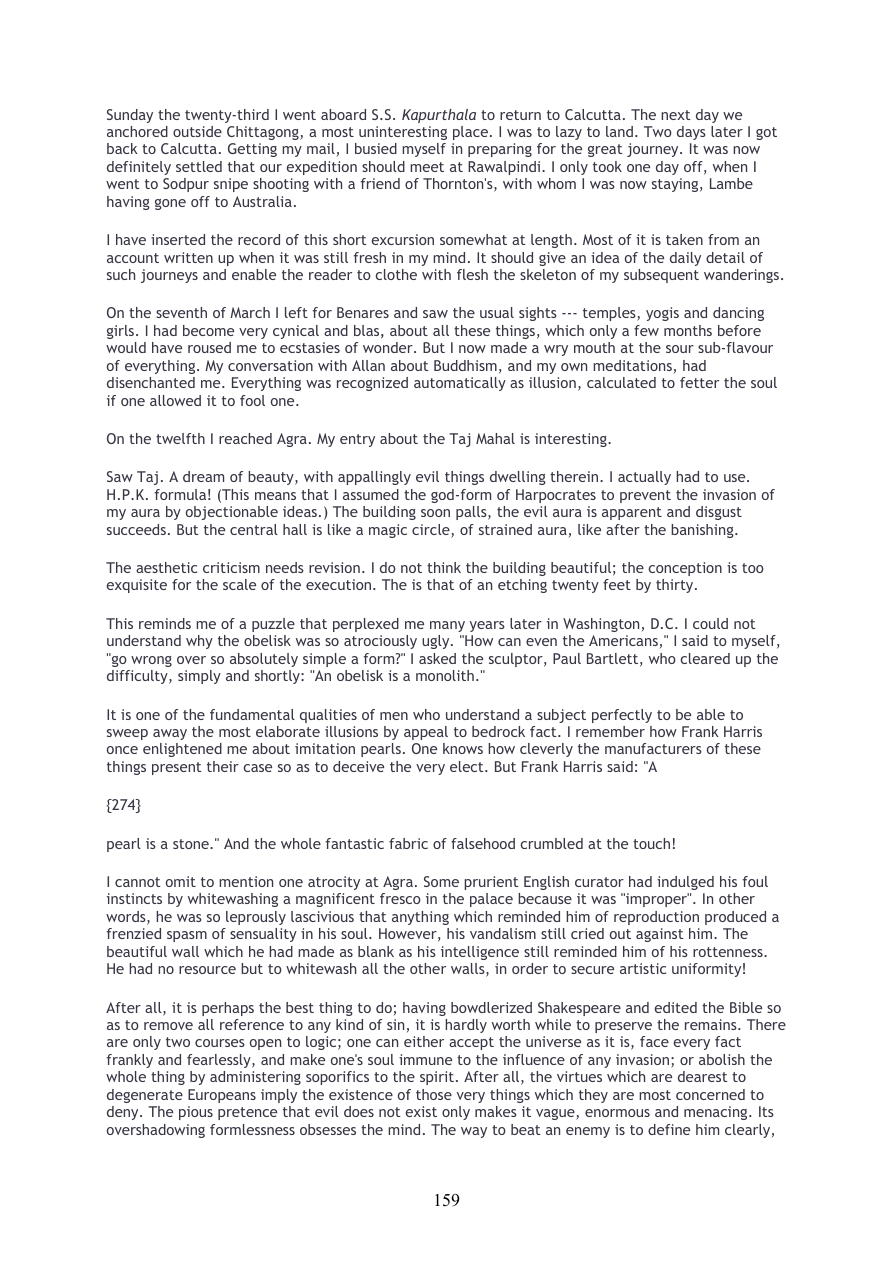
Highlights use the original PDF text layer. OCR-only matches may not be visible on the scan.
Transcription
Download text ↓raw extractionoriginal embedded textReview: unreviewed
159
Sunday the twenty-third I went aboard S.S. Kapurthala to return to Calcutta. The next day we
anchored outside Chittagong, a most uninteresting place. I was to lazy to land. Two days later I got
back to Calcutta. Getting my mail, I busied myself in preparing for the great journey. It was now
definitely settled that our expedition should meet at Rawalpindi. I only took one day off, when I
went to Sodpur snipe shooting with a friend of Thornton's, with whom I was now staying, Lambe
having gone off to Australia.
I have inserted the record of this short excursion somewhat at length. Most of it is taken from an
account written up when it was still fresh in my mind. It should give an idea of the daily detail of
such journeys and enable the reader to clothe with flesh the skeleton of my subsequent wanderings.
On the seventh of March I left for Benares and saw the usual sights --- temples, yogis and dancing
girls. I had become very cynical and blas about all these things, which only a few months before
would have roused me to ecstasies of wonder. But I now made a wry mouth at the sour sub-flavour
of everything. My conversation with Allan about Buddhism, and my own meditations, had
disenchanted me. Everything was recognized automatically as illusion, calculated to fetter the soul
if one allowed it to fool one.
On the twelfth I reached Agra. My entry about the Taj Mahal is interesting.
Saw Taj. A dream of beauty, with appallingly evil things dwelling therein. I actually had to use.
H.P.K. formula! (This means that I assumed the god-form of Harpocrates to prevent the invasion of
my aura by objectionable ideas.) The building soon palls, the evil aura is apparent and disgust
succeeds. But the central hall is like a magic circle, of strained aura, like after the banishing.
The aesthetic criticism needs revision. I do not think the building beautiful; the conception is too
exquisite for the scale of the execution. The is that of an etching twenty feet by thirty.
This reminds me of a puzzle that perplexed me many years later in Washington, D.C. I could not
understand why the obelisk was so atrociously ugly. "How can even the Americans," I said to myself,
"go wrong over so absolutely simple a form?" I asked the sculptor, Paul Bartlett, who cleared up the
difficulty, simply and shortly: "An obelisk is a monolith."
It is one of the fundamental qualities of men who understand a subject perfectly to be able to
sweep away the most elaborate illusions by appeal to bedrock fact. I remember how Frank Harris
once enlightened me about imitation pearls. One knows how cleverly the manufacturers of these
things present their case so as to deceive the very elect. But Frank Harris said: "A
{274}
pearl is a stone." And the whole fantastic fabric of falsehood crumbled at the touch!
I cannot omit to mention one atrocity at Agra. Some prurient English curator had indulged his foul
instincts by whitewashing a magnificent fresco in the palace because it was "improper". In other
words, he was so leprously lascivious that anything which reminded him of reproduction produced a
frenzied spasm of sensuality in his soul. However, his vandalism still cried out against him. The
beautiful wall which he had made as blank as his intelligence still reminded him of his rottenness.
He had no resource but to whitewash all the other walls, in order to secure artistic uniformity!
After all, it is perhaps the best thing to do; having bowdlerized Shakespeare and edited the Bible so
as to remove all reference to any kind of sin, it is hardly worth while to preserve the remains. There
are only two courses open to logic; one can either accept the universe as it is, face every fact
frankly and fearlessly, and make one's soul immune to the influence of any invasion; or abolish the
whole thing by administering soporifics to the spirit. After all, the virtues which are dearest to
degenerate Europeans imply the existence of those very things which they are most concerned to
deny. The pious pretence that evil does not exist only makes it vague, enormous and menacing. Its
overshadowing formlessness obsesses the mind. The way to beat an enemy is to define him clearly,
Page provenance & review flags
Stable page ID: 5ef44b98d8f9c4af5f6f86e1:p00159
Line breaks are preserved. Reading order and OCR accuracy may need review.
Printed page label has not been verified.
- No automated review flags. This does not establish transcription accuracy.