1906 · CLOSE READING
Collected Works (Vol. II)
Collected Works (Vol. II) (1906), PDF p. 66
Original page
Enlarge ↗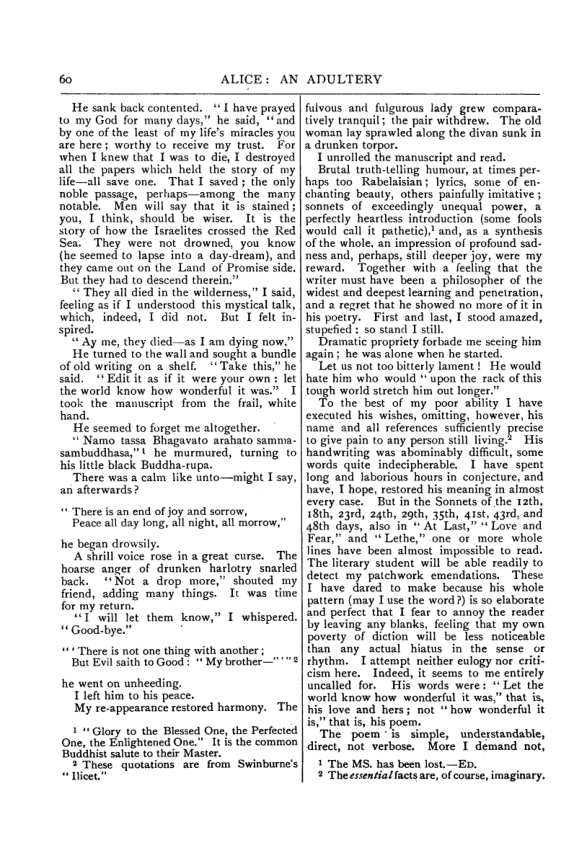
Highlights use the original PDF text layer. OCR-only matches may not be visible on the scan.
Transcription
Download text ↓raw extractionoriginal embedded textReview: unreviewed
60 ALICE: AN ADULTERY
He sank back contented. ‘‘I have prayed
to my God for many days,” he said, ‘‘and
by one of the least of my life’s miracles you
are here; worthy to receive my trust. For
when I knew that I was to die, I destroyed
all the papers which held the story of my
life—all save one. That I saved; the only
noble passage, perhaps—among the many
notable. Men will say that it is stained;
you, I think, should be wiser. It is the
story of how the Israelites crossed the Red
Sea. They were not drowned, you know
(he seemed to lapse into a day-dream), and
they came out on the Land of Promise side.
But they had to descend therein.”
‘* They all died in the wilderness,” I said,
feeling as if I understood this mystical talk,
which, indeed, I did not. But I felt in-
spired.
‘* Ay me, they died—as I am dying now.”
He turned to the wall and sought a bundle
of old writing on a shelf. ‘‘ Take this,” he
said. ‘‘ Edit it as if it were your own: let
the world know how wonderful it was.” I
took the manuscript from the frail, white
hand.
He seemed to forget me altogether.
‘* Namo tassa Bhagavato arahato samma-
sambuddhasa,”’' he murmured, turning to
his little black Buddha-rupa.
There was a calm like unto—might I say,
an afterwards? :
‘ There is an end of joy and sorrow,
Peace all day long, all night, all morrow,”
he began drowsily.
A shrill voice rose in a great curse. The
hoarse anger of drunken harlotry snarled
back. ‘*Not a drop more,” shouted my
friend, adding many things. It was time
for my return.
‘“‘T will let them know,” I whispered.
‘* Good-bye.”
‘¢« There is not one thing with another;
But Evil saith toGood: ‘‘ My brother—"’"’ 2
he went on unheeding.
I left him to his peace.
My re-appearance restored harmony. The
1 ‘*Glory to the Blessed One, the Perfected
One, the Enlightened One.” It is the common
Buddhist salute to their Master.
2 These quotations. are from Swinburne’s
‘* Tlicet.”’
fulvous and fulgurous lady grew compara-
tively tranquil; the pair withdrew. The old
woman lay sprawled along the divan sunk in
a drunken torpor.
I unrolled the manuscript and read.
Brutal truth-telling humour, at times per-
haps too Rabelaisian; lyrics, some of en-
chanting beauty, others painfully imitative;
sonnets of exceedingly unequal power, a
perfectly heartless introduction (some fools
would call it pathetic),! and, as a synthesis
of the whole, an impression of profound sad-
ness and, perhaps, still deeper joy, were my
reward. Together with a feeling that the
writer must have been a philosopher of the
widest and deepest learning and penetration,
and a recret that he showed no more of it in
his poetry. First and last, I stood amazed,
stupefied; so stand [I still.
Dramatic propriety forbade me seeing him
again; he was alone when he started.
Let us not too bitterly lament! He would
hate him who would ‘‘ upon the rack of this
tough world stretch him out longer.”
To the best of my poor ability I have
executed his wishes, omitting, however, his
name and all references sufficiently precise
to give pain to any person still living.? His
handwriting was abominably difficult, some
words quite indecipherable. I have spent
long and laborious hours in conjecture, and
have, I hope, restored his meaning in almost
every case. But in the Sonnets of the 12th,
18th, 23rd, 24th, 29th, 35th, 41st, 43rd, and
48th days, also in ‘‘ At Last,” ‘* Love and
Fear,” and ‘‘ Lethe,” -one or more whole
lines have been almost impossible to read.
The literary student will be able readily to
detect my patchwork emendations. These
I have dared to make because his whole
pattern (may I use the word ?) is so elaborate
and perfect that I fear to annoy the reader
by leaving any blanks, feeling that my own
poverty of diction will be less noticeable
than any actual hiatus in the sense or
rhythm. I attempt neither eulogy nor criti-
cism here. Indeed, it seems to me entirely
uncalled for. His words were: ‘‘ Let the
world know how wonderful it was,” that is,
his love and hers; not ‘‘ how wonderful it
is,’ that is, his poem.
The poem is simple, understandable,
direct, not verbose. More I demand not,
1 The MS. has been lost.—Eb. ©
2 The essential facts are, of course, imaginary.
Page provenance & review flags
Stable page ID: 59a930c2e614ddb0b1a2a000:p00066
Line breaks are preserved. Reading order and OCR accuracy may need review.
Printed page label has not been verified.
- No automated review flags. This does not establish transcription accuracy.