1906 · CLOSE READING
Collected Works (Vol. II)
Collected Works (Vol. II) (1906), PDF p. 65
Original page
Enlarge ↗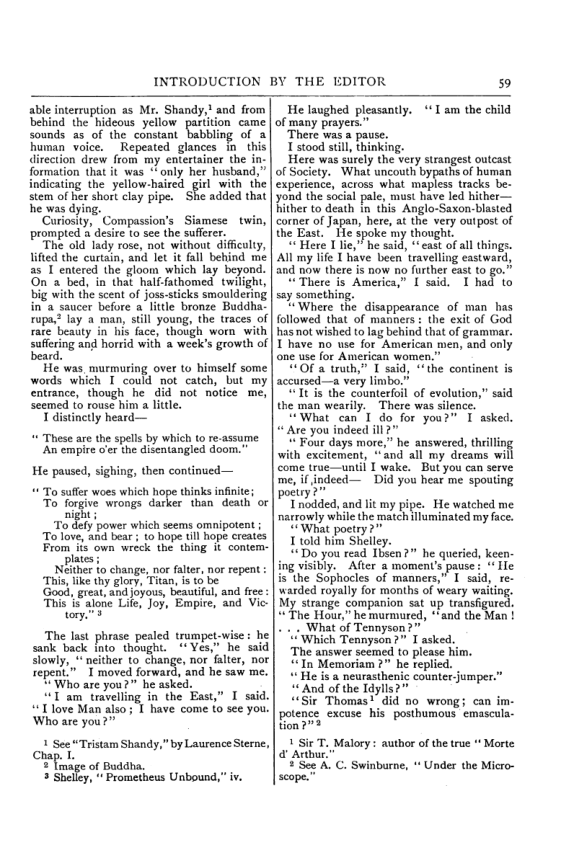
Highlights use the original PDF text layer. OCR-only matches may not be visible on the scan.
Transcription
Download text ↓raw extractionoriginal embedded textReview: unreviewed
INTRODUCTION
BY THE EDITOR 59
able interruption as Mr. Shandy,! and from
behind the hideous yellow partition came
sounds as of the constant babbling of a
human voice. Repeated glances in this
direction drew from my entertainer the in-
formation that it was ‘‘only her husband,”’
indicating the yellow-haired girl with the
stem of her short clay pipe. She added that
he was dying.
Curiosity, Compassion’s Siamese
prompted a desire to see the sufferer.
The old lady rose, not without difficulty,
lifted the curtain, and let it fall behind me
as I entered the gloom which lay beyond.
On a bed, in that half-fathomed twilight,
big with the scent of joss-sticks smouldering
in a saucer before a little bronze Buddha-
rupa,” lay a man, still young, the traces of
rare beauty in his face, though worn with
suffering and horrid with a week’s growth of
beard.
He was, murmuring over to himself some
words which I could not catch, but my
entrance, though he did not notice me,
seemed to rouse him a little.
I distinctly heard—
twin,
‘« These are the spells by which to re-assume
An empire o’er the disentangled doom.”
He paused, sighing, then continued—
‘* To suffer woes which hope thinks infinite;
To forgive wrongs darker than death or
night ;
To defy power which seems omnipotent ;
To love, and bear ; to hope till hope creates
From its own wreck the thing it contem-
plates ;
Neither to change, nor falter, nor repent :
This, like thy glory, Titan, is to be
Good, great, and joyous, beautiful, and free:
This is alone Life, Joy, Empire, and Vic-
tory,” 3
The last phrase pealed trumpet-wise: he
sank back into thought. ‘‘ Yes,” he said
slowly, ‘‘ neither to change, nor falter, nor
repent.” I moved forward, and he saw me.
‘Who are you?” he asked. .
‘‘T am travelling in the East,” I said.
‘‘T love Man also; I have come to see you.
Who are you?”
1 See “Tristam Shandy,” by Laurence Sterne,
Chap. I.
2 Image of Buddha.
3 Shelley, ‘‘ Prometheus Unbound,” iv.
He laughed pleasantly. ‘‘I am the child
of many prayers.”’
There was a pause.
I stood still, thinking.
Here was surely the very strangest outcast
of Society. What uncouth bypaths of human
experience, across what mapless tracks be-
yond the social pale, must have led hither—
hither to death in this Anglo-Saxon-blasted
corner of Japan, here, at the very outpost of
the East. He spoke my thought.
‘Here I lie,” he said, ‘‘ east of all things.
All my life I have been travelling eastward,
and now there is now no further east to go.”
‘‘ There is America,” I said. I had to
say something.
‘Where the disappearance of man has
followed that of manners: the exit of God
has not wished to lag behind that of grammar.
I have no use for American men, and only
one use for American women.”
‘“*Of a truth,” I said, ‘‘the continent is
accursed—a very limbo.”
‘‘Tt is the counterfoil of evolution,” said
the man wearily. There was silence.
‘* What can I do for you?” I asked.
“* Are you indeed ill?”
‘* Four days more,” he answered, thrilling
with excitement, ‘‘and all my dreams will
come true—until I wake. But you can serve
me, if indeed— Did you hear me spouting
poetry ?”
I nodded, and lit my pipe. He watched me
narrowly while the match illuminated my face.
‘‘ What poetry ?”’
I told him Shelley.
‘*Do you read Ibsen?” he queried, keen-
ing visibly. After a moment’s pause: ‘‘ He
is the Sophocles of manners,” I said, re-
warded royally for months of weary waiting.
My strange companion sat up transfigured.
‘¢ The Hour,” he murmured, ‘‘and the Man !
. . . What of Tennyson?”
‘* Which Tennyson ?”’ I asked.
The answer seemed to please him.
‘In Memoriam ?” he replied.
‘‘ He is a neurasthenic counter-jumper.”
‘And of the Idylls?” - .
‘‘Sir Thomas! did no wrong; can im-
potence excuse his posthumous emascula-
tion ?” 2
1 Sir T. Malory: author of the true ‘‘ Morte
d’ Arthur.”’
2 See A. C. Swinburne, ‘‘ Under the Micro-
scope.”
Page provenance & review flags
Stable page ID: 59a930c2e614ddb0b1a2a000:p00065
Line breaks are preserved. Reading order and OCR accuracy may need review.
Printed page label has not been verified.
- No automated review flags. This does not establish transcription accuracy.