1954 · CLOSE READING
Magick Without Tears
Magick Without Tears (1954), PDF p. 98
Original page
Enlarge ↗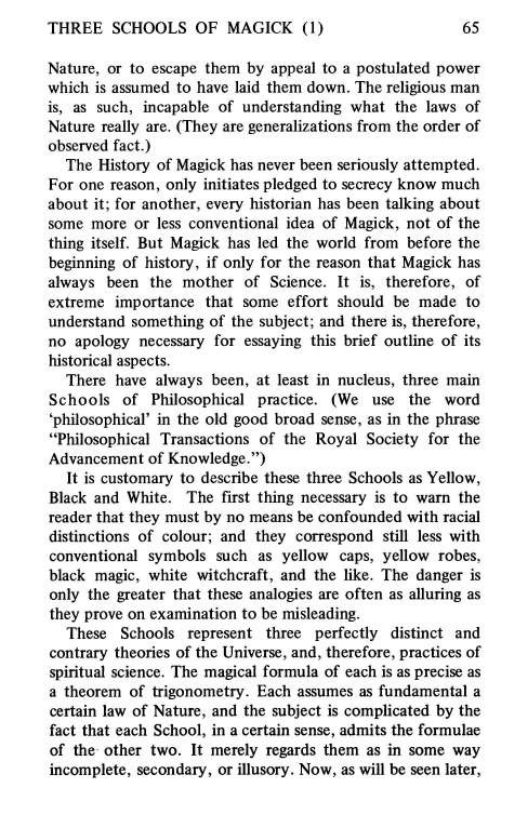
Highlights use the original PDF text layer. OCR-only matches may not be visible on the scan.
Transcription
Download text ↓raw extractionoriginal embedded textReview: unreviewed
THREE SCHOOLS OF MAGICK (I)
65
Nature, or to escape them by appeal to a postulated power
which is assumed to have laid them down. The religious man
is, as such, incapable of understanding what the laws of
Nature really are. (They are generalizations from the order of
observed fact.)
The History of Magick has never been seriously attempted.
For one reason, only initiates pledged to secrecy know much
about it; for another, every historian has been talking about
some more or less conventional idea of Magick, not of the
thing itself. But Magick has led the world from before the
beginning of history, if only for the reason that Magick has
always been the mother of Science. It is, therefore, of
extreme importance that some effort should be made to
understand something of the subject; and there is, therefore,
no apology necessary for essaying this brief outline of its
historical aspects.
There have always been, at least in nucleus, three main
Schools
of Philosophical practice. (We use the word
'philosophical' in the old good broad sense, as in the phrase
"Philosophical Transactions of the Royal Society for the
Advancement of Knowledge.")
It is customary to describe these three Schools as Yellow,
Black and White. The first thing necessary is to warn the
reader that they must by no means be confounded with racial
distinctions of colour; and they correspond still less with
conventional symbols such as yellow caps, yellow robes,
black magic, white witchcraft, and the like. The danger is
only the greater that these analogies are often as alluring as
they prove on examination to be misleading.
These Schools represent three perfectly distinct and
contrary theories of the Universe, and, therefore, practices of
spiritual science. The magical formula of each is as precise as
a theorem of trigonometry. Each assumes as fundamental a
certain law of Nature, and the subject is complicated by the
fact that each School, in a certain sense, admits the formulae
of the other two. It merely regards them as in some way
incomplete, secondary, or illusory. Now, as will be seen later,
Page provenance & review flags
Stable page ID: e7a83bd7c68d4e96894f9e69:p00098
Line breaks are preserved. Reading order and OCR accuracy may need review.
Printed page label has not been verified.
- No automated review flags. This does not establish transcription accuracy.