1954 · CLOSE READING
Magick Without Tears
Magick Without Tears (1954), PDF p. 64
Original page
Enlarge ↗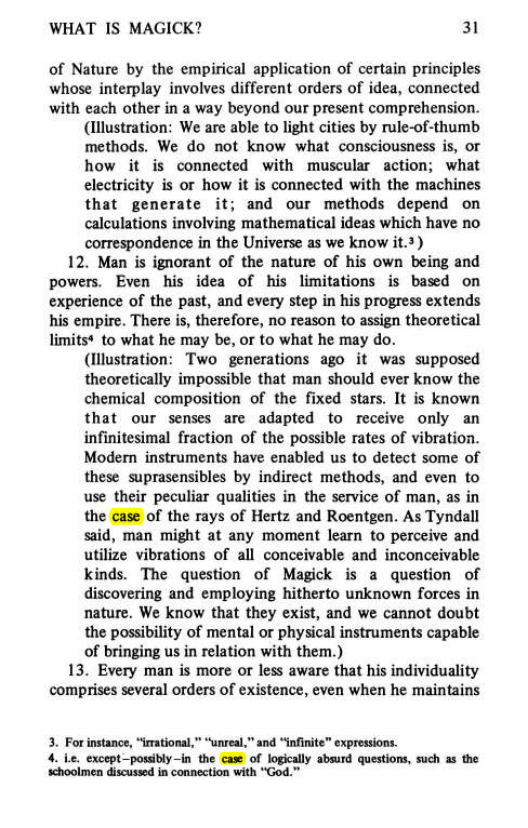
Highlights use the original PDF text layer. OCR-only matches may not be visible on the scan.
Transcription
Download text ↓raw extractionoriginal embedded textReview: unreviewed
WHA T IS MAGICK?
31
of Nature by the empirical application of certain principles
whose interplay involves different orders of idea, connected
with each other in a way beyond our present comprehension.
(Illustration: We are able to light cities by rule-of-thumb
methods. We do not know what consciousness is, or
how it is connected with muscular action; what
electricity is or how it is connected with the machines
that generate
it; and our methods depend on
calculations involving mathematical ideas which have no
correspondence in the Universe as we know it. 3 )
12. Man is ignorant of the nature of his own being and
powers. Even his idea of his limitations is based on
experience of the past, and every step in his progress extends
his empire. There is, therefore, no reason to assign theoretical
limits4 to what he may be, or to what he may do.
(Illustration: Two generations ago it was supposed
theoretically impossible that man should ever know the
chemical composition of the fixed stars. It is known
that our senses are adapted to receive only an
infinitesimal fraction of the possible rates of vibration.
Modem instruments have enabled us to detect some of
these suprasensibles by indirect methods, and even to
use their peculiar qualities in the service of man, as in
the case of the rays of Hertz and Roentgen. As Tyndall
said, man might at any moment learn to perceive and
utilize vibrations of all conceivable and inconceivable
kinds. The question of Magick is a question of
discovering and employing hitherto unknown forces in
nature. We know that
exist, and we cannot doubt
the possibility of mental or physical instruments capable
of bringing us in relation with them.)
13. Every man is more or less aware that his individuality
comprises several orders of existence, even when he maintains
3. For instance, ''irrational,'' "unreal," and "infinite" expressions.
4. i.e. excepf-possibly-in
the case of logically absurd questions, such as the
schoolmen discussed in connection with "God."
Page provenance & review flags
Stable page ID: e7a83bd7c68d4e96894f9e69:p00064
Line breaks are preserved. Reading order and OCR accuracy may need review.
Printed page label has not been verified.
- No automated review flags. This does not establish transcription accuracy.