1954 · CLOSE READING
Magick Without Tears
Magick Without Tears (1954), PDF p. 537
Original page
Enlarge ↗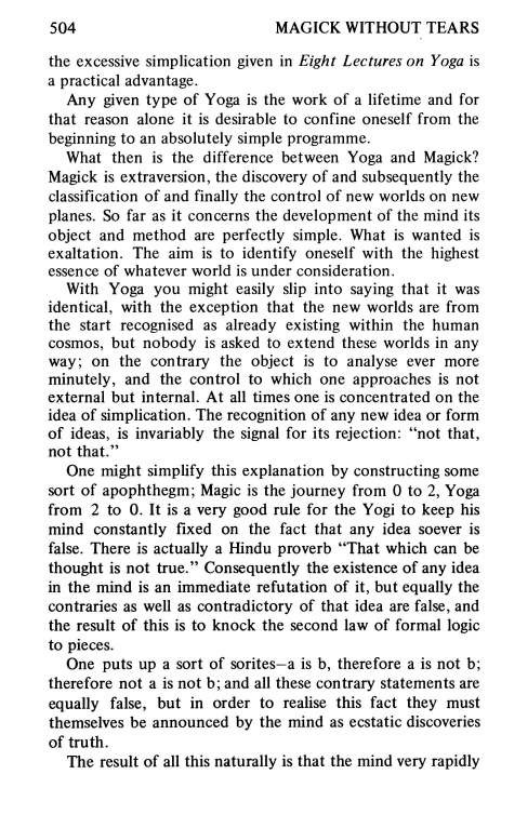
Highlights use the original PDF text layer. OCR-only matches may not be visible on the scan.
Transcription
Download text ↓raw extractionoriginal embedded textReview: unreviewed
504
MAGICK WITHOUT TEARS
the excessive simplication given in Eight Lectures on Yoga is
a practical advantage .
Any given type of Yoga is the work of a lifetime and for
that reason alone it is desirable to confine oneself from the
beginning to an absolutely simple programme.
What then is the difference between Yoga and Magick?
Magick is extraversion, the discovery of and subsequently the
classification of and finally the control of new worlds on new
planes. So far as it concerns the development of the mind its
object and method are perfectly simple. What is wanted is
exaltation. The aim is to identify oneself with the highest
essence of whatever world is under consideration.
With Yoga you might easily slip into saying that it was
identical, with the exception that the new worlds are from
the start recognised as already existing within the human
cosmos, but nobody is asked to extend these worlds in any
way; on the contrary the object is to analyse ever more
minutely, and the control to which one approaches is not
external but internal. At all times one is concentrated on the
idea of simplication. The recognition of any new idea or form
of ideas, is invariably the signal for its rejection: "not that,
not that."
One might simplify this explanation by constructing some
sort of apophthegm; Magic is the journey from 0 to 2, Yoga
from 2 to o. It is a very good rule for the Yogi to keep his
mind constantly fixed on the fact that any idea soever is
false. There is actually a Hindu proverb "That which can be
thought is not true." Consequently the existence of any idea
in the mind is an immediate refutation of it, but equally the
contraries as well as contradictory of that idea are false, and
the result of this is to knock the second law of formal logic
to pieces.
One puts up a sort of sorites-a is b, therefore a is not b;
therefore not a is not b; and all these contrary statements are
equally false, but in order to realise this fact they must
themselves be announced by the mind as ecstatic discoveries
of truth.
The result of all this naturally is that the mind very rapidly
Page provenance & review flags
Stable page ID: e7a83bd7c68d4e96894f9e69:p00537
Line breaks are preserved. Reading order and OCR accuracy may need review.
Printed page label has not been verified.
- No automated review flags. This does not establish transcription accuracy.