1954 · CLOSE READING
Magick Without Tears
Magick Without Tears (1954), PDF p. 536
Original page
Enlarge ↗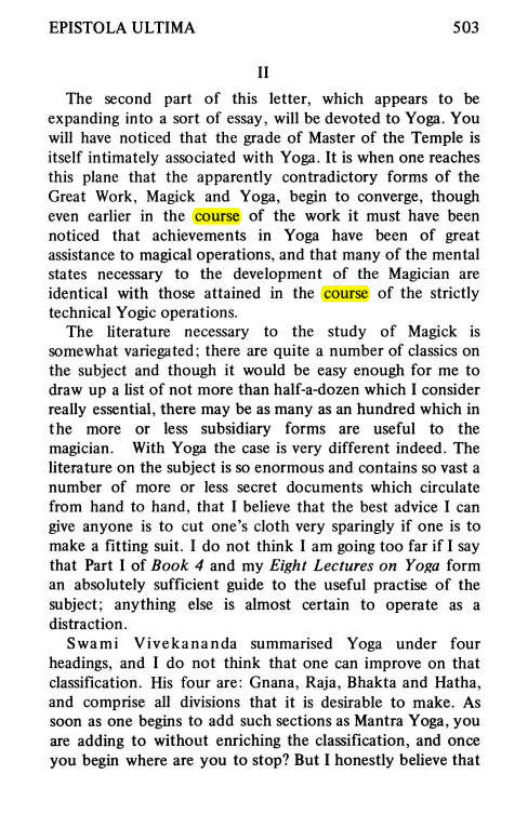
Highlights use the original PDF text layer. OCR-only matches may not be visible on the scan.
Transcription
Download text ↓raw extractionoriginal embedded textReview: unreviewed
EPISTO LA ULTIMA
503
II
The second part of this letter, which appears to be
expanding into a sort of essay, will be devoted to Yoga. You
will have noticed that the grade of Mas-ter of the Temple is
itself intimately associated with Yoga. It is when one reaches
this plane that the apparently contradictory forms of the
Great Work, Magick and Yoga, begin to converge, though
even earlier in the course of the work it must have been
noticed that achievements in Yoga have been of great
assistance to magical operations , and that many of the mental
states necessary to the development of the Magician are
identical with those attained in the course of the strictly
technical Yogic operations.
The literature necessary to the study of Magick is
somewhat variegated; there are quite a number of classics on
the subject and though it would be easy enough for me to
draw up a list of not more than half-a-dozen which I consider
really essential, there may be as many as an hundred which in
the more or less subsidiary forms are useful to the
magICian. With Yoga the case is very different indeed. The
literature on the subject is so enormous and contains so vast a
number of more or less secret documents which circulate
from hand to hand , that I believe that the best advice I can
give anyone is to cut one's cloth very sparingly if one is to
make a fitting suit. I do not think I am going too far if I say
that Part I of Book 4 and my Eight Lectures on Yoga form
an absolutely sufficient guide to the useful practise of the
subject ; anything else is almost certain to operate as a
distraction .
Swami
Vivekananda
summarised Yoga under four
headings, and I do not think that one can improve on that
classification. His four are: Gnana, Raja, Bhakta and Hatha,
and comprise all divisions that it is desirable to make. As
soon as one begins to add such sections as Mantra Yoga, you
are adding to without enriching the classification, and once
you begin where are you to stop? But I honestly believe that
Page provenance & review flags
Stable page ID: e7a83bd7c68d4e96894f9e69:p00536
Line breaks are preserved. Reading order and OCR accuracy may need review.
Printed page label has not been verified.
- No automated review flags. This does not establish transcription accuracy.