1954 · CLOSE READING
Magick Without Tears
Magick Without Tears (1954), PDF p. 534
Original page
Enlarge ↗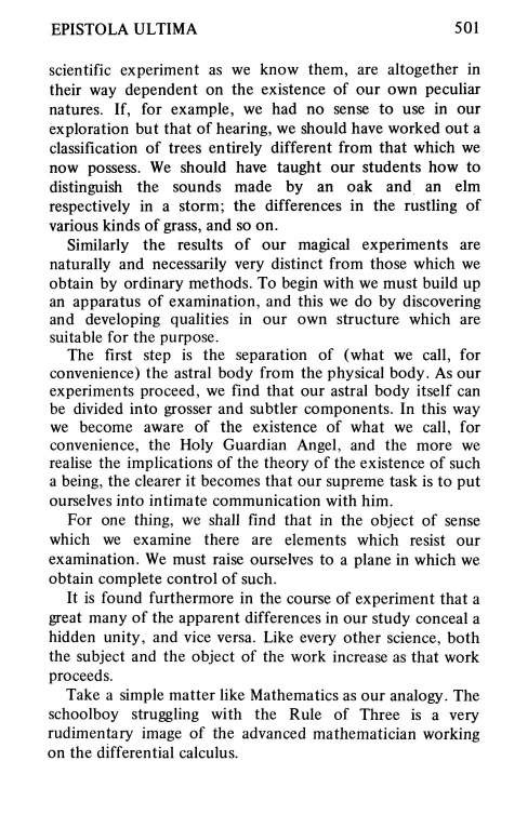
Highlights use the original PDF text layer. OCR-only matches may not be visible on the scan.
Transcription
Download text ↓raw extractionoriginal embedded textReview: unreviewed
EPISTOLA ULTIMA
501
scientific experiment as we know them, are altogether in
their way dependent on the existence of our own peculiar
natures. If, for example, we had no sense to use in our
exploration but that of hearing, we should have worked out a
classification of trees entirely different from that which we
now possess. We should have taught our students how to
distinguish the sounds made by an oak and an elm
respectively in a storm; the differences in the rustling of
various kinds of grass, and so on.
Similarly the results of our magical experiments
are
naturally and necessarily very distinct from those which we
obtain by ordinary methods. To begin with we must build up
an apparatus of examination, and this we do by discovering
and developing qualities in our own structure which are
suitable for the purpose.
The first step is the separation of (what we call, for
convenience) the astral body from the physical body. As our
experiments proceed, we find that our astral body itself can
be divided into grosser and subtler components. In this way
we become aware of the existence of what we call, for
convenience, the Holy Guardian Angel, and the more we
realise the implications of the theory of the existence of such
a being, the clearer it becomes that our supreme task is to put
ourselves into intimate communication with him.
For one thing, we shaH find that in the object of sense
which we examine there are elements which resist our
examination. We must raise ourselves to a plane in which we
obtain complete control of such.
It is found furthermore in the course of experiment that a
great many of the apparent differences in our study conceal a
hidden unity, and vice versa. Like every other science, both
the subject and the object of the work increase as that work
proceeds.
Take a simple matter like Mathematics as our analogy. The
schoolboy struggling with the Rule of Three is a very
rudimentary image of the advanced mathematician working
on the differential calculus.
Page provenance & review flags
Stable page ID: e7a83bd7c68d4e96894f9e69:p00534
Line breaks are preserved. Reading order and OCR accuracy may need review.
Printed page label has not been verified.
- No automated review flags. This does not establish transcription accuracy.