1954 · CLOSE READING
Magick Without Tears
Magick Without Tears (1954), PDF p. 418
Original page
Enlarge ↗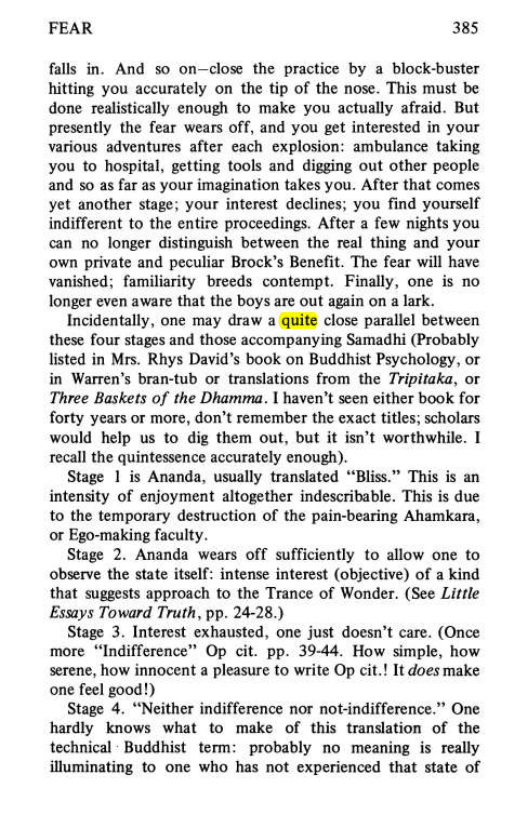
Highlights use the original PDF text layer. OCR-only matches may not be visible on the scan.
Transcription
Download text ↓raw extractionoriginal embedded textReview: unreviewed
FEAR
385
falls in. And so on-close the practice by a block-buster
hitting you accurately on the tip of the nose. This must be
done realistically enough to make you actually afraid. But
presently the fear wears off, and you get interested in your
various adventures after each explosion: ambulance taking
you to hospital, getting tools and digging out other people
and so as far as your imagination takes you. After that comes
yet another stage; your interest declines; you find yourself
indifferent to the entire proceedings. After a few nights you
can no longer distinguish between the real thing and your
own private and peculiar Brock's Benefit. The fear will have
vanished; familiarity breeds contempt. Finally, one is no
longer even aware that the boys are out again on a lark.
Incidentally, one may draw a quite close parallel between
these four stages and those accompanying Samadhi (Probably
listed in Mrs. Rhys David's book on Buddhist Psychology, or
in Warren's bran-tub or translations from the Tripitaka, or
Three Baskets of the Dhamma. I haven't seen either book for
forty years or more, don't remember the exact titles; scholars
would help us to dig them out, but it isn't worthwhile. I
recall the quintessence accurately enough).
Stage I is Ananda, usually translated "Bliss." This is an
intensity of enjoyment altogether indescribable. This is due
to the temporary destruction of the pain-bearing Ahamkara,
or Ego-making faculty.
Stage 2. Ananda wears off sufficiently to allow one to
observe the state itself: intense interest (objective) of a kind
that suggests approach to the Trance of Wonder. (See Little
Essays Toward Truth, pp. 24-28.)
Stage 3. Interest exhausted, one just doesn't care. (Once
more "Indifference" Op cit. pp. 39-44. How simple, how
serene, how innocent a pleasure to write Op cit.! It does make
one feel good!)
Stage 4. "Neither indifference nor not-indifference ." One
hardly knows what to make of this translation of the
technical · Buddhist term: probably no meaning is really
illuminating to one who has not experienced that state of
Page provenance & review flags
Stable page ID: e7a83bd7c68d4e96894f9e69:p00418
Line breaks are preserved. Reading order and OCR accuracy may need review.
Printed page label has not been verified.
- No automated review flags. This does not establish transcription accuracy.