1954 · CLOSE READING
Magick Without Tears
Magick Without Tears (1954), PDF p. 31
Original page
Enlarge ↗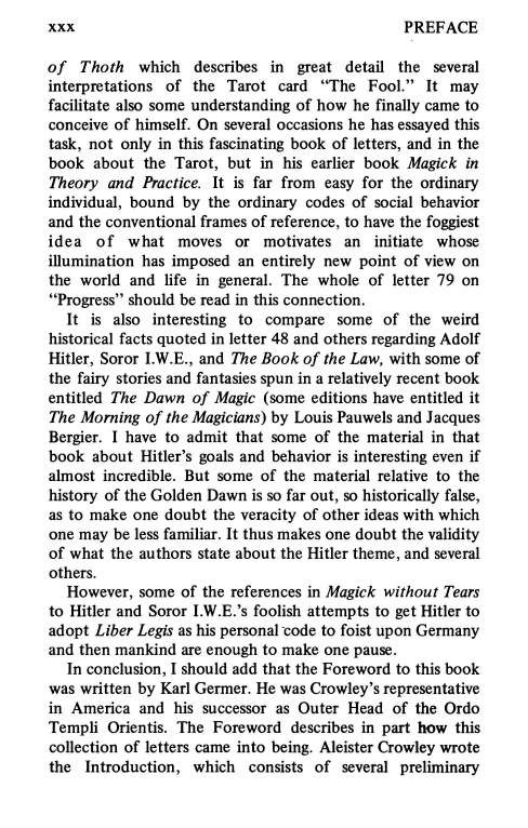
Highlights use the original PDF text layer. OCR-only matches may not be visible on the scan.
Transcription
Download text ↓raw extractionoriginal embedded textReview: unreviewed
xxx
PREFACE
of Thoth
which describes in great detail the several
interpretations
of the Tarot card "The Fool." It may
facilitate also some understanding of how he finally came to
conceive of himself. On several occasions he has essayed this
task, not only in this fascinating book of letters, and in the
book about the Tarot, but in his earlier book Magick in
Theory and Practice. It is far from easy for the ordinary
individual, bound by the ordinary codes of social behavior
and the conventional frames of reference, to have the foggiest
idea of what moves or motivates an initiate whose
illumination has imposed an entirely new point of view on
the world and life in general. The whole of letter 79 on
"Progress" should be read in this connection.
It is also interesting to compare some of the weird
historical facts quoted in letter 48 and others regarding Adolf
Hitler, Soror I.W.E., and The Book of the Law, with some of
the fairy stories and fantasies spun in a relatively recent book
entitled The Dawn of Magic (some editions have entitled it
The Morning of the Magicians) by Louis Pauwels and Jacques
Bergier. I have to admit that some of the material in that
book about Hitler's goals and behavior is interesting even if
almost incredible. But some of the material relative to the
history of the Golden Dawn is so far out, so historically false,
as to make one doubt the veracity of other ideas with which
one may be less familiar. It thus makes one doubt the validity
of what the authors state about the Hitler theme, and several
others.
However, some of the references in Magick without Tears
to Hitler and Soror I.W.E.'s foolish attempts to get Hitler to
adopt Liber Legis as his personal-code to foist upon Germany
and then mankind are enough to make one pause.
In conclusion, I should add that the Foreword to this book
was written by Karl Germer. He was Crowley's representative
in America and his successor as Outer Head of the Ordo
Templi Orientis. The Foreword describes in part how this
collection of letters came into being. Aleister Crowley wrote
the Introduction,
which consists of several preliminary
Page provenance & review flags
Stable page ID: e7a83bd7c68d4e96894f9e69:p00031
Line breaks are preserved. Reading order and OCR accuracy may need review.
Printed page label has not been verified.
- No automated review flags. This does not establish transcription accuracy.