1954 · CLOSE READING
Magick Without Tears
Magick Without Tears (1954), PDF p. 265
Original page
Enlarge ↗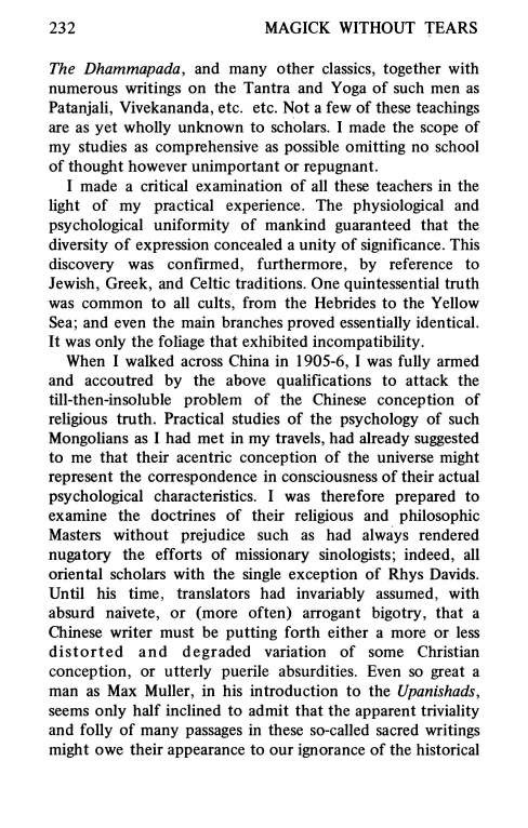
Highlights use the original PDF text layer. OCR-only matches may not be visible on the scan.
Transcription
Download text ↓raw extractionoriginal embedded textReview: unreviewed
232
MAGICK WITHOUT TEARS
The Dhammapada, and many other classics, together with
numerous writings on the Tantra and Yoga of such men as
Patanjali, Vivekananda, etc. etc. Not a few of these teachings
are as yet wholly unknown to scholars. I made the scope of
my studies as comprehensive as possible omitting no school
of thought however unimportant or repugnant.
I made a critical examination of all these teachers in the
light of my practical experience. The physiological and
psychological uniformity of mankind guaranteed that the
diversity of expression concealed a unity of significance. This
discovery was confirmed, furthermore,
by reference to
Jewish, Greek, and Celtic traditions. One quintessential truth
was common to all cults, from the Hebrides to the Yellow
Sea; and even the main branches proved essentially identical.
It was only the foliage that exhibited incompatibility.
When I walked across China in 1905-6, I was fully armed
and accoutred by the above qualifications to attack the
till-then-insoluble problem of the Chinese conception of
religious truth. Practical studies of the psychology of such
Mongolians as I had met in my travels, had already suggested
to me that their acentric conception of the universe might
represent the correspondence in consciousness of their actual
psychological characteristics . I was therefore prepared to
examine the doctrines of their religious and philosophic
Masters without prejudice such as had always rendered
nugatory the efforts of missionary sinologists; indeed, all
oriental scholars with the single exception of Rhys Davids.
Until his time, translators had invariably assumed, with
absurd naivete, or (more often) arrogant bigotry, that a
Chinese writer must be putting forth either a more or less
distorted
and degraded
variation of some Christian
conception, or utterly puerile absurdities . Even so great a
man as Max Muller, in his introduction to the Upanishads,
seems only half inclined to admit that the apparent triviality
and folly of many passages in these so-called sacred writings
might owe their appearance to our ignorance of the historical
Page provenance & review flags
Stable page ID: e7a83bd7c68d4e96894f9e69:p00265
Line breaks are preserved. Reading order and OCR accuracy may need review.
Printed page label has not been verified.
- No automated review flags. This does not establish transcription accuracy.