1954 · CLOSE READING
Magick Without Tears
Magick Without Tears (1954), PDF p. 261
Original page
Enlarge ↗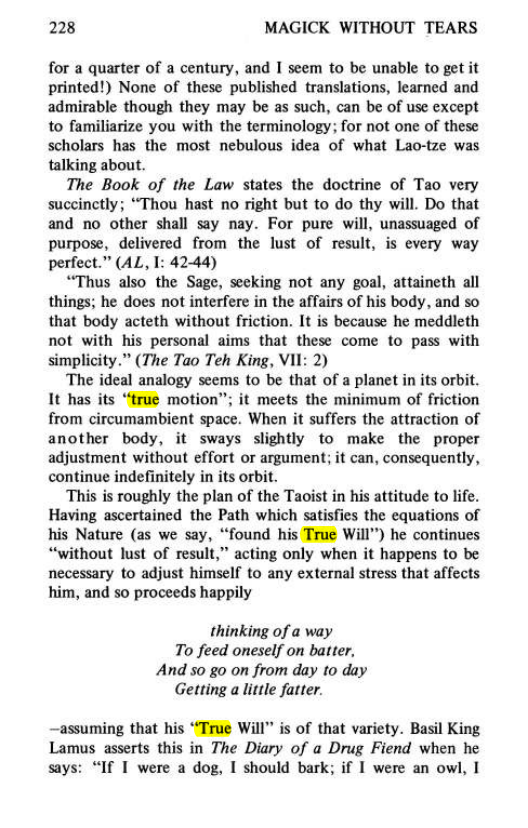
Highlights use the original PDF text layer. OCR-only matches may not be visible on the scan.
Transcription
Download text ↓raw extractionoriginal embedded textReview: unreviewed
228
MAGICK WITHOUT TEARS
for a quarter of a century, and I seem to be unable to get it
printed!) None of these published translations, learned and
admirable though they may be as such, can be of use except
to familiarize you with the terminology; for not one of these
scholars has the most nebulous idea of what Lao-tze was
talking about.
The Book of the Law states the doctrine of Tao very
succinctly; "Thou hast no right but to do thy will. Do that
and no other shall say nay. For pure will, unassuaged of
purpose, delivered from the lust of result, is every way
perfect." (AL, I: 42-44)
"Thus also the Sage, seeking not any goal, attaineth all
things; he does not interfere in the affairs of his body, and so
that body acteth without friction . It is because he meddleth
not with his personal aims that these come to pass with
simplicity." (The Tao Teh King, VII: 2)
The ideal analogy seems to be that of a planet in its orbit.
It has its "true motion"; it meets the minimum of friction
from circumambient space. When it suffers the attraction of
another
body, it sways slightly to make the proper
adjustment without effort or argument; it can, consequently,
continue indefinitely in its orbit.
This is roughly the plan of the Taoist in his attitude to life.
Having ascertained the Path which satisfies the equations of
his Nature (as we say, "found his True Will") he continues
"without lust of result," acting only when it happens to be
necessary to adjust himself to any external stress that affects
him, and so proceeds happily
thinking of a way
To feed oneself on batter.
And so go on from day to day
Getting a little fatter.
-assuming that his "True Will" is of that variety. Basil King
Lamus asserts this in The Diary of a Drug Fiend when he
says: "If I were a dog, I should bark; if I were an owl, I
Page provenance & review flags
Stable page ID: e7a83bd7c68d4e96894f9e69:p00261
Line breaks are preserved. Reading order and OCR accuracy may need review.
Printed page label has not been verified.
- No automated review flags. This does not establish transcription accuracy.