1954 · CLOSE READING
Magick Without Tears
Magick Without Tears (1954), PDF p. 18
Original page
Enlarge ↗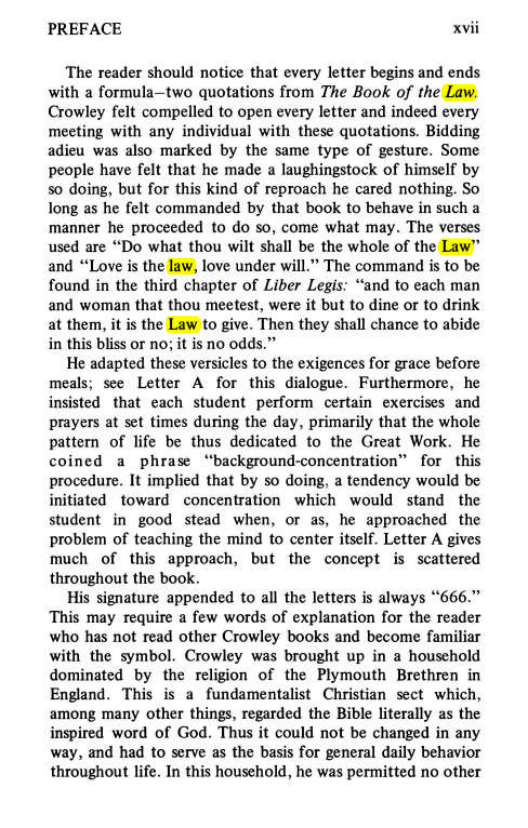
Highlights use the original PDF text layer. OCR-only matches may not be visible on the scan.
Transcription
Download text ↓raw extractionoriginal embedded textReview: unreviewed
PREFACE
XVll
The reader should notice that every letter begins and ends
with a formula-two quotations from The Book of the Law.
Crowley felt compelled to open every letter and indeed every
meeting with any individual with these quotations . Bidding
adieu was also marked by the same type of gesture. Some
people have felt that he made a laughingstock of himself by
so doing, but for this kind of reproach he cared nothing. So
long as he felt commanded by that book to behave in such a
manner he proceeded to do so, come what may. The verses
used are "Do what thou wilt shall be the whole of the Law"
and "Love is the law, love under will." The command is to be
found in the third chapter of Liber Legis: "and to each man
and woman that thou meetest, were it but to dine or to drink
at them, it is the Law to give. Then they shall chance to abide
in this bliss or no ; it is no odds."
He adapted these versicles to the exigences for grace before
meals; see Letter A for this dialogue. Furthermore, he
insisted that each student perform certain exercises and
prayers at set times during the day, primarily that the whole
pattern of life be thus dedicated to the Great Work. He
coined
a phrase
"background-concentration"
for this
procedure . It implied that by so doing, a tendency would be
initiated toward concentration
which would stand the
student in good stead when, or as, he approached the
problem of teaching the mind to center itself. Letter A gives
much of this approach, but the concept is scattered
throughout the book.
His signature appended to all the letters is always "666."
This may require a few words of explanation for the reader
who has not read other Crowley books and become familiar
with the symbol. Crowley was brought up in a household
dominated by the religion of the Plymouth Brethren in
England. This is a fundamentalist Christian sect which,
among many other things, regarded the Bible literally as the
inspired word of God. Thus it could not be changed in any
way, and had to serve as the basis for general daily behavior
throughout life. In this household, he was permitted no other
Page provenance & review flags
Stable page ID: e7a83bd7c68d4e96894f9e69:p00018
Line breaks are preserved. Reading order and OCR accuracy may need review.
Printed page label has not been verified.
- No automated review flags. This does not establish transcription accuracy.