1954 · CLOSE READING
Magick Without Tears
Magick Without Tears (1954), PDF p. 169
Original page
Enlarge ↗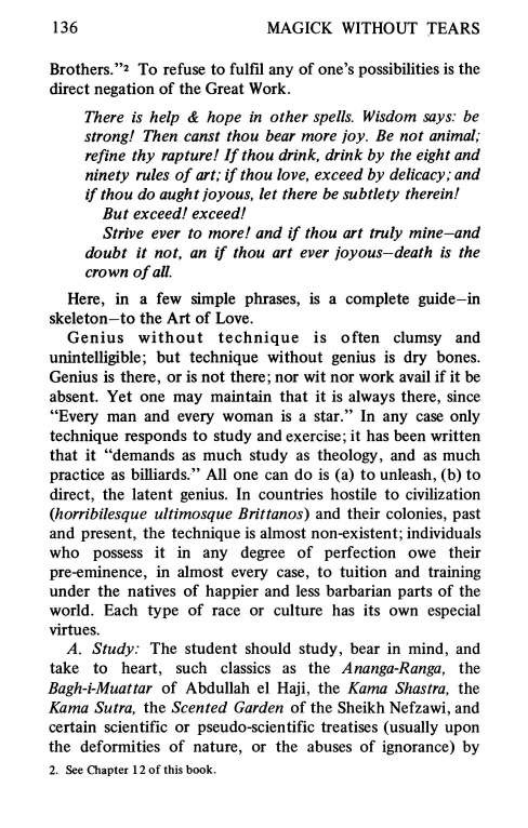
Highlights use the original PDF text layer. OCR-only matches may not be visible on the scan.
Transcription
Download text ↓raw extractionoriginal embedded textReview: unreviewed
136
MAGICK WITHOUT TEARS
Brothers."2 To refuse to fulfil any of one's possibilities is the
direct negation of the Great Work.
There is help & hope in other spells. Wisdom says: be
strong! Then canst thou bear more joy. Be not animal;
refine thy rapture! If thou drink, drink by the eight and
ninety rules of art; if thou love, exceed by delicacy; and
if thou do aught joyous, let there be subtlety therein!
But exceed! exceed!
Strive ever to more! and if thou art truly mine-and
doubt it not, an if thou art ever joyous-death is the
crown of all.
Here, in a few simple phrases, is a complete guide-in
skeleton-to the Art of Love.
Genius
without
technique
is often clumsy and
unintelligible; but technique without genius is dry bones.
Genius is there, or is not there; nor wit nor work avail if it be
absent. Yet one may maintain that it is always there, since
"Every man and every woman is a star." In any case only
technique responds to study and exercise; it has been written
that it "demands as much study as theology, and as much
practice as billiards." All one can do is (a) to unleash, (b) to
direct, the latent genius. In countries hostile to civilization
(horribilesque ultimosque Brittanos) and their colonies, past
and present, the technique is almost non-existent; individuals
who possess it in any degree of perfection owe their
pre-eminence, in almost every case, to tuition and training
under the natives of happier and less barbarian parts of the
world. Each type of race or culture has its own especial
virtues.
A. Study: The student should study, bear in mind, and
take to heart, such classics as the Ananga-Ranga, the
Bagh-i-Muattar of Abdullah el Haji, the Kama Shastra, the
Kama Sutra, the Scented Garden of the Sheikh Nefzawi, and
certain scientific or pseudo-scientific treatises (usually upon
the deformities of nature, or the abuses of ignorance) by
2. See Chapter 12 of this book.
Page provenance & review flags
Stable page ID: e7a83bd7c68d4e96894f9e69:p00169
Line breaks are preserved. Reading order and OCR accuracy may need review.
Printed page label has not been verified.
- No automated review flags. This does not establish transcription accuracy.