1954 · CLOSE READING
Magick Without Tears
Magick Without Tears (1954), PDF p. 13
Original page
Enlarge ↗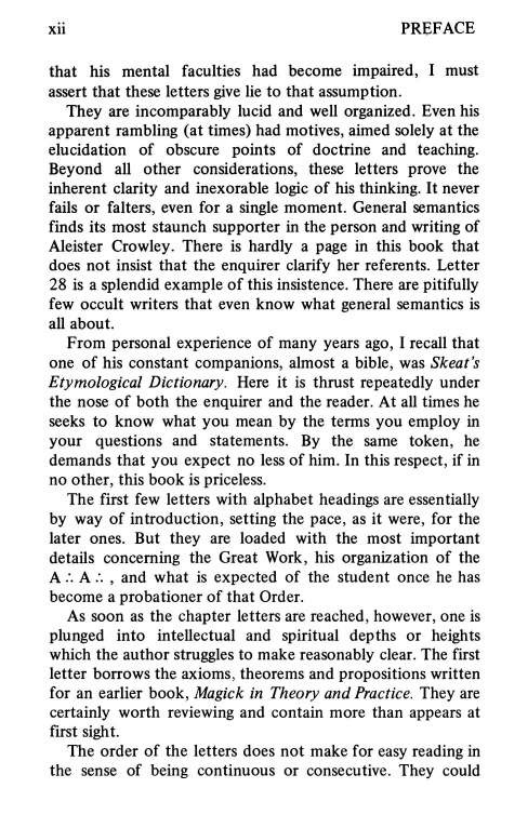
Highlights use the original PDF text layer. OCR-only matches may not be visible on the scan.
Transcription
Download text ↓raw extractionoriginal embedded textReview: unreviewed
Xli
PREFACE
that his mental faculties had become impaired, I must
assert that these letters give lie to that assumption.
They are incomparably lucid and well organized. Even his
apparent rambling (at times) had motives, aimed solely at the
elucidation of obscure points of doctrine and teaching.
Beyond all other considerations, these letters prove the
inherent clarity and inexorable logic of his thinking. It never
fails or falters, even for a single moment. General semantics
finds its most staunch supporter in the person and writing of
Aleister Crowley. There is hardly a page in this book that
does not insist that the enquirer clarify her referents. Letter
28 is a splendid example of this insistence. There are pitifully
few occult writers that even know what general semantics is
all about.
From personal experience of many years ago, I recall that
one of his constant companions, almost a bible, was Skeat's
Etymological Dictionary . Here it is thrust repeatedly under
the nose of both the enquirer and the reader. At all times he
seeks to know what you mean by the terms you employ in
your questions and statements. By the same token, he
demands that you expect no less of him. In this respect , if in
no other, this book is priceless.
The first few letters with alphabet headings are essentially
by way of introduction, setting the pace, as it were, for the
later ones. But they are loaded with the most important
details concerning the Great Work, his organization of the
A :. A :. , and what is expected of the student once he has
become a probationer of that Order.
As soon as the chapter letters are reached, however, one is
plunged into intellectual and spiritual depths or heights
which the author struggles to make reasonably clear. The first
letter borrows the axioms, theorems and propositions written
for an earlier book, Magick in Theory and Practice. They are
certainly worth reviewing and contain more than appears at
first sigh t.
The order of the letters does not make for easy reading in
the sense of being continuous or consecutive. They could
Page provenance & review flags
Stable page ID: e7a83bd7c68d4e96894f9e69:p00013
Line breaks are preserved. Reading order and OCR accuracy may need review.
Printed page label has not been verified.
- No automated review flags. This does not establish transcription accuracy.