1954 · CLOSE READING
Magick Without Tears
Magick Without Tears (1954), PDF p. 107
Original page
Enlarge ↗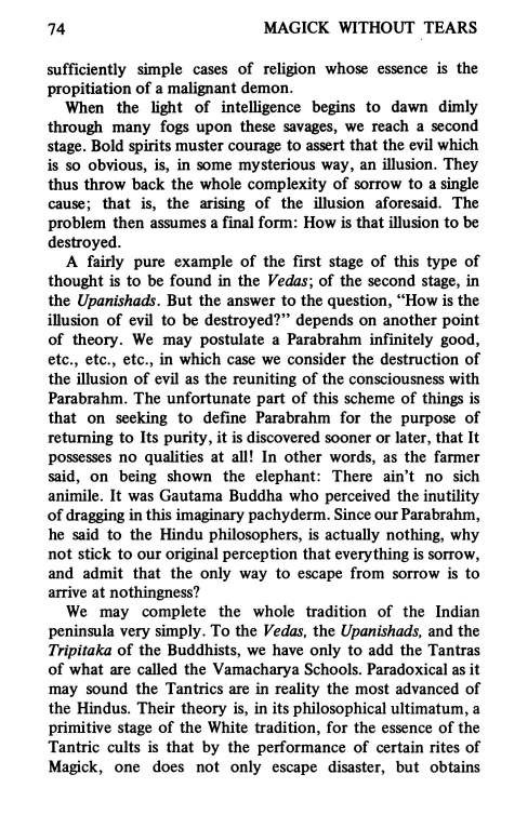
Highlights use the original PDF text layer. OCR-only matches may not be visible on the scan.
Transcription
Download text ↓raw extractionoriginal embedded textReview: unreviewed
74
MAGICK WITHOUT TEARS
sufficiently simple cases of religion whose essence is the
propitiation of a malignant demon.
When the light of intelligence begins to dawn dimly
through many fogs upon these savages, we reach a second
stage. Bold spirits muster courage to assert that the evil which
is so obvious, is, in some mysterious way, an illusion. They
thus throw back the whole complexity of sorrow to a single
cause; that is, the arising of the illusion aforesaid. The
problem then assumes a final fonn: How is that illusion to be
destroyed.
A fairly pure example of the first stage of this type of
thought is to be found in the Vedas; of the second stage, in
the Upanishads. But the answer to the question, "How is the
illusion of evil to be destroyed?" depends on another point
of theory. We may postulate a Parabrahm infinitely good,
etc., etc., etc., in which case we consider the destruction of
the illusion of evil as the reuniting of the consciousness with
Parabrahm. The unfortunate part of this scheme of things is
that on seeking to define Parabrahm for the purpose of
returning to Its purity, it is discovered sooner or later, that It
possesses no qualities at all! In other words, as the fanner
said, on being shown the elephant: There ain't no sich
animile. It was Gautama Buddha who perceived the inutility
of dragging in this imaginary pachyderm. Since our Para brahm,
he said to the Hindu philosophers, is actually nothing, why
not stick to our original perception that everything is sorrow,
and admit that the only way to escape from sorrow is to
arrive at nothingness?
We may complete the whole tradition of the Indian
peninsula very simply. To the Vedas, the Upanishads, and the
Tripitaka of the Buddhists, we have only to add the Tantras
of what are called the Vamacharya Schools. Paradoxical as it
may sound the Tantrics are in reality the most advanced of
the Hindus. Their theory is, in its philosophical ultimatum, a
primitive stage of the White tradition, for the essence of the
Tantric cults is that by the performance of certain rites of
Magick, one does not only escape disaster, but obtains
Page provenance & review flags
Stable page ID: e7a83bd7c68d4e96894f9e69:p00107
Line breaks are preserved. Reading order and OCR accuracy may need review.
Printed page label has not been verified.
- No automated review flags. This does not establish transcription accuracy.