1954 · CLOSE READING
Magick Without Tears
Magick Without Tears (1954), PDF p. 101
Original page
Enlarge ↗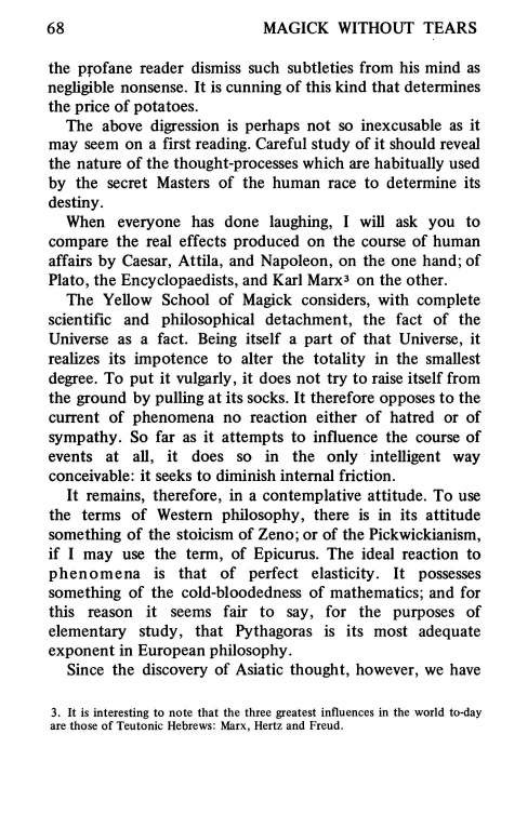
Highlights use the original PDF text layer. OCR-only matches may not be visible on the scan.
Transcription
Download text ↓raw extractionoriginal embedded textReview: unreviewed
68
MAGICK WITHOUT TEARS
the profane reader dismiss such subtleties from his mind as
negligible nonsense. It is cunning of this kind that determines
the price of potatoes.
The above digression is perhaps not so inexcusable as it
may seem on a first reading. Careful study of it should reveal
the nature of the thought-processes which are habitually used
by the secret Masters of the human race to determine its
destiny.
When everyone has done laughing, I will ask you to
compare the real effects produced on the course of human
affairs by Caesar, Attila, and Napoleon, on the one hand; of
Plato, the Encyclopaedists, and Karl Marx3 on the other.
The Yellow School of Magick considers, with complete
scientific and philosophical detachment, the fact of the
Universe as a fact. Being itself a part of that Universe, it
realizes its impotence to alter the totality in the smallest
degree. To put it vulgarly, it does not try to raise itself from
the ground by pulling at its socks. It therefore opposes to the
current of phenomena no reaction either of hatred or of
sympathy. So far as it attempts to influence the course of
events at all, it does so in the only intelligent way
conceivable: it seeks to diminish internal friction.
It remains, therefore, in a contemplative attitude. To use
the terms of Western philosophy, there is in its attitude
something of the stoicism of Zeno; or of the Pickwickianism,
if I may use the term, of Epicurus. The ideal reaction to
phenomena
is that of perfect elasticity. It possesses
something of the cold-bloodedness of mathematics; and for
this reason it seems fair to say, for the purposes of
elementary study, that Pythagoras is its most adequate
exponent in European philosophy.
Since the discovery of Asiatic thought, however, we have
3. It is interesting to note that the three greatest influences in the world to-day
are those of Teutonic Hebrews: Marx, Hertz and Freud.
Page provenance & review flags
Stable page ID: e7a83bd7c68d4e96894f9e69:p00101
Line breaks are preserved. Reading order and OCR accuracy may need review.
Printed page label has not been verified.
- No automated review flags. This does not establish transcription accuracy.