1911 · CLOSE READING
The Equinox (Volume I, Number V)
The Equinox (Volume I, Number V) (1911), PDF p. 172
Original page
Enlarge ↗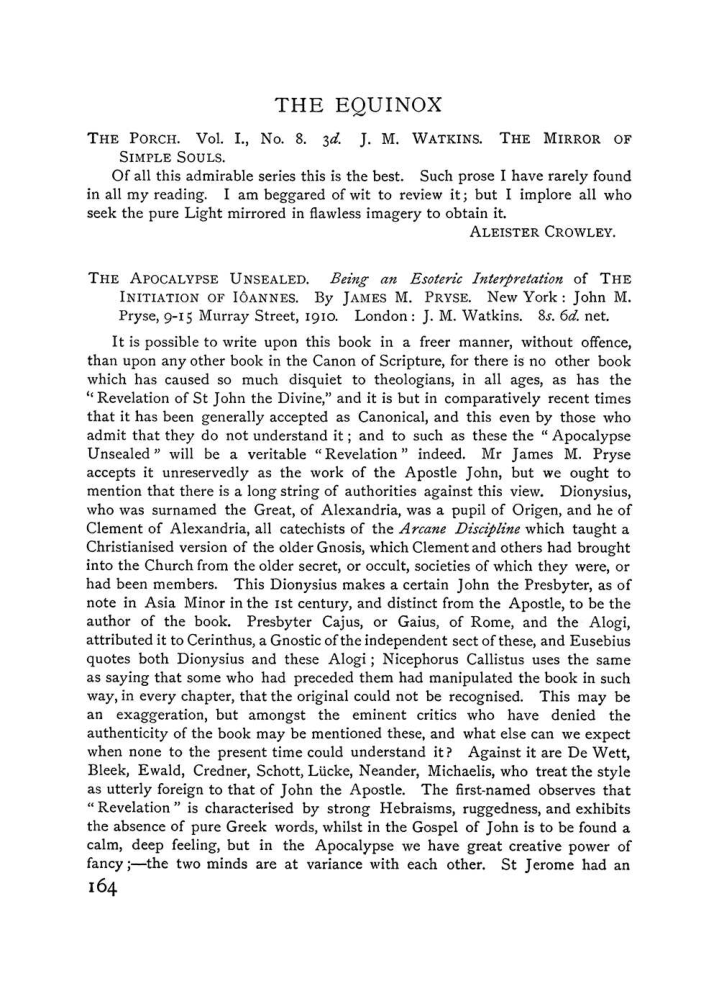
Highlights use the original PDF text layer. OCR-only matches may not be visible on the scan.
Transcription
Download text ↓raw extractionoriginal embedded textReview: unreviewed
THE EQUINOX
THE
PORCH.
Vol.
I.,
No.
8.
3d,
[. M.
WATKINS.
THE
MIRROR
OF
SIMPLE SOULS.
Of all this admirable series this is the best.
Such prose I have rarely found
in all my reading.
I am beggared of wit to review it; but I implore all who
seek the pure Light mirrored in flawless imagery to obtain it.
ALEISTEK CROWLEY.
THE
APOCALYPSE
UNSEALED.
Being an
Exatm‘c Intznþretatian of THE
INITIATION or IOANNEs.
By JAMES Μ.
PRVSE.
New York: John M.
Pryse, 9-15 Murray Street, 1910.
London: J. Μ. Watkins.
85. δεῖ. net.
It is possible to write upon this book in a freer manner, without ofi'ence,
than upon any other book in the Canon of Scripture, for there is no other book
which has caused so much disquiet to theologians, in all ages, as has the
“ Revelation of St John the Divine,” and it is but in comparatively recent times
that it has been generally accepted as Canonical, and this even by those who
admit that they do not understand it; and to such as these the “Apocalypse
Unsealed " will be a veritable " Revelation ” indeedi
Mr James
M. Pryse
accepts it unreservedly as the work of the Apostle John, but we ought to
mention that there is a long string of authorities against this view.
Dionysius,
who was surnamed the Great, of Alexandria, was a pupil of Origen, and he of
Clement of Alexandria, all catechists of the Arcane Discipline which taught a
Christianised version of the older Gnosis, which Clement and others had brought
into the Church from the older secret, or occult, societies of which they were, or
had been members.
This Dionysius makes a certain John the Presbyter, as of
note in Asia Minor in the ist century, and distinct from the Apostle, to be the
author of the book.
Presbyter
Cajus, or Gaius, of Rome, and the Alogi,
attributed it to Cerinthus, a Gnosticofthe independent sect of these, and Eusebius
quotes both Dionysius and these Alogi; Nicephorus Callistus uses the same
as saying that some who had preceded them had manipulated the book in such
way, in every chapter, that the original could not be recognised.
This may be
an
exaggeration, but amongst
the
eminent critics who
have denied the
authenticity of the book may be mentioned these, and what else can we expect
when none to the present time could understand it?
Against it are De Wett,
Bleek, Ewald, Credner, Schott, Lücke, Neander, Michaelis, who treat the style
as utterly foreign to that of John the Apostle
The first-named observes that
“Revelation" is characterised by strong Hebraisms, ruggedness, and exhibits
the absence of pure Greek words, whilst in the Gospel of John is to be found a
calm, deep feeling, but in the Apocalypse we have great creative power of
[mey,—the two minds are at variance with each other.
St Jerome had an
164
Page provenance & review flags
Stable page ID: d29ae6afb8f15dae5e9d6cb4:p00172
Line breaks are preserved. Reading order and OCR accuracy may need review.
Printed page label has not been verified.
- No automated review flags. This does not establish transcription accuracy.