1910 · CLOSE READING
The Equinox (Volume I, Number III)
The Equinox (Volume I, Number III) (1910), PDF p. 85
Original page
Enlarge ↗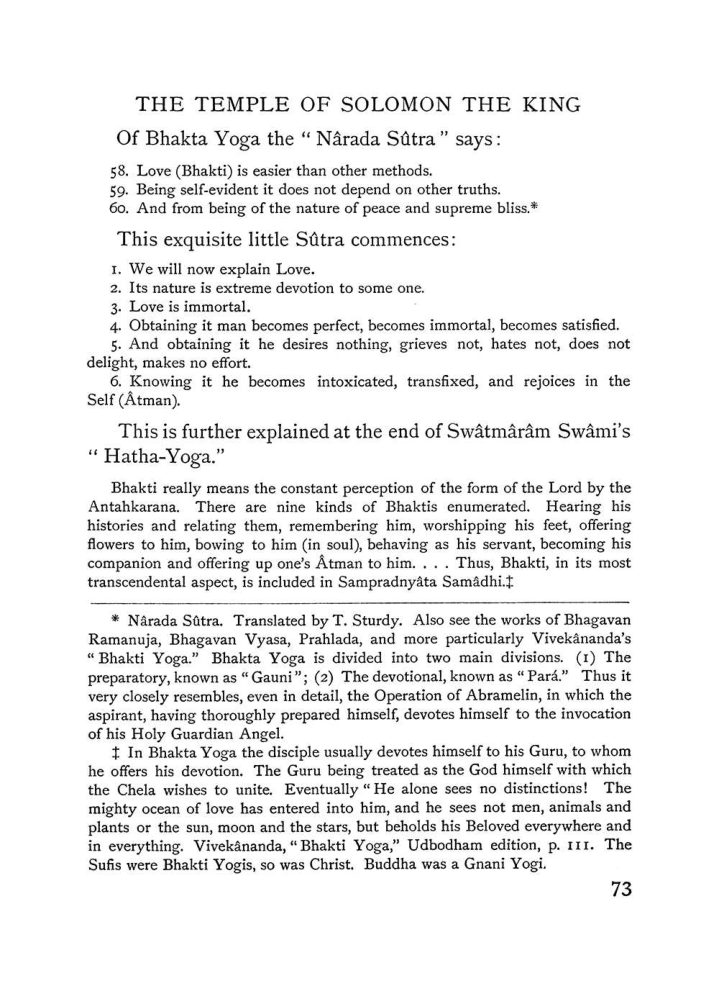
Highlights use the original PDF text layer. OCR-only matches may not be visible on the scan.
Transcription
Download text ↓raw extractionoriginal embedded textReview: unreviewed
THE TEMPLE OF SOLOMON THE KING
Of Bhakta Yoga the “ Narada Stra” says:
58. Love (Bhakti) is easier than other methods.
59. Being self-evident it does not depend on other truths.
60. And from being of the nature of peace and supreme bliss.*
This exquisite little S@tra commences:
1. We will now explain Love.
2. Its nature is extreme devotion to some one.
3. Love is immortal.
4. Obtaining it man becomes perfect, becomes immortal, becomes satisfied.
5. And obtaining it he desires nothing, grieves not, hates not, does not
delight, makes no effort.
6. Knowing it he becomes intoxicated, transfixed, and rejoices in the
Self (Atman),
This is further explained at the end of Swatmaram Swami’s
“ Hatha-Yoga.”
Bhakti really means the constant perception of the form of the Lord by the
Antahkarana. There are nine kinds of Bhaktis enumerated. Hearing his
histories and relating them, remembering him, worshipping his feet, offering
flowers to him, bowing to him (in soul), behaving as his servant, becoming his
companion and offering up one’s Atman to him. . . . Thus, Bhakti, in its most
transcendental aspect, is included in Sampradnyata Samadhi.t
* Narada Sfitra. Translated by T. Sturdy. Also see the works of Bhagavan
Ramanuja, Bhagavan Vyasa, Prahlada, and more particularly Vivekananda’s
“Bhakti Yoga.” Bhakta Yoga is divided into two main divisions. (1) The
preparatory, known as “Gauni”; (2) The devotional, known as “Para.” Thus it
very closely resembles, even in detail, the Operation of Abramelin, in which the
aspirant, having thoroughly prepared himself, devotes himself to the invocation
of his Holy Guardian Angel.
+ In Bhakta Yoga the disciple usually devotes himself to his Guru, to whom
he offers his devotion. The Guru being treated as the God himself with which
the Chela wishes to unite. Eventually “He alone sees no distinctions! The
mighty ocean of love has entered into him, and he sees not men, animals and
plants or the sun, moon and the stars, but beholds his Beloved everywhere and
in everything. Vivekananda, “ Bhakti Yoga,” Udbodham edition, p. 111. The
Sufis were Bhakti Yogis, so was Christ. Buddha was a Gnani Yogi.
73
Page provenance & review flags
Stable page ID: d1f23c8ca1536b365e6ad0ea:p00085
Line breaks are preserved. Reading order and OCR accuracy may need review.
Printed page label has not been verified.
- No automated review flags. This does not establish transcription accuracy.