1910 · CLOSE READING
The Equinox (Volume I, Number III)
The Equinox (Volume I, Number III) (1910), PDF p. 84
Original page
Enlarge ↗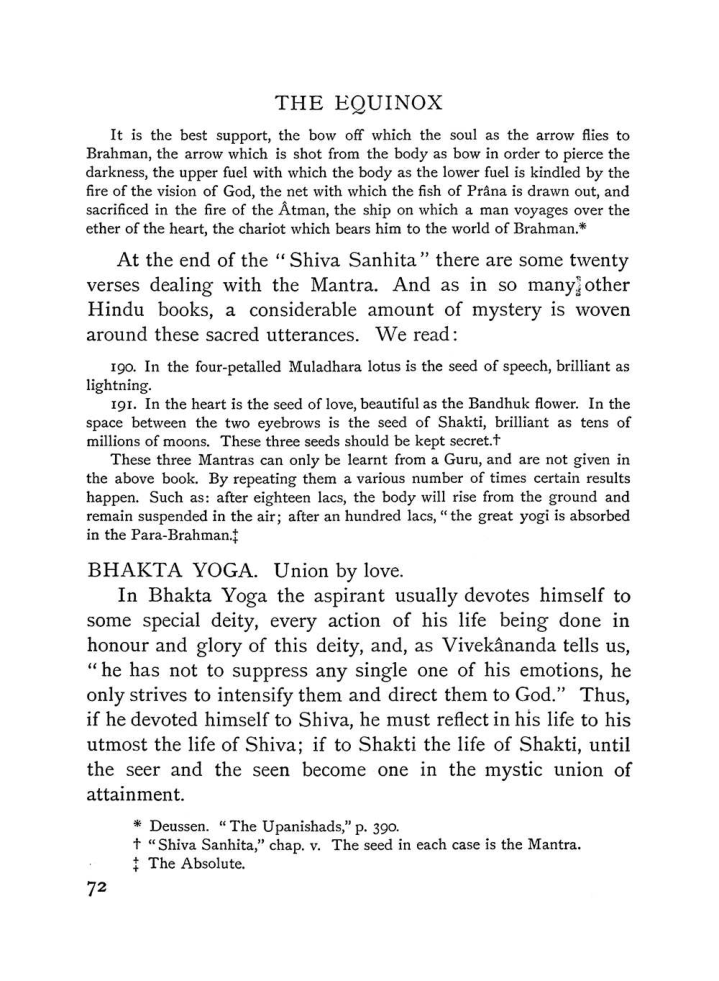
Highlights use the original PDF text layer. OCR-only matches may not be visible on the scan.
Transcription
Download text ↓raw extractionoriginal embedded textReview: unreviewed
THE EQUINOX
It is the best support, the bow off which the soul as the arrow flies to
Brahman, the arrow which is shot from the body as bow in order to pierce the
darkness, the upper fuel with which the body as the lower fuel is kindled by the
fire of the vision of God, the net with which the fish of Prana is drawn out, and
sacrificed in the fire of the Atman, the ship on which a man voyages over the
ether of the heart, the chariot which bears him to the world of Brahman.*
At the end of the “Shiva Sanhita” there are some twenty
verses dealing with the Mantra. And as in so many; other
Hindu books, a considerable amount of mystery is woven
around these sacred utterances. We read:
190. In the four-petalled Muladhara lotus is the seed of speech, brilliant as
lightning.
1g1. In the heart is the seed of love, beautiful as the Bandhuk flower. In the
space between the two eyebrows is the seed of Shakti, brilliant as tens of
millions of moons. These three seeds should be kept secret.t
These three Mantras can only be learnt from a Guru, and are not given in
the above book. By repeating them a various number of times certain results
happen. Such as: after eighteen lacs, the body will rise from the ground and
remain suspended in the air; after an hundred lacs, “the great yogi is absorbed
in the Para-Brahman{
BHAKTA YOGA. Union by love.
In Bhakta Yoga the aspirant usually devotes himself to
some special deity, every action of his life being done in
honour and glory of this deity, and, as Vivekananda tells us,
“he has not to suppress any single one of his emotions, he
only strives to intensify them and direct them to God.” Thus,
if he devoted himself to Shiva, he must reflect in his life to his
utmost the life of Shiva; if to Shakti the life of Shakti, until
the seer and the seen become one in the mystic union of
attainment.
* Deussen. “The Upanishads,” p. 390.
+ “Shiva Sanhita,” chap. v. The seed in each case is the Mantra.
¢ The Absolute.
72
Page provenance & review flags
Stable page ID: d1f23c8ca1536b365e6ad0ea:p00084
Line breaks are preserved. Reading order and OCR accuracy may need review.
Printed page label has not been verified.
- No automated review flags. This does not establish transcription accuracy.