1910 · CLOSE READING
The Equinox (Volume I, Number III)
The Equinox (Volume I, Number III) (1910), PDF p. 83
Original page
Enlarge ↗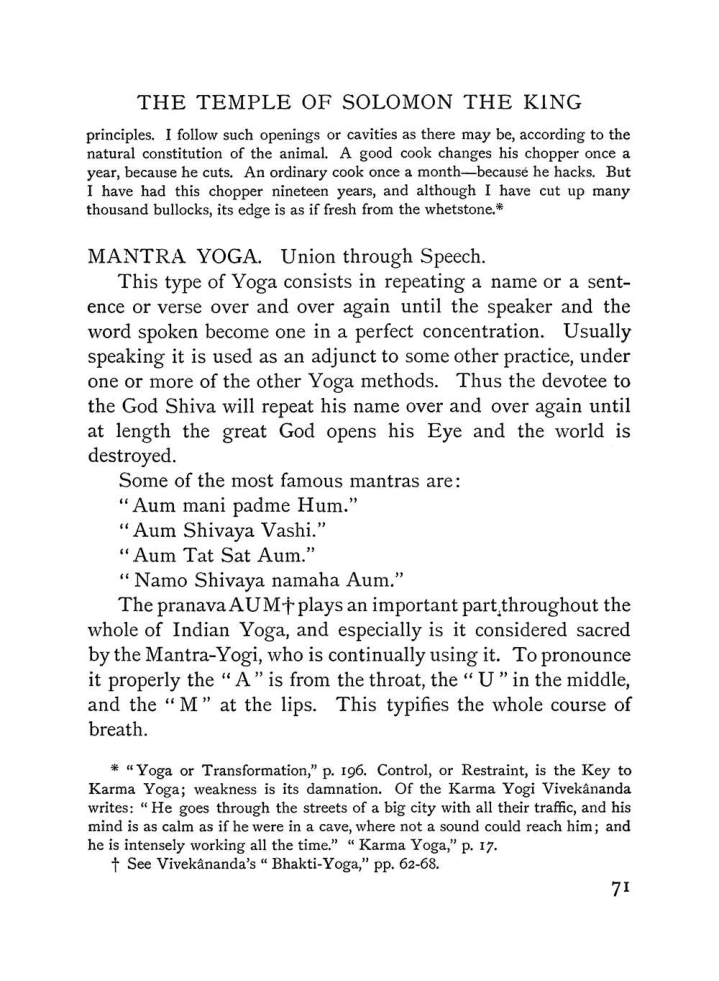
Highlights use the original PDF text layer. OCR-only matches may not be visible on the scan.
Transcription
Download text ↓raw extractionoriginal embedded textReview: unreviewed
THE TEMPLE OF SOLOMON THE KING
principles. I follow such openings or cavities as there may be, according to the
natural constitution of the animal. A good cook changes his chopper once a
year, because he cuts. An ordinary cook once a month—becausé he hacks, But
I have had this chopper nineteen years, and although I have cut up many
thousand bullocks, its edge is as if fresh from the whetstone.*
MANTRA YOGA. Union through Speech.
This type of Yoga consists in repeating a name or a sent-
ence or verse over and over again until the speaker and the
word spoken become one in a perfect concentration. Usually
speaking it is used as an adjunct to some other practice, under
one or more of the other Yoga methods. Thus the devotee to
the God Shiva will repeat his name over and over again until
at length the great God opens his Eye and the world is
destroyed.
Some of the most famous mantras are:
“Aum mani padme Hum.”
“ Aum Shivaya Vashi.”
“Aum Tat Sat Aum.”
“Namo Shivaya namaha Aum.”
The pranava AU M+ plays an important part, throughout the
whole of Indian Yoga, and especially is it considered sacred
by the Mantra-Yogi, who is continually using it. To pronounce
it properly the “A” is from the throat, the “ U ” in the middle,
and the “M” at the lips. This typifies the whole course of
breath.
* “Yoga or Transformation,” p. 196. Control, or Restraint, is the Key to
Karma Yoga; weakness is its damnation. Of the Karma Yogi Vivekananda
writes: “He goes through the streets of a big city with all their traffic, and his
mind is as calm as if he were in a cave, where not a sound could reach him; and
he is intensely working all the time.” “Karma Yoga,” p. 17.
+ See Vivekananda’s “ Bhakti-Yoga,” pp. 62-68.
71
Page provenance & review flags
Stable page ID: d1f23c8ca1536b365e6ad0ea:p00083
Line breaks are preserved. Reading order and OCR accuracy may need review.
Printed page label has not been verified.
- No automated review flags. This does not establish transcription accuracy.