1910 · CLOSE READING
The Equinox (Volume I, Number III)
The Equinox (Volume I, Number III) (1910), PDF p. 275
Original page
Enlarge ↗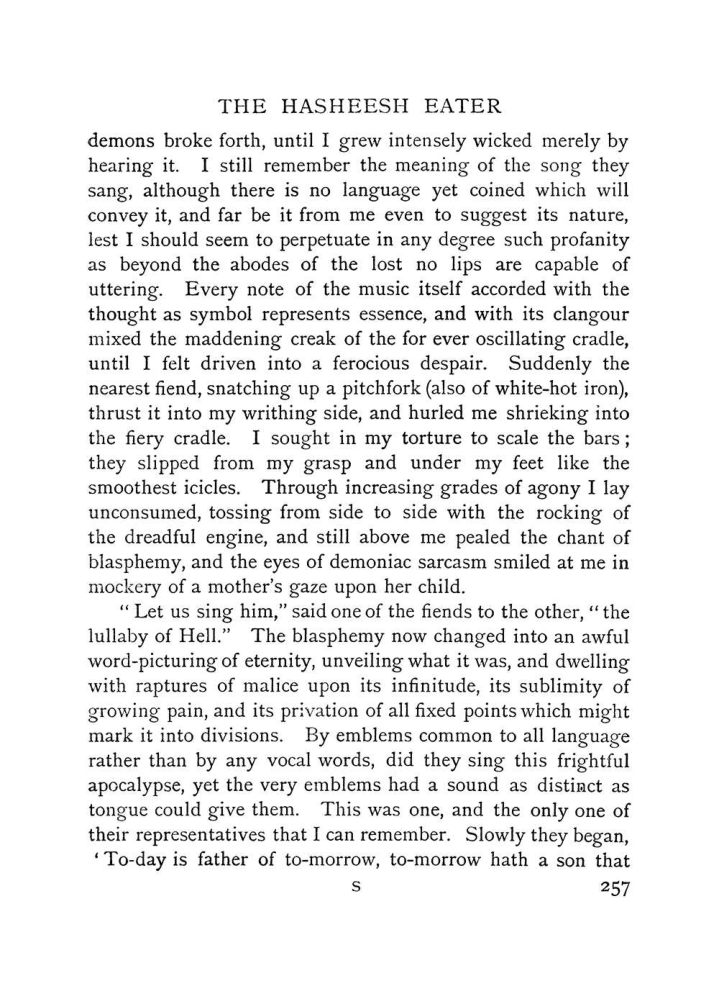
Highlights use the original PDF text layer. OCR-only matches may not be visible on the scan.
Transcription
Download text ↓raw extractionoriginal embedded textReview: unreviewed
THE HASHEESH EATER
demons broke forth, until I grew intensely wicked merely by
hearing it. I still remember the meaning of the song they
sang, although there is no language yet coined which will
convey it, and far be it from me even to suggest its nature,
lest I should seem to perpetuate in any degree such profanity
as beyond the abodes of the lost no lips are capable of
uttering. Every note of the music itself accorded with the
thought as symbol represents essence, and with its clangour
mixed the maddening creak of the for ever oscillating cradle,
until I felt driven into a ferocious despair. Suddenly the
nearest fiend, snatching up a pitchfork (also of white-hot iron),
thrust it into my writhing side, and hurled me shrieking into
the fiery cradle. I sought in my torture to scale the bars;
they slipped from my grasp and under my feet like the
smoothest icicles. Through increasing grades of agony I lay
unconsumed, tossing from side to side with the rocking of
the dreadful engine, and still above me pealed the chant of
blasphemy, and the eyes of demoniac sarcasm smiled at me in
mockery of a mother’s gaze upon her child.
“Let us sing him,” said one of the fiends to the other, “the
lullaby of Hell.” The blasphemy now changed into an awful
word-picturing of eternity, unveiling what it was, and dwelling
with raptures of malice upon its infinitude, its sublimity of
growing pain, and its privation of all fixed points which might
mark it into divisions. By emblems common to all language
rather than by any vocal words, did they sing this frightful
apocalypse, yet the very emblems had a sound as distinct as
tongue could give them. This was one, and the only one of
their representatives that I can remember. Slowly they began,
‘To-day is father of to-morrow, to-morrow hath a son that
Ss 257
Page provenance & review flags
Stable page ID: d1f23c8ca1536b365e6ad0ea:p00275
Line breaks are preserved. Reading order and OCR accuracy may need review.
Printed page label has not been verified.
- No automated review flags. This does not establish transcription accuracy.