1910 · CLOSE READING
The Equinox (Volume I, Number III)
The Equinox (Volume I, Number III) (1910), PDF p. 168
Original page
Enlarge ↗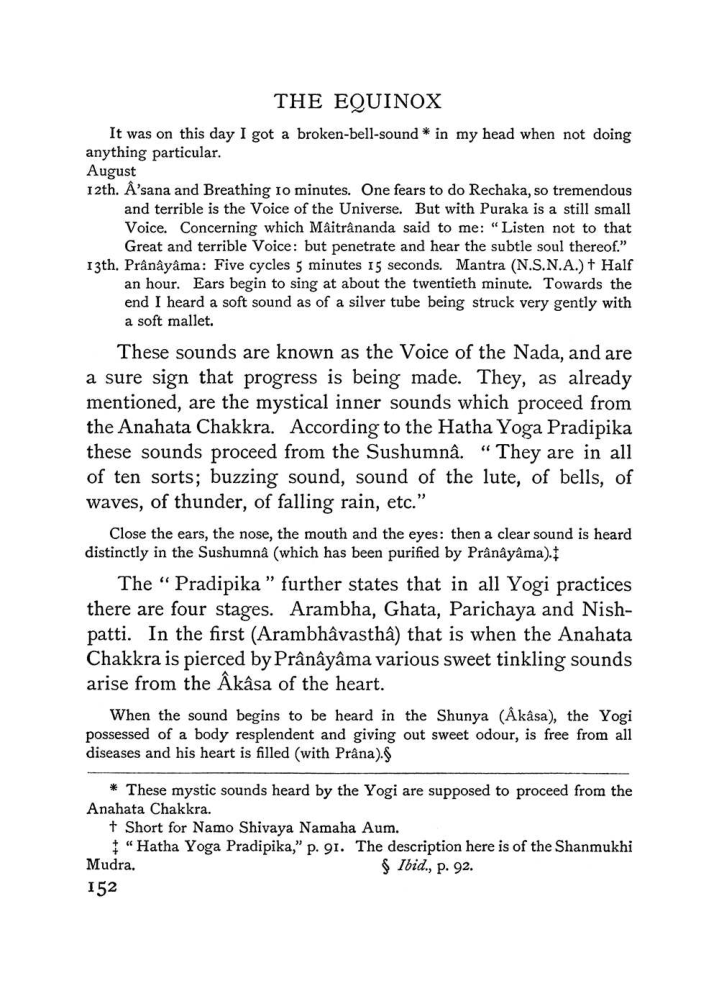
Highlights use the original PDF text layer. OCR-only matches may not be visible on the scan.
Transcription
Download text ↓raw extractionoriginal embedded textReview: unreviewed
THE EQUINOX
It was on this day I got a broken-bell-sound * in my head when not doing
anything particular.
August
12th, A’sana and Breathing 10 minutes. One fears to do Rechaka, so tremendous
and terrible is the Voice of the Universe. But with Puraka is a still small
Voice. Concerning which Maitrananda said to me: “Listen not to that
Great and terrible Voice: but penetrate and hear the subtle soul thereof.”
13th, Pranayama: Five cycles § minutes 15 seconds. Mantra (N.S.N.A.) t Half
an hour. Ears begin to sing at about the twentieth minute. Towards the
end I heard a soft sound as of a silver tube being struck very gently with
a soft mallet.
These sounds are known as the Voice of the Nada, and are
a sure sign that progress is being made. They, as already
mentioned, are the mystical inner sounds which proceed from
the Anahata Chakkra. According to the Hatha Yoga Pradipika
these sounds proceed from the Sushumna. “ They are in all
of ten sorts; buzzing sound, sound of the lute, of bells, of
waves, of thunder, of falling rain, etc.”
Close the ears, the nose, the mouth and the eyes: then a clear sound is heard
distinctly in the Sushumna (which has been purified by Pranayama).}
The “ Pradipika ” further states that in all Yogi practices
there are four stages. Arambha, Ghata, Parichaya and Nish-
patti. In the first (Arambhavastha) that is when the Anahata
Chakkra is pierced by Pranayama various sweet tinkling sounds
arise from the Akasa of the heart.
When the sound begins to be heard in the Shunya (Akasa), the Yogi
possessed of a body resplendent and giving out sweet odour, is free from all
diseases and his heart is filled (with Prana).§
* These mystic sounds heard by the Yogi are supposed to proceed from the
Anahata Chakkra.
+ Short for Namo Shivaya Namaha Aum.
¢ “Hatha Yoga Pradipika,” p. 91. The description here is of the Shanmukhi
Mudra, § Lbid., p. 92.
152
Page provenance & review flags
Stable page ID: d1f23c8ca1536b365e6ad0ea:p00168
Line breaks are preserved. Reading order and OCR accuracy may need review.
Printed page label has not been verified.
- No automated review flags. This does not establish transcription accuracy.