1910 · CLOSE READING
The Equinox (Volume I, Number III)
The Equinox (Volume I, Number III) (1910), PDF p. 155
Original page
Enlarge ↗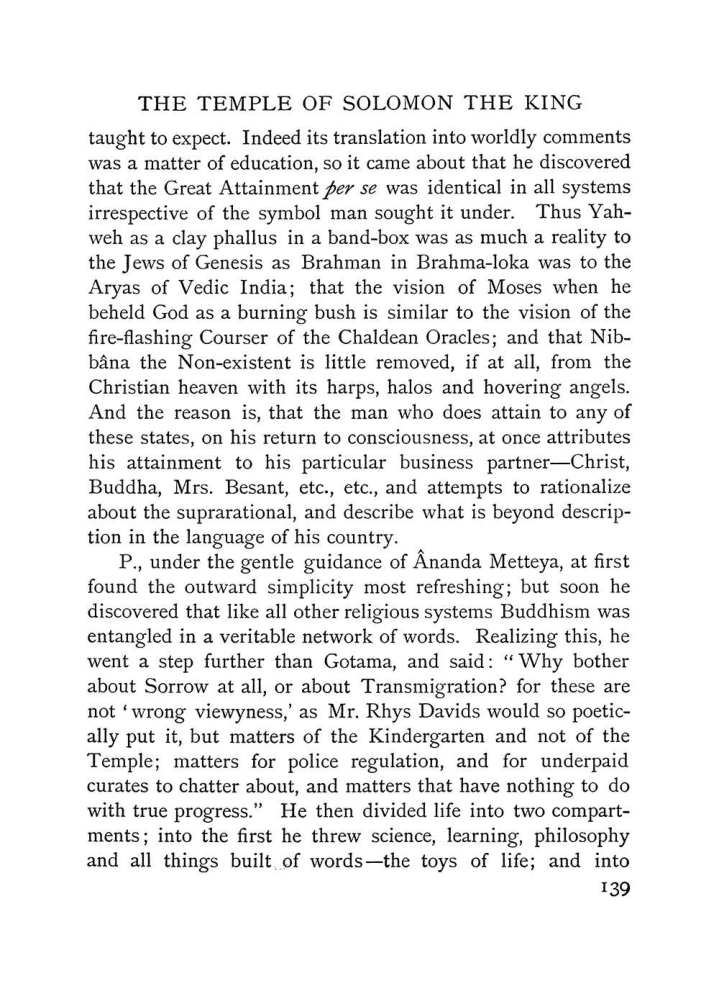
Highlights use the original PDF text layer. OCR-only matches may not be visible on the scan.
Transcription
Download text ↓raw extractionoriginal embedded textReview: unreviewed
THE TEMPLE OF SOLOMON THE KING
taught to expect. Indeed its translation into worldly comments
was a matter of education, so it came about that he discovered
that the Great Attainment fer se was identical in all systems
irrespective of the symbol man sought it under. Thus Yah-
weh as a clay phallus in a band-box was as mucha reality to
the Jews of Genesis as Brahman in Brahma-loka was to the
Aryas of Vedic India; that the vision of Moses when he
beheld God as a burning bush is similar to the vision of the
fire-flashing Courser of the Chaldean Oracles; and that Nib-
bana the Non-existent is little removed, if at all, from the
Christian heaven with its harps, halos and hovering angels.
And the reason is, that the man who does attain to any of
these states, on his return to consciousness, at once attributes
his attainment to his particular business partner—Christ,
Buddha, Mrs. Besant, etc., etc., and attempts to rationalize
about the suprarational, and describe what is beyond descrip-
tion in the language of his country.
P., under the gentle guidance of Ananda Metteya, at first
found the outward simplicity most refreshing; but soon he
discovered that like all other religious systems Buddhism was
entangled in a veritable network of words. Realizing this, he
went a step further than Gotama, and said: “ Why bother
about Sorrow at all, or about Transmigration? for these are
not ‘wrong viewyness,’ as Mr. Rhys Davids would so poetic-
ally put it, but matters of the Kindergarten and not of the
Temple; matters for police regulation, and for underpaid
curates to chatter about, and matters that have nothing to do
with true progress.” He then divided life into two compart-
ments; into the first he threw science, learning, philosophy
and all things built.of words—the toys of life; and into
139
Page provenance & review flags
Stable page ID: d1f23c8ca1536b365e6ad0ea:p00155
Line breaks are preserved. Reading order and OCR accuracy may need review.
Printed page label has not been verified.
- No automated review flags. This does not establish transcription accuracy.