1910 · CLOSE READING
The Equinox (Volume I, Number III)
The Equinox (Volume I, Number III) (1910), PDF p. 111
Original page
Enlarge ↗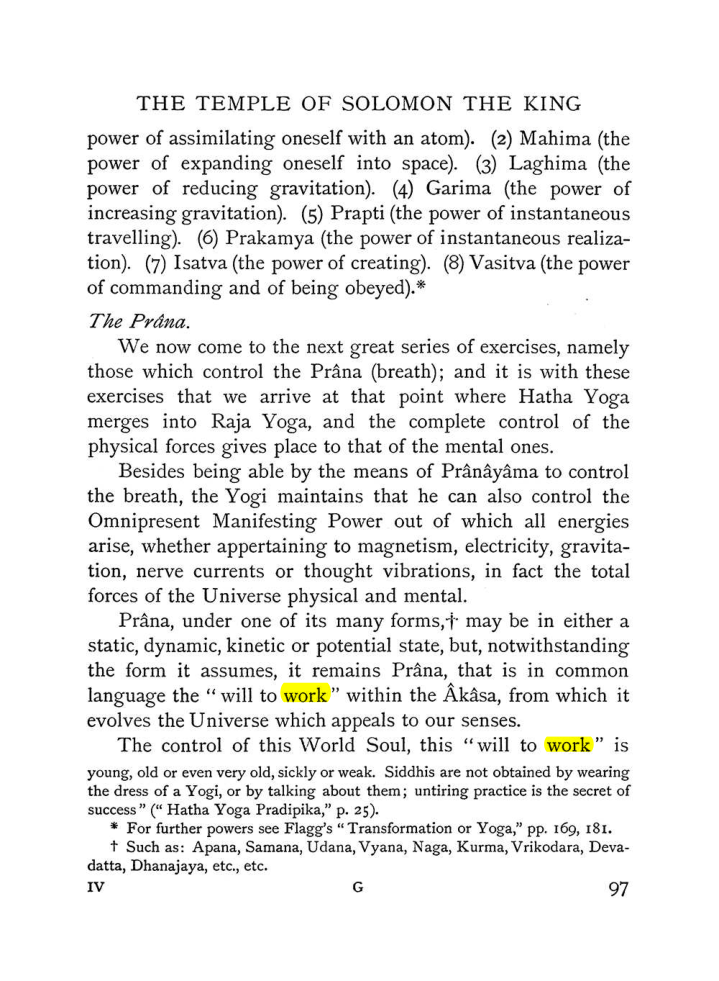
Highlights use the original PDF text layer. OCR-only matches may not be visible on the scan.
Transcription
Download text ↓raw extractionoriginal embedded textReview: unreviewed
THE TEMPLE OF SOLOMON THE KING
power of assimilating oneself with an atom). (2) Mahima (the
power of expanding oneself into space). (3) Laghima (the
power of reducing gravitation). (4) Garima (the power of
increasing gravitation). (5) Prapti (the power of instantaneous
travelling). (6) Prakamya (the power of instantaneous realiza-
tion). (7) Isatva (the power of creating). (8) Vasitva (the power
of commanding and of being obeyed).*
The Préna.
We now come to the next great series of exercises, namely
those which control the Prana (breath); and it is with these
exercises that we arrive at that point where Hatha Yoga
merges into Raja Yoga, and the complete control of the
physical forces gives place to that of the mental ones.
Besides being able by the means of Pranayama to control
the breath, the Yogi maintains that he can also control the
Omnipresent Manifesting Power out of which all energies
arise, whether appertaining to magnetism, electricity, gravita-
tion, nerve currents or thought vibrations, in fact the total
forces of the Universe physical and mental.
Prana, under one of its many forms,} may be in either a
static, dynamic, kinetic or potential state, but, notwithstanding
the form it assumes, it remains Prana, that is in common
language the “ will to work” within the Akasa, from which it
evolves the Universe which appeals to our senses.
The control of this World Soul, this “will to work” is
young, old or even very old, sickly or weak. Siddhis are not obtained by wearing
the dress of a Yogi, or by talking about them; untiring practice is the secret of
success” (“ Hatha Yoga Pradipika,” p. 25).
* For further powers see Flagg’s “ Transformation or Yoga,” pp. 169, 181.
+ Such as: Apana, Samana, Udana, Vyana, Naga, Kurma, Vrikodara, Deva-
datta, Dhanajaya, etc., etc.
IV G 97
Page provenance & review flags
Stable page ID: d1f23c8ca1536b365e6ad0ea:p00111
Line breaks are preserved. Reading order and OCR accuracy may need review.
Printed page label has not been verified.
- No automated review flags. This does not establish transcription accuracy.