1904 · CLOSE READING
The Sword of Song
The Sword of Song (1904), PDF p. 68
Original page
Enlarge ↗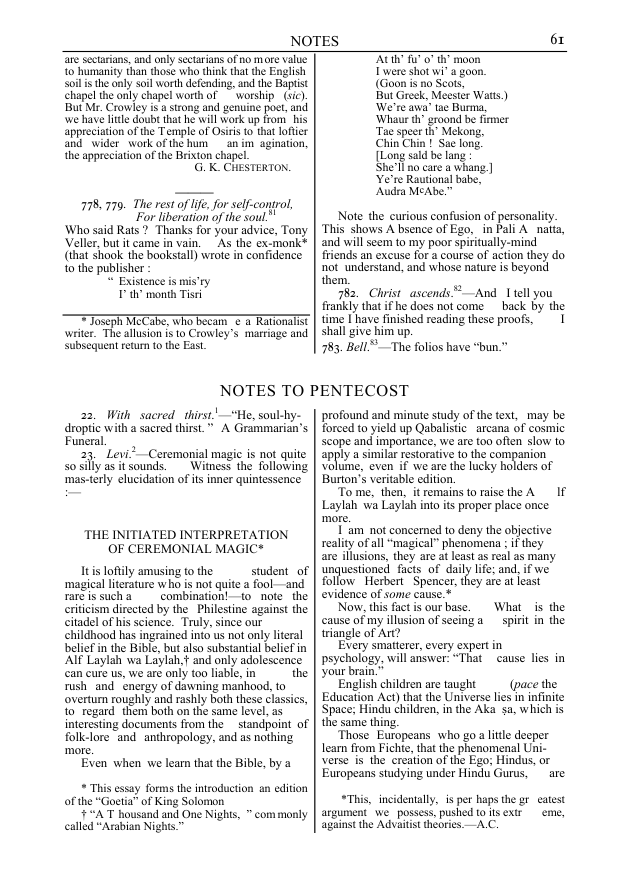
Highlights use the original PDF text layer. OCR-only matches may not be visible on the scan.
Transcription
Download text ↓raw extractionoriginal embedded textReview: unreviewed
NOTES
61
are sectarians, and only sectarians of no more value
to humanity than those who think that the English
soil is the only soil worth defending, and the Baptist
chapel the only chapel worth of
worship (sic).
But Mr. Crowley is a strong and genuine poet, and
we have little doubt that he will work up from his
appreciation of the Temple of Osiris to that loftier
and wider work of the hum
an im agination,
the appreciation of the Brixton chapel.
G. K. CHESTERTON.
778, 779. The rest of life, for self-control,
For liberation of the soul.81
Who said Rats ? Thanks for your advice, Tony
Veller, but it came in vain. As the ex-monk*
(that shook the bookstall) wrote in confidence
to the publisher :
“ Existence is mis’ry
I’ th’ month Tisri
* Joseph McCabe, who becam e a Rationalist
writer. The allusion is to Crowley’s marriage and
subsequent return to the East.
At th’ fu’ o’ th’ moon
I were shot wi’ a goon.
(Goon is no Scots,
But Greek, Meester Watts.)
We’re awa’ tae Burma,
Whaur th’ groond be firmer
Tae speer th’ Mekong,
Chin Chin ! Sae long.
[Long sald be lang :
She’ll no care a whang.]
Ye’re Rautional babe,
Audra McAbe.”
Note the curious confusion of personality.
This shows A bsence of Ego, in Pali A natta,
and will seem to my poor spiritually-mind
friends an excuse for a course of action they do
not understand, and whose nature is beyond
them.
782. Christ ascends.82—And I tell you
frankly that if he does not come
back by the
time I have finished reading these proofs,
I
shall give him up.
783. Bell.83—The folios have “bun.”
NOTES TO PENTECOST
22. With sacred thirst.1—“He, soul-hy-
droptic with a sacred thirst. ” A Grammarian’s
Funeral.
23. Levi.2—Ceremonial magic is not quite
so silly as it sounds.
Witness the following
mas-terly elucidation of its inner quintessence
:—
THE INITIATED INTERPRETATION
OF CEREMONIAL MAGIC*
It is loftily amusing to the
student of
magical literature who is not quite a fool—and
rare is such a
combination!—to note the
criticism directed by the Philestine against the
citadel of his science. Truly, since our
childhood has ingrained into us not only literal
belief in the Bible, but also substantial belief in
Alf Laylah wa Laylah,† and only adolescence
can cure us, we are only too liable, in
the
rush and energy of dawning manhood, to
overturn roughly and rashly both these classics,
to regard them both on the same level, as
interesting documents from the
standpoint of
folk-lore and anthropology, and as nothing
more.
Even when we learn that the Bible, by a
* This essay forms the introduction an edition
of the “Goetia” of King Solomon
† “A T housand and One Nights, ” com monly
called “Arabian Nights.”
profound and minute study of the text, may be
forced to yield up Qabalistic arcana of cosmic
scope and importance, we are too often slow to
apply a similar restorative to the companion
volume, even if we are the lucky holders of
Burton’s veritable edition.
To me, then, it remains to raise the A
lf
Laylah wa Laylah into its proper place once
more.
I am not concerned to deny the objective
reality of all “magical” phenomena ; if they
are illusions, they are at least as real as many
unquestioned facts of daily life; and, if we
follow Herbert Spencer, they are at least
evidence of some cause.*
Now, this fact is our base.
What is the
cause of my illusion of seeing a
spirit in the
triangle of Art?
Every smatterer, every expert in
psychology, will answer: “That
cause lies in
your brain.”
English children are taught
(pace the
Education Act) that the Universe lies in infinite
Space; Hindu children, in the Aka sa, which is
the same thing.
Those Europeans who go a little deeper
learn from Fichte, that the phenomenal Uni-
verse is the creation of the Ego; Hindus, or
Europeans studying under Hindu Gurus,
are
*This, incidentally, is per haps the gr eatest
argument we possess, pushed to its extr
eme,
against the Advaitist theories.—A.C.
Page provenance & review flags
Stable page ID: cdd842c2ae8f5d9753c40b33:p00068
Line breaks are preserved. Reading order and OCR accuracy may need review.
Printed page label has not been verified.
- No automated review flags. This does not establish transcription accuracy.