1904 · CLOSE READING
The Sword of Song
The Sword of Song (1904), PDF p. 6
Original page
Enlarge ↗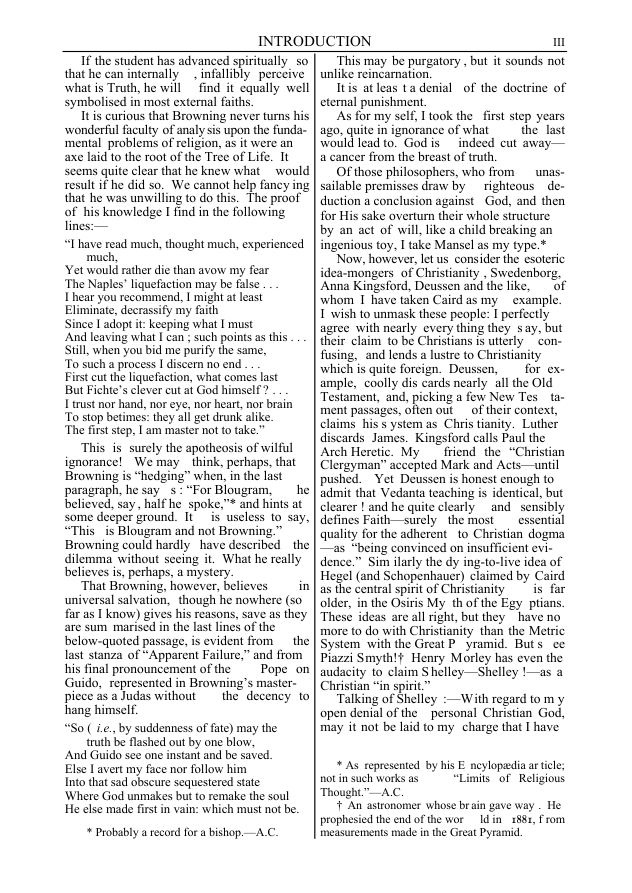
Highlights use the original PDF text layer. OCR-only matches may not be visible on the scan.
Transcription
Download text ↓raw extractionoriginal embedded textReview: unreviewed
INTRODUCTION
III
If the student has advanced spiritually so
that he can internally
, infallibly perceive
what is Truth, he will
find it equally well
symbolised in most external faiths.
It is curious that Browning never turns his
wonderful faculty of analysis upon the funda-
mental problems of religion, as it were an
axe laid to the root of the Tree of Life. It
seems quite clear that he knew what
would
result if he did so. We cannot help fancy ing
that he was unwilling to do this. The proof
of his knowledge I find in the following
lines:—
“I have read much, thought much, experienced
much,
Yet would rather die than avow my fear
The Naples’ liquefaction may be false . . .
I hear you recommend, I might at least
Eliminate, decrassify my faith
Since I adopt it: keeping what I must
And leaving what I can ; such points as this . . .
Still, when you bid me purify the same,
To such a process I discern no end . . .
First cut the liquefaction, what comes last
But Fichte’s clever cut at God himself ? . . .
I trust nor hand, nor eye, nor heart, nor brain
To stop betimes: they all get drunk alike.
The first step, I am master not to take.”
This is surely the apotheosis of wilful
ignorance! We may think, perhaps, that
Browning is “hedging” when, in the last
paragraph, he say
s : “For Blougram,
he
believed, say, half he spoke,”* and hints at
some deeper ground. It
is useless to say,
“This is Blougram and not Browning.”
Browning could hardly have described the
dilemma without seeing it. What he really
believes is, perhaps, a mystery.
That Browning, however, believes
in
universal salvation, though he nowhere (so
far as I know) gives his reasons, save as they
are sum marised in the last lines of the
below-quoted passage, is evident from
the
last stanza of “Apparent Failure,” and from
his final pronouncement of the
Pope on
Guido, represented in Browning’s master-
piece as a Judas without
the decency to
hang himself.
“So ( i.e., by suddenness of fate) may the
truth be flashed out by one blow,
And Guido see one instant and be saved.
Else I avert my face nor follow him
Into that sad obscure sequestered state
Where God unmakes but to remake the soul
He else made first in vain: which must not be.
* Probably a record for a bishop.—A.C.
This may be purgatory , but it sounds not
unlike reincarnation.
It is at leas t a denial of the doctrine of
eternal punishment.
As for my self, I took the first step years
ago, quite in ignorance of what
the last
would lead to. God is
indeed cut away—
a cancer from the breast of truth.
Of those philosophers, who from
unas-
sailable premisses draw by
righteous de-
duction a conclusion against God, and then
for His sake overturn their whole structure
by an act of will, like a child breaking an
ingenious toy, I take Mansel as my type.*
Now, however, let us consider the esoteric
idea-mongers of Christianity , Swedenborg,
Anna Kingsford, Deussen and the like,
of
whom I have taken Caird as my
example.
I wish to unmask these people: I perfectly
agree with nearly every thing they s ay, but
their claim to be Christians is utterly
con-
fusing, and lends a lustre to Christianity
which is quite foreign. Deussen,
for ex-
ample, coolly dis cards nearly all the Old
Testament, and, picking a few New Tes
ta-
ment passages, often out
of their context,
claims his s ystem as Chris tianity. Luther
discards James. Kingsford calls Paul the
Arch Heretic. My
friend the “Christian
Clergyman” accepted Mark and Acts—until
pushed. Yet Deussen is honest enough to
admit that Vedanta teaching is identical, but
clearer ! and he quite clearly
and sensibly
defines Faith—surely the most
essential
quality for the adherent to Christian dogma
—as “being convinced on insufficient evi-
dence.” Sim ilarly the dy ing-to-live idea of
Hegel (and Schopenhauer) claimed by Caird
as the central spirit of Christianity
is far
older, in the Osiris My th of the Egy ptians.
These ideas are all right, but they have no
more to do with Christianity than the Metric
System with the Great P yramid. But s ee
Piazzi Smyth!† Henry Morley has even the
audacity to claim S helley—Shelley !—as a
Christian “in spirit.”
Talking of Shelley :—With regard to m y
open denial of the personal Christian God,
may it not be laid to my charge that I have
* As represented by his E ncylopædia ar ticle;
not in such works as
“Limits of Religious
Thought.”—A.C.
† An astronomer whose br ain gave way . He
prophesied the end of the wor
ld in 1881, f rom
measurements made in the Great Pyramid.
Page provenance & review flags
Stable page ID: cdd842c2ae8f5d9753c40b33:p00006
Line breaks are preserved. Reading order and OCR accuracy may need review.
Printed page label has not been verified.
- No automated review flags. This does not establish transcription accuracy.