1904 · CLOSE READING
The Sword of Song
The Sword of Song (1904), PDF p. 58
Original page
Enlarge ↗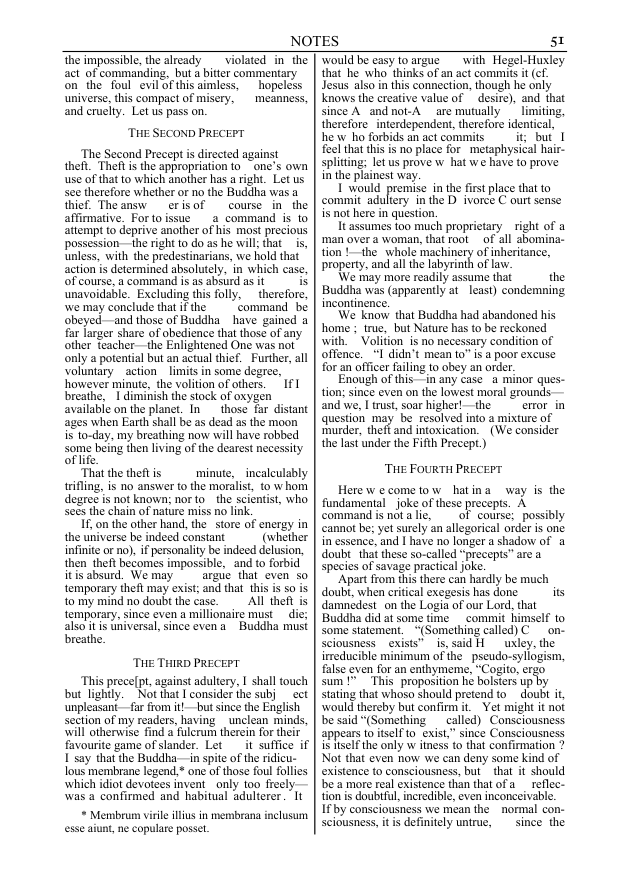
Highlights use the original PDF text layer. OCR-only matches may not be visible on the scan.
Transcription
Download text ↓raw extractionoriginal embedded textReview: unreviewed
NOTES
51
the impossible, the already
violated in the
act of commanding, but a bitter commentary
on the foul evil of this aimless,
hopeless
universe, this compact of misery,
meanness,
and cruelty. Let us pass on.
THE SECOND PRECEPT
The Second Precept is directed against
theft. Theft is the appropriation to one’s own
use of that to which another has a right. Let us
see therefore whether or no the Buddha was a
thief. The answ
er is of
course in the
affirmative. For to issue
a command is to
attempt to deprive another of his most precious
possession—the right to do as he will; that
is,
unless, with the predestinarians, we hold that
action is determined absolutely, in which case,
of course, a command is as absurd as it
is
unavoidable. Excluding this folly,
therefore,
we may conclude that if the
command be
obeyed—and those of Buddha have gained a
far larger share of obedience that those of any
other teacher—the Enlightened One was not
only a potential but an actual thief. Further, all
voluntary action limits in some degree,
however minute, the volition of others.
If I
breathe, I diminish the stock of oxygen
available on the planet. In
those far distant
ages when Earth shall be as dead as the moon
is to-day, my breathing now will have robbed
some being then living of the dearest necessity
of life.
That the theft is
minute, incalculably
trifling, is no answer to the moralist, to w hom
degree is not known; nor to the scientist, who
sees the chain of nature miss no link.
If, on the other hand, the store of energy in
the universe be indeed constant
(whether
infinite or no), if personality be indeed delusion,
then theft becomes impossible, and to forbid
it is absurd. We may
argue that even so
temporary theft may exist; and that this is so is
to my mind no doubt the case.
All theft is
temporary, since even a millionaire must
die;
also it is universal, since even a Buddha must
breathe.
THE THIRD PRECEPT
This prece[pt, against adultery, I shall touch
but lightly. Not that I consider the subj
ect
unpleasant—far from it!—but since the English
section of my readers, having unclean minds,
will otherwise find a fulcrum therein for their
favourite game of slander. Let
it suffice if
I say that the Buddha—in spite of the ridicu-
lous membrane legend,* one of those foul follies
which idiot devotees invent only too freely—
was a confirmed and habitual adulterer . It
* Membrum virile illius in membrana inclusum
esse aiunt, ne copulare posset.
would be easy to argue
with Hegel-Huxley
that he who thinks of an act commits it (cf.
Jesus also in this connection, though he only
knows the creative value of
desire), and that
since A and not-A
are mutually
limiting,
therefore interdependent, therefore identical,
he w ho forbids an act commits
it; but I
feel that this is no place for metaphysical hair-
splitting; let us prove w hat w e have to prove
in the plainest way.
I would premise in the first place that to
commit adultery in the D ivorce C ourt sense
is not here in question.
It assumes too much proprietary right of a
man over a woman, that root
of all abomina-
tion !—the whole machinery of inheritance,
property, and all the labyrinth of law.
We may more readily assume that
the
Buddha was (apparently at least) condemning
incontinence.
We know that Buddha had abandoned his
home ; true, but Nature has to be reckoned
with. Volition is no necessary condition of
offence. “I didn’t mean to” is a poor excuse
for an officer failing to obey an order.
Enough of this—in any case a minor ques-
tion; since even on the lowest moral grounds—
and we, I trust, soar higher!—the
error in
question may be resolved into a mixture of
murder, theft and intoxication. (We consider
the last under the Fifth Precept.)
THE FOURTH PRECEPT
Here w e come to w
hat in a
way is the
fundamental joke of these precepts. A
command is not a lie,
of course; possibly
cannot be; yet surely an allegorical order is one
in essence, and I have no longer a shadow of a
doubt that these so-called “precepts” are a
species of savage practical joke.
Apart from this there can hardly be much
doubt, when critical exegesis has done
its
damnedest on the Logia of our Lord, that
Buddha did at some time
commit himself to
some statement. “(Something called) C
on-
sciousness exists” is, said H
uxley, the
irreducible minimum of the pseudo-syllogism,
false even for an enthymeme, “Cogito, ergo
sum !” This proposition he bolsters up by
stating that whoso should pretend to
doubt it,
would thereby but confirm it. Yet might it not
be said “(Something
called) Consciousness
appears to itself to exist,” since Consciousness
is itself the only w itness to that confirmation ?
Not that even now we can deny some kind of
existence to consciousness, but that it should
be a more real existence than that of a
reflec-
tion is doubtful, incredible, even inconceivable.
If by consciousness we mean the normal con-
sciousness, it is definitely untrue,
since the
Page provenance & review flags
Stable page ID: cdd842c2ae8f5d9753c40b33:p00058
Line breaks are preserved. Reading order and OCR accuracy may need review.
Printed page label has not been verified.
- No automated review flags. This does not establish transcription accuracy.