1904 · CLOSE READING
The Sword of Song
The Sword of Song (1904), PDF p. 51
Original page
Enlarge ↗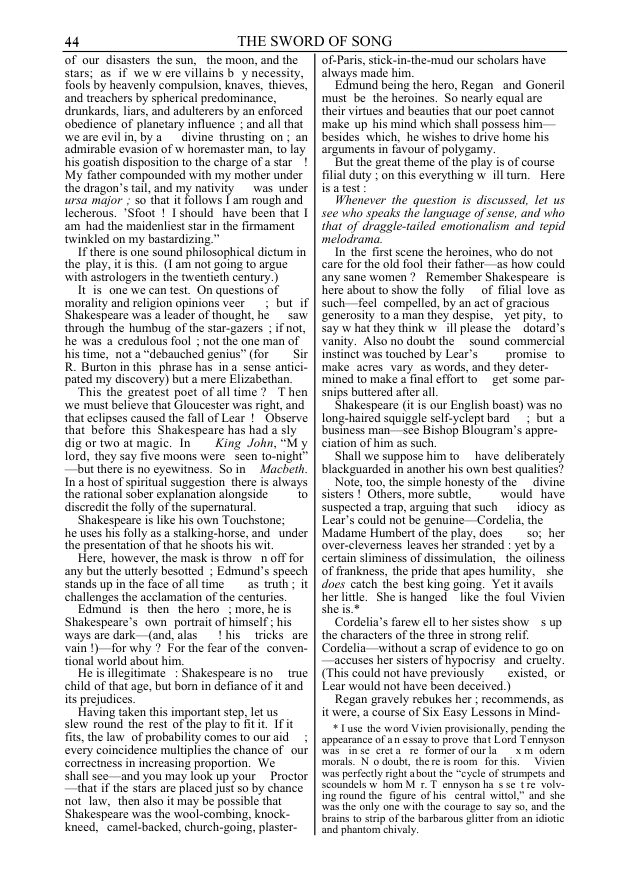
Highlights use the original PDF text layer. OCR-only matches may not be visible on the scan.
Transcription
Download text ↓raw extractionoriginal embedded textReview: unreviewed
THE SWORD OF SONG
44
of our disasters the sun, the moon, and the
stars; as if we w ere villains b y necessity,
fools by heavenly compulsion, knaves, thieves,
and treachers by spherical predominance,
drunkards, liars, and adulterers by an enforced
obedience of planetary influence ; and all that
we are evil in, by a
divine thrusting on ; an
admirable evasion of w horemaster man, to lay
his goatish disposition to the charge of a star !
My father compounded with my mother under
the dragon’s tail, and my nativity
was under
ursa major ; so that it follows I am rough and
lecherous. ’Sfoot ! I should have been that I
am had the maidenliest star in the firmament
twinkled on my bastardizing.”
If there is one sound philosophical dictum in
the play, it is this. (I am not going to argue
with astrologers in the twentieth century.)
It is one we can test. On questions of
morality and religion opinions veer
; but if
Shakespeare was a leader of thought, he
saw
through the humbug of the star-gazers ; if not,
he was a credulous fool ; not the one man of
his time, not a “debauched genius” (for
Sir
R. Burton in this phrase has in a sense antici-
pated my discovery) but a mere Elizabethan.
This the greatest poet of all time ? T hen
we must believe that Gloucester was right, and
that eclipses caused the fall of Lear ! Observe
that before this Shakespeare has had a sly
dig or two at magic. In
King John, “M y
lord, they say five moons were seen to-night”
—but there is no eyewitness. So in
Macbeth.
In a host of spiritual suggestion there is always
the rational sober explanation alongside
to
discredit the folly of the supernatural.
Shakespeare is like his own Touchstone;
he uses his folly as a stalking-horse, and under
the presentation of that he shoots his wit.
Here, however, the mask is throw n off for
any but the utterly besotted ; Edmund’s speech
stands up in the face of all time
as truth ; it
challenges the acclamation of the centuries.
Edmund is then the hero ; more, he is
Shakespeare’s own portrait of himself ; his
ways are dark—(and, alas
! his
tricks are
vain !)—for why ? For the fear of the conven-
tional world about him.
He is illegitimate : Shakespeare is no
true
child of that age, but born in defiance of it and
its prejudices.
Having taken this important step, let us
slew round the rest of the play to fit it. If it
fits, the law of probability comes to our aid
;
every coincidence multiplies the chance of our
correctness in increasing proportion. We
shall see—and you may look up your
Proctor
—that if the stars are placed just so by chance
not law, then also it may be possible that
Shakespeare was the wool-combing, knock-
kneed, camel-backed, church-going, plaster-
of-Paris, stick-in-the-mud our scholars have
always made him.
Edmund being the hero, Regan and Goneril
must be the heroines. So nearly equal are
their virtues and beauties that our poet cannot
make up his mind which shall possess him—
besides which, he wishes to drive home his
arguments in favour of polygamy.
But the great theme of the play is of course
filial duty ; on this everything w ill turn. Here
is a test :
Whenever the question is discussed, let us
see who speaks the language of sense, and who
that of draggle-tailed emotionalism and tepid
melodrama.
In the first scene the heroines, who do not
care for the old fool their father—as how could
any sane women ? Remember Shakespeare is
here about to show the folly
of filial love as
such—feel compelled, by an act of gracious
generosity to a man they despise, yet pity, to
say w hat they think w ill please the dotard’s
vanity. Also no doubt the
sound commercial
instinct was touched by Lear’s
promise to
make acres vary as words, and they deter-
mined to make a final effort to
get some par-
snips buttered after all.
Shakespeare (it is our English boast) was no
long-haired squiggle self-yclept bard
; but a
business man—see Bishop Blougram’s appre-
ciation of him as such.
Shall we suppose him to
have deliberately
blackguarded in another his own best qualities?
Note, too, the simple honesty of the
divine
sisters ! Others, more subtle,
would have
suspected a trap, arguing that such
idiocy as
Lear’s could not be genuine—Cordelia, the
Madame Humbert of the play, does
so; her
over-cleverness leaves her stranded : yet by a
certain sliminess of dissimulation, the oiliness
of frankness, the pride that apes humility, she
does catch the best king going. Yet it avails
her little. She is hanged like the foul Vivien
she is.*
Cordelia’s farew ell to her sistes show
s up
the characters of the three in strong relif.
Cordelia—without a scrap of evidence to go on
—accuses her sisters of hypocrisy and cruelty.
(This could not have previously
existed, or
Lear would not have been deceived.)
Regan gravely rebukes her ; recommends, as
it were, a course of Six Easy Lessons in Mind-
* I use the word Vivien provisionally, pending the
appearance of a n essay to prove that Lord Tennyson
was in se cret a re former of our la
x m odern
morals. N o doubt, the re is room for this. Vivien
was perfectly right about the “cycle of strumpets and
scoundels w hom M r. T ennyson ha s se t re volv-
ing round the figure of his central wittol,” and she
was the only one with the courage to say so, and the
brains to strip of the barbarous glitter from an idiotic
and phantom chivaly.
Page provenance & review flags
Stable page ID: cdd842c2ae8f5d9753c40b33:p00051
Line breaks are preserved. Reading order and OCR accuracy may need review.
Printed page label has not been verified.
- No automated review flags. This does not establish transcription accuracy.