1904 · CLOSE READING
The Sword of Song
The Sword of Song (1904), PDF p. 50
Original page
Enlarge ↗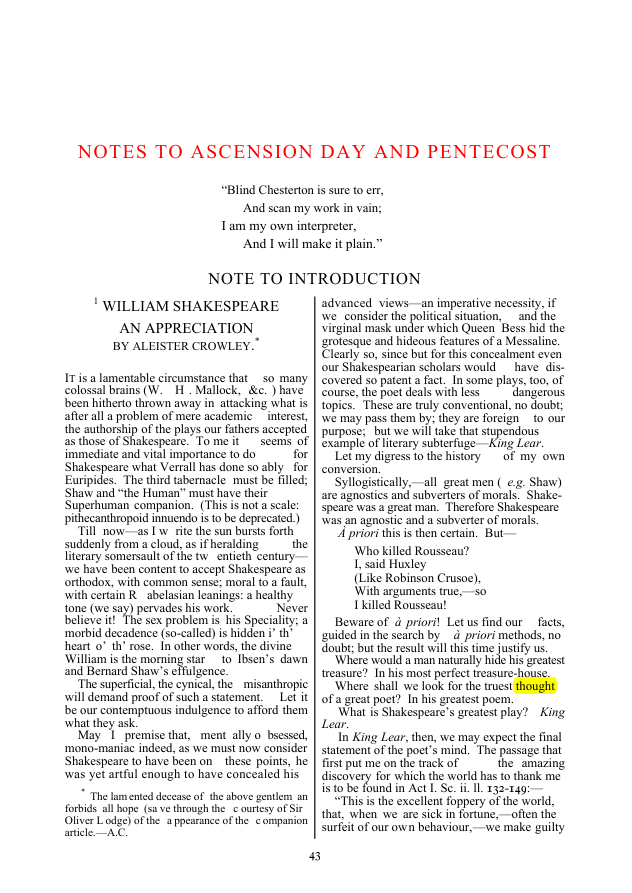
Highlights use the original PDF text layer. OCR-only matches may not be visible on the scan.
Transcription
Download text ↓raw extractionoriginal embedded textReview: unreviewed
43
NOTES TO ASCENSION DAY AND PENTECOST
“Blind Chesterton is sure to err,
And scan my work in vain;
I am my own interpreter,
And I will make it plain.”
NOTE TO INTRODUCTION
1 WILLIAM SHAKESPEARE
AN APPRECIATION
BY ALEISTER CROWLEY.*
IT is a lamentable circumstance that
so many
colossal brains (W. H . Mallock, &c. ) have
been hitherto thrown away in attacking what is
after all a problem of mere academic
interest,
the authorship of the plays our fathers accepted
as those of Shakespeare. To me it
seems of
immediate and vital importance to do
for
Shakespeare what Verrall has done so ably for
Euripides. The third tabernacle must be filled;
Shaw and “the Human” must have their
Superhuman companion. (This is not a scale:
pithecanthropoid innuendo is to be deprecated.)
Till now—as I w rite the sun bursts forth
suddenly from a cloud, as if heralding
the
literary somersault of the tw entieth century—
we have been content to accept Shakespeare as
orthodox, with common sense; moral to a fault,
with certain R abelasian leanings: a healthy
tone (we say) pervades his work.
Never
believe it! The sex problem is his Speciality; a
morbid decadence (so-called) is hidden i’ th’
heart o’ th’ rose. In other words, the divine
William is the morning star
to Ibsen’s dawn
and Bernard Shaw’s effulgence.
The superficial, the cynical, the misanthropic
will demand proof of such a statement. Let it
be our contemptuous indulgence to afford them
what they ask.
May I premise that, ment ally o bsessed,
mono-maniac indeed, as we must now consider
Shakespeare to have been on these points, he
was yet artful enough to have concealed his
* The lamented decease of the above gentlem an
forbids all hope (sa ve through the c ourtesy of Sir
Oliver L odge) of the a ppearance of the c ompanion
article.—A.C.
advanced views—an imperative necessity, if
we consider the political situation,
and the
virginal mask under which Queen Bess hid the
grotesque and hideous features of a Messaline.
Clearly so, since but for this concealment even
our Shakespearian scholars would
have dis-
covered so patent a fact. In some plays, too, of
course, the poet deals with less
dangerous
topics. These are truly conventional, no doubt;
we may pass them by; they are foreign
to our
purpose; but we will take that stupendous
example of literary subterfuge—King Lear.
Let my digress to the history
of my own
conversion.
Syllogistically,—all great men ( e.g. Shaw)
are agnostics and subverters of morals. Shake-
speare was a great man. Therefore Shakespeare
was an agnostic and a subverter of morals.
À priori this is then certain. But—
Who killed Rousseau?
I, said Huxley
(Like Robinson Crusoe),
With arguments true,—so
I killed Rousseau!
Beware of à priori! Let us find our
facts,
guided in the search by
à priori methods, no
doubt; but the result will this time justify us.
Where would a man naturally hide his greatest
treasure? In his most perfect treasure-house.
Where shall we look for the truest thought
of a great poet? In his greatest poem.
What is Shakespeare’s greatest play? King
Lear.
In King Lear, then, we may expect the final
statement of the poet’s mind. The passage that
first put me on the track of
the amazing
discovery for which the world has to thank me
is to be found in Act I. Sc. ii. ll. 132-149:—
“This is the excellent foppery of the world,
that, when we are sick in fortune,—often the
surfeit of our own behaviour,—we make guilty
Page provenance & review flags
Stable page ID: cdd842c2ae8f5d9753c40b33:p00050
Line breaks are preserved. Reading order and OCR accuracy may need review.
Printed page label has not been verified.
- legacy text differs review