1904 · CLOSE READING
The Sword of Song
The Sword of Song (1904), PDF p. 116
Original page
Enlarge ↗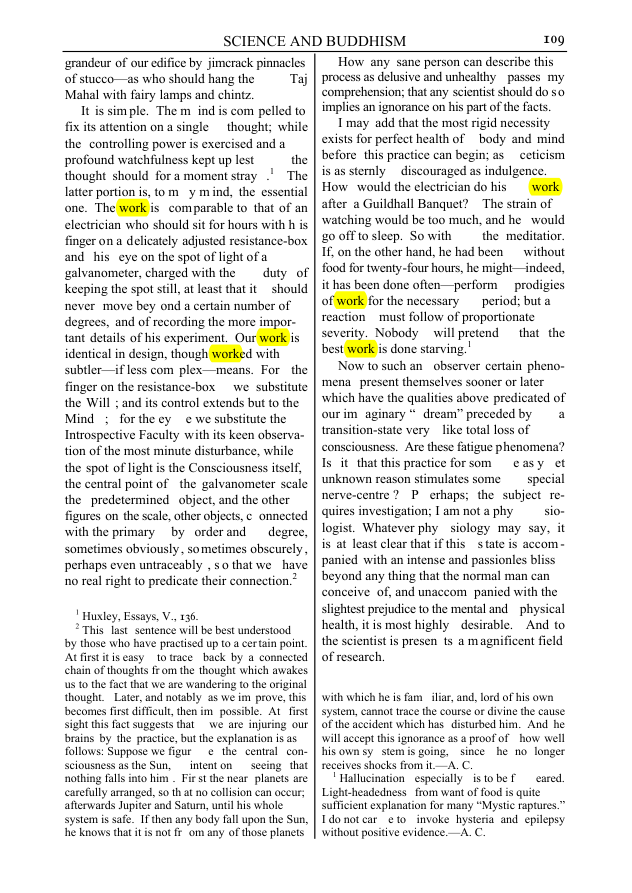
Highlights use the original PDF text layer. OCR-only matches may not be visible on the scan.
Transcription
Download text ↓raw extractionoriginal embedded textReview: unreviewed
SCIENCE AND BUDDHISM
109
grandeur of our edifice by jimcrack pinnacles
of stucco—as who should hang the
Taj
Mahal with fairy lamps and chintz.
It is sim ple. The m ind is com pelled to
fix its attention on a single
thought; while
the controlling power is exercised and a
profound watchfulness kept up lest
the
thought should for a moment stray .1 The
latter portion is, to m y m ind, the essential
one. The work is comparable to that of an
electrician who should sit for hours with h is
finger on a delicately adjusted resistance-box
and his eye on the spot of light of a
galvanometer, charged with the
duty of
keeping the spot still, at least that it
should
never move bey ond a certain number of
degrees, and of recording the more impor-
tant details of his experiment. Our work is
identical in design, though worked with
subtler—if less com plex—means. For the
finger on the resistance-box
we substitute
the Will ; and its control extends but to the
Mind ; for the ey
e we substitute the
Introspective Faculty with its keen observa-
tion of the most minute disturbance, while
the spot of light is the Consciousness itself,
the central point of the galvanometer scale
the predetermined object, and the other
figures on the scale, other objects, c onnected
with the primary
by order and
degree,
sometimes obviously, sometimes obscurely,
perhaps even untraceably , s o that we have
no real right to predicate their connection.2
1 Huxley, Essays, V., 136.
2 This last sentence will be best understood
by those who have practised up to a cer tain point.
At first it is easy
to trace back by a connected
chain of thoughts fr om the thought which awakes
us to the fact that we are wandering to the original
thought. Later, and notably as we im prove, this
becomes first difficult, then im possible. At first
sight this fact suggests that
we are injuring our
brains by the practice, but the explanation is as
follows: Suppose we figur
e the central con-
sciousness as the Sun,
intent on
seeing that
nothing falls into him . Fir st the near planets are
carefully arranged, so th at no collision can occur;
afterwards Jupiter and Saturn, until his whole
system is safe. If then any body fall upon the Sun,
he knows that it is not fr om any of those planets
How any sane person can describe this
process as delusive and unhealthy passes my
comprehension; that any scientist should do so
implies an ignorance on his part of the facts.
I may add that the most rigid necessity
exists for perfect health of
body and mind
before this practice can begin; as
ceticism
is as sternly
discouraged as indulgence.
How would the electrician do his
work
after a Guildhall Banquet? The strain of
watching would be too much, and he would
go off to sleep. So with
the meditatior.
If, on the other hand, he had been
without
food for twenty-four hours, he might—indeed,
it has been done often—perform
prodigies
of work for the necessary
period; but a
reaction must follow of proportionate
severity. Nobody
will pretend
that the
best work is done starving.1
Now to such an observer certain pheno-
mena present themselves sooner or later
which have the qualities above predicated of
our im aginary “ dream” preceded by
a
transition-state very like total loss of
consciousness. Are these fatigue phenomena?
Is it that this practice for som
e as y
et
unknown reason stimulates some
special
nerve-centre ? P
erhaps; the subject re-
quires investigation; I am not a phy
sio-
logist. Whatever phy
siology may say, it
is at least clear that if this s tate is accom -
panied with an intense and passionles bliss
beyond any thing that the normal man can
conceive of, and unaccom panied with the
slightest prejudice to the mental and physical
health, it is most highly desirable. And to
the scientist is presen ts a m agnificent field
of research.
with which he is fam iliar, and, lord of his own
system, cannot trace the course or divine the cause
of the accident which has disturbed him. And he
will accept this ignorance as a proof of how well
his own sy stem is going, since he no longer
receives shocks from it.—A. C.
1 Hallucination especially is to be f
eared.
Light-headedness from want of food is quite
sufficient explanation for many “Mystic raptures.”
I do not car
e to invoke hysteria and epilepsy
without positive evidence.—A. C.
Page provenance & review flags
Stable page ID: cdd842c2ae8f5d9753c40b33:p00116
Line breaks are preserved. Reading order and OCR accuracy may need review.
Printed page label has not been verified.
- No automated review flags. This does not establish transcription accuracy.