1904 · CLOSE READING
The Sword of Song
The Sword of Song (1904), PDF p. 107
Original page
Enlarge ↗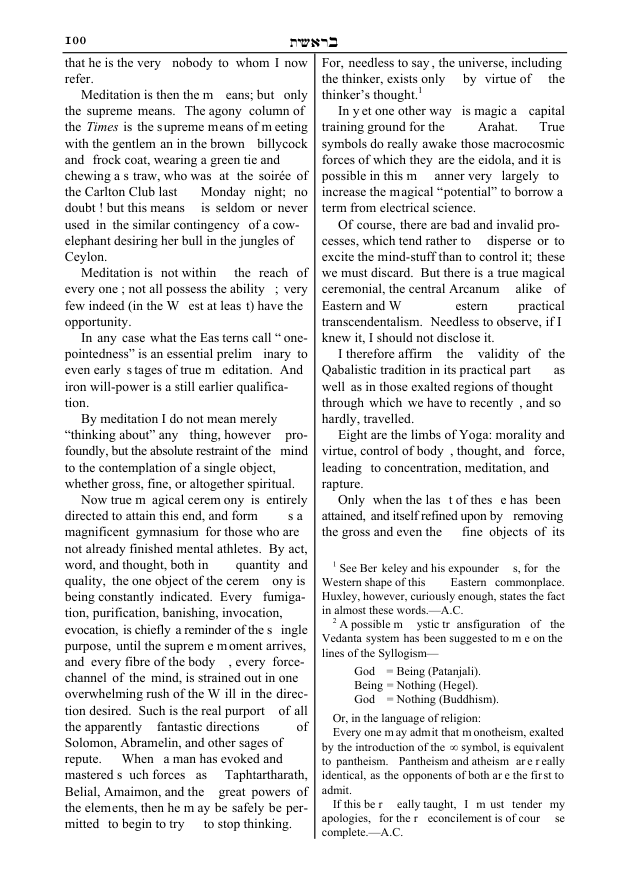
Highlights use the original PDF text layer. OCR-only matches may not be visible on the scan.
Transcription
Download text ↓raw extractionoriginal embedded textReview: unreviewed
tycarb
100
that he is the very nobody to whom I now
refer.
Meditation is then the m
eans; but only
the supreme means. The agony column of
the Times is the supreme means of m eeting
with the gentlem an in the brown billycock
and frock coat, wearing a green tie and
chewing a s traw, who was at the soirée of
the Carlton Club last
Monday night; no
doubt ! but this means
is seldom or never
used in the similar contingency of a cow-
elephant desiring her bull in the jungles of
Ceylon.
Meditation is not within
the reach of
every one ; not all possess the ability ; very
few indeed (in the W est at leas t) have the
opportunity.
In any case what the Eas terns call “ one-
pointedness” is an essential prelim
inary to
even early s tages of true m editation. And
iron will-power is a still earlier qualifica-
tion.
By meditation I do not mean merely
“thinking about” any
thing, however
pro-
foundly, but the absolute restraint of the mind
to the contemplation of a single object,
whether gross, fine, or altogether spiritual.
Now true m agical cerem ony is entirely
directed to attain this end, and form
s a
magnificent gymnasium for those who are
not already finished mental athletes. By act,
word, and thought, both in
quantity and
quality, the one object of the cerem
ony is
being constantly indicated. Every fumiga-
tion, purification, banishing, invocation,
evocation, is chiefly a reminder of the s ingle
purpose, until the suprem e moment arrives,
and every fibre of the body
, every force-
channel of the mind, is strained out in one
overwhelming rush of the W ill in the direc-
tion desired. Such is the real purport of all
the apparently
fantastic directions
of
Solomon, Abramelin, and other sages of
repute. When a man has evoked and
mastered s uch forces as Taphtartharath,
Belial, Amaimon, and the
great powers of
the elements, then he m ay be safely be per-
mitted to begin to try
to stop thinking.
For, needless to say , the universe, including
the thinker, exists only
by virtue of
the
thinker’s thought.1
In y et one other way is magic a capital
training ground for the
Arahat. True
symbols do really awake those macrocosmic
forces of which they are the eidola, and it is
possible in this m
anner very largely to
increase the magical “potential” to borrow a
term from electrical science.
Of course, there are bad and invalid pro-
cesses, which tend rather to
disperse or to
excite the mind-stuff than to control it; these
we must discard. But there is a true magical
ceremonial, the central Arcanum
alike of
Eastern and W
estern
practical
transcendentalism. Needless to observe, if I
knew it, I should not disclose it.
I therefore affirm
the
validity of the
Qabalistic tradition in its practical part
as
well as in those exalted regions of thought
through which we have to recently , and so
hardly, travelled.
Eight are the limbs of Yoga: morality and
virtue, control of body , thought, and force,
leading to concentration, meditation, and
rapture.
Only when the las t of thes e has been
attained, and itself refined upon by removing
the gross and even the
fine objects of its
1 See Ber keley and his expounder
s, for the
Western shape of this
Eastern commonplace.
Huxley, however, curiously enough, states the fact
in almost these words.—A.C.
2 A possible m
ystic tr ansfiguration of the
Vedanta system has been suggested to m e on the
lines of the Syllogism—
God = Being (Patanjali).
Being = Nothing (Hegel).
God = Nothing (Buddhism).
Or, in the language of religion:
Every one m ay admit that m onotheism, exalted
by the introduction of the ∞ symbol, is equivalent
to pantheism. Pantheism and atheism ar e r eally
identical, as the opponents of both ar e the first to
admit.
If this be r
eally taught, I m ust tender my
apologies, for the r
econcilement is of cour
se
complete.—A.C.
Page provenance & review flags
Stable page ID: cdd842c2ae8f5d9753c40b33:p00107
Line breaks are preserved. Reading order and OCR accuracy may need review.
Printed page label has not been verified.
- No automated review flags. This does not establish transcription accuracy.