1907 · CLOSE READING
The Star in the West
The Star in the West (1907), PDF p. 234
Original page
Enlarge ↗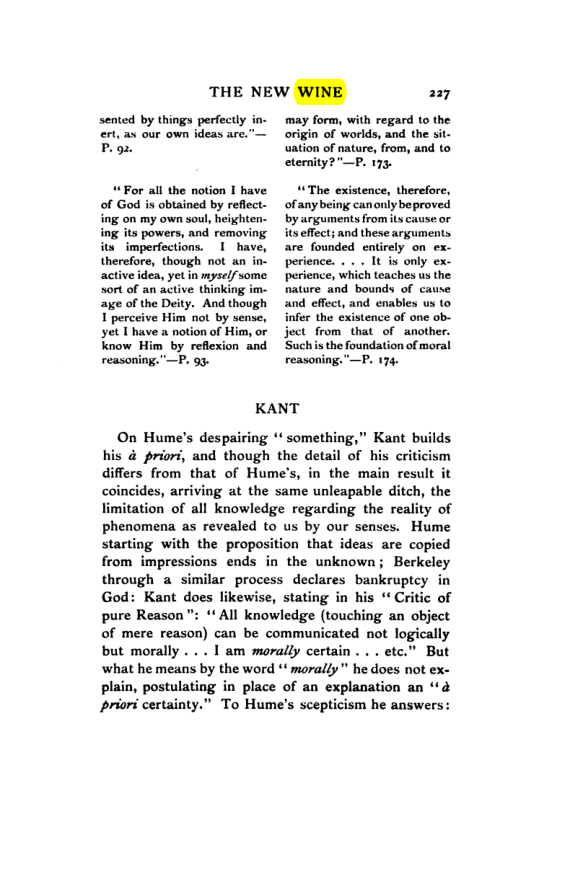
Highlights use the original PDF text layer. OCR-only matches may not be visible on the scan.
Transcription
Download text ↓raw extractionoriginal embedded textReview: unreviewed
THE NEW WINE
227
sented
by things perfectly
in
ert , as our own ideas are."
P. 92
may
form , with regard
to the
origin
of worlds , and the
sit
.
uation
of
nature
,
from
,
and
to
eternity
?”
—
P
.
173
.
66
ex
“
For
all the
notion
I
have
of
God
is
obtained
by
reflect
ing
on
my own soul
,
heighten
ing
its
powers
,
and
removing
its
imperfections
.
I
have
,
therefore
,
though
not
an
in
active idea
,
yet
in
myself some
sort
of
an
active thinking im
age
of
the Deity
.
And though
I
perceive Him
not
by
sense
,
yet
I
have
a
notion
of
Him
,
or
know
Him
by
reflexion
and
reasoning
.”
—
P.
93
.
"
The existence
,
therefore
,
of
any being can only
be
proved
by
arguments from
its
cause
or
its effect
;
and these arguments
are
founded entirely
on
perience
.
.
.
It
is
only
ex
perience
,
which teaches
us
the
nature and
bounds
of
cause
and effect
,
and enables
us
to
infer the existence
of
one ob
ject
from
that
of
another
.
Such
is
the foundation of moral
reasoning
.”
—
P.
174
.
KANT
On
Hume's
despairing
"
something
,"
Kant builds
his
à
priori
,
and
though
the
detail
of
his criticism
differs
from
that
of
Hume's
,
in
the
main
result
it
coincides
,
arriving
at
the
same
unleapable ditch
,
the
limitation
of
all
knowledge
regarding
the
reality
of
phenomena
as
revealed
to
us
by
our
senses
.
Hume
starting
with
the
proposition
that
ideas
are
copied
from
impressions
ends
in
the
unknown
;
Berkeley
through
a
similar
process
declares
bankruptcy
in
God
:
Kant does
likewise
,
stating
in
his
“
Critic
of
pure Reason
"
:
“
All knowledge
(
touching
an
object
of
mere
reason
)
can
be
communicated
not logically
but morally ...
I
am
morally
certain ... etc.
”
But
what
he
means
by
the word
“
morally
”
he
does not ex
plain
,
postulating
in
place
of
an
explanation
an
“
à
priori certainty
."
To Hume's
scepticism
he
answers
:
Page provenance & review flags
Stable page ID: cbb8a01aa468b5fc3df19238:p00234
Line breaks are preserved. Reading order and OCR accuracy may need review.
Printed page label has not been verified.
- No automated review flags. This does not establish transcription accuracy.