1913 · CLOSE READING
Book 4 (Part II)
Book 4 (Part II) (1913), PDF p. 98
Original page
Enlarge ↗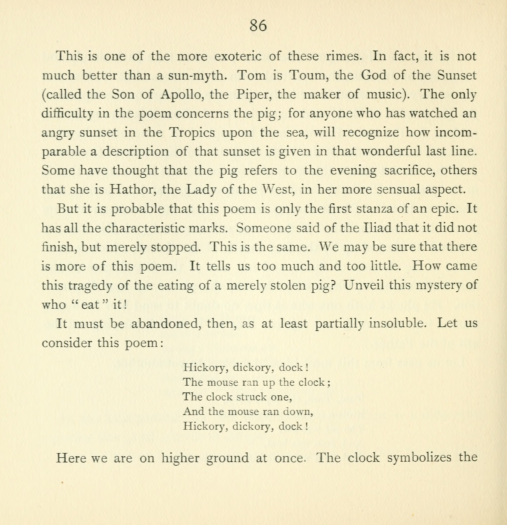
Highlights use the original PDF text layer. OCR-only matches may not be visible on the scan.
Transcription
Download text ↓raw extractionoriginal embedded textReview: unreviewed
86
This is one of the
more
exoteric
of these
rimes.
In
fact, it
is
not
much
better
than
a sun-myth.
Tom
is Toum, the God of the Sunset
(called
the Son
of Apollo, the Piper, the
maker
of music).
The
only
difficulty
in the poem concerns
the pig; for anyone who has watched
an
angry sunset
in
the Tropics
upon
the
sea, will
recognize
how incom-
parable
a description
of that sunset is given in that wonderful
last line.
Some have thought
that
the pig
refers
to
the
evening
sacrifice,
others
that she is Hathor, the Lady of the West,
in her more sensual aspect.
But it is probable
that this poem is only the first stanza of an epic. It
has all the characteristic
marks.
Someone
said of the Iliad that it did not
finish, but merely stopped.
This is the same.
We may be sure that there
is more of this
poem.
It tells
us
too much
and too little.
How came
this tragedy of the eating of a merely stolen
pig?
Unveil this mystery of
who " eat " it !
It must
be
abandoned,
then,
as
at
least
partially
insoluble.
Let
us
consider
this poem:
Hickor}',
dickory,
dock !
The mouse ran up the clock ;
The clock struck one,
And the mouse ran down,
Hickory, dickorj',
dock !
Here we are
on
higher
ground
at
once.
The clock
symbolizes
the
Page provenance & review flags
Stable page ID: c96b4a13199c68ca1345dc34:p00098
Line breaks are preserved. Reading order and OCR accuracy may need review.
Printed page label has not been verified.
- No automated review flags. This does not establish transcription accuracy.