1913 · CLOSE READING
Book 4 (Part II)
Book 4 (Part II) (1913), PDF p. 81
Original page
Enlarge ↗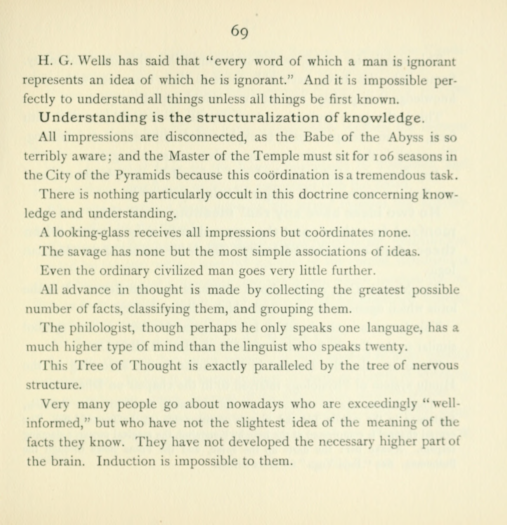
Highlights use the original PDF text layer. OCR-only matches may not be visible on the scan.
Transcription
Download text ↓raw extractionoriginal embedded textReview: unreviewed
69
H. G. Wells
has
said
that "every word of which
a
man is ignorant
represents
an idea of which
he is ignorant."
And it is
impossible
per-
fectly to understand
all things
unless all things
be first known.
Understanding
is the structuralization
of knowledge.
All
impressions
are disconnected,
as
the
Babe
of the
Abyss
is so
terribly
aware;
and the Master of the Temple must sit for 106 seasons in
the City of the Pyramids
because this coordination
is a tremendous
task.
There is nothing
[)articularly
occult
in this doctrine
concerning
know-
ledge and understanding.
A looking-glass
receives all impressions
but coordinates
none.
The savage has none but the most simple
associations
of ideas.
Even
the ordinary
civilized
man goes very little
further.
All advance
in
thought
is
made
by collecting
the
greatest
possible
number
of facts, classifying
them, and grouping
them.
The philologist,
though
perhaps he only
speaks
one
language,
has a
much
higher
type of mind
than the linguist
who speaks twenty.
This
Tree of Thought
is exactly
paralleled
by the
tree of nervous
structure.
Very
many
people
go about
nowadays
who
are exceedingly
" well-
informed,"
but who have
not
the
slightest
idea of the
meaning of the
facts they know.
They have not developed
the necessary higher
part of
the brain.
Induction
is impossible
to them.
Page provenance & review flags
Stable page ID: c96b4a13199c68ca1345dc34:p00081
Line breaks are preserved. Reading order and OCR accuracy may need review.
Printed page label has not been verified.
- No automated review flags. This does not establish transcription accuracy.