1913 · CLOSE READING
Book 4 (Part II)
Book 4 (Part II) (1913), PDF p. 56
Original page
Enlarge ↗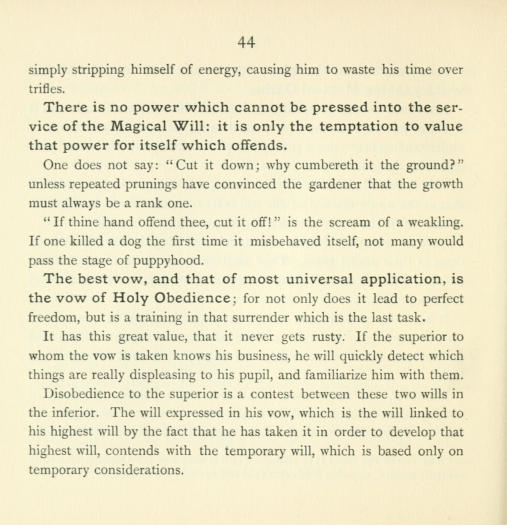
Highlights use the original PDF text layer. OCR-only matches may not be visible on the scan.
Transcription
Download text ↓raw extractionoriginal embedded textReview: unreviewed
44
simply
stripping
himself
of energy, causing
him
to waste
his time
over
trifles.
There is no power which cannot be pressed into the ser-
vice of the Magical Will: it is only the temptation
to value
that power for itself which offends.
One
does not
say: "Cut
it down; why cumbereth
it
the ground?"
unless repeated prunings
have convinced the
gardener
that
the growth
must always be a rank one.
" If thine hand
offend thee, cut it off! " is the scream
of a weakling.
If one killed a dog the first
time
it
misbehaved
itself, not
many would
pass the stage of puppyhood.
The best vow, and that of most universal
application,
is
the vow of Holy Obedience;
for not
only does
it
lead
to perfect
freedom,
but is a training
in that surrender
which
is the last task.
It
has
this
great value, that
it
never
gets
rusty.
If the
superior
to
whom
the vow is taken knows
his business,
he will quickly
detect which
things are really
displeasing
to his pupil,
and familiarize
him with
them.
Disobedience
to the superior
is a contest
between
these
two wills
in
the inferior.
The will expressed in his vow, which
is the will linked to
his highest will by the fact that he has taken it in
order to develop
that
highest
will,
contends
with
the temporary
will,
which
is based
only on
temporary
considerations.
Page provenance & review flags
Stable page ID: c96b4a13199c68ca1345dc34:p00056
Line breaks are preserved. Reading order and OCR accuracy may need review.
Printed page label has not been verified.
- No automated review flags. This does not establish transcription accuracy.