1913 · CLOSE READING
Book 4 (Part II)
Book 4 (Part II) (1913), PDF p. 40
Original page
Enlarge ↗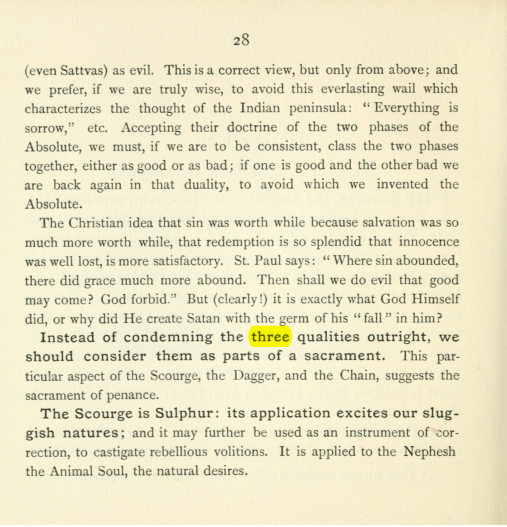
Highlights use the original PDF text layer. OCR-only matches may not be visible on the scan.
Transcription
Download text ↓raw extractionoriginal embedded textReview: unreviewed
28
(even Sattvas)
as evil.
This is a correct
view, but
only from above;
and
we
prefer, if
we
are
truly
wise,
to
avoid
this
everlasting
wail
which
characterizes
the
thought
of the Indian
peninsula:
"Everything
is
sorrow,"
etc.
Accepting
their
doctrine
of
the
two
phases
of
the
Absolute, we
must, if we are
to
be
consistent,
class
the
two
phases
together,
either
as good
or as bad; if one
is good and the other bad we
are
back
again
in
that
duality,
to
avoid
which
we
invented
the
Absolute.
The Christian idea that sin was worth
while
because salvation
was
so
much
more worth
while,
that redemption
is so splendid
that
innocence
was well lost, is more satisfactory.
St. Paul says : " Where sin abounded,
there did grace much
more
abound.
Then
shall we do evil
that
good
may come?
God forbid."
But (clearly!)
it is exactly what God Himself
did,
or why did He create Satan with the germ of his " fall " in him?
Instead
of condemning
the three qualities
outright,
we
should
consider
them as parts of a sacrament.
This
par-
ticular
aspect of the Scourge,
the
Dagger,
and
the Chain, suggests the
sacrament of penance.
The Scourge is Sulphur:
its application
excites our slug-
gish natures;
and it may
further
be used as an
instrument
of cor-
rection,
to castigate rebellious
volitions.
It is applied
to the
Nephesh
the Animal Soul,
the natural
desires.
Page provenance & review flags
Stable page ID: c96b4a13199c68ca1345dc34:p00040
Line breaks are preserved. Reading order and OCR accuracy may need review.
Printed page label has not been verified.
- No automated review flags. This does not establish transcription accuracy.