1913 · CLOSE READING
Book 4 (Part II)
Book 4 (Part II) (1913), PDF p. 133
Original page
Enlarge ↗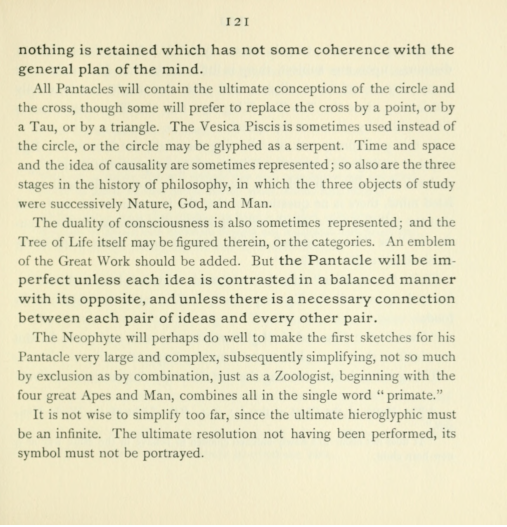
Highlights use the original PDF text layer. OCR-only matches may not be visible on the scan.
Transcription
Download text ↓raw extractionoriginal embedded textReview: unreviewed
121
nothing is retained which
has not some
coherence with the
general plan of the mind.
All Pantacles
will contain
the ultimate
conceptions
of the circle
and
the cross, though
some will prefer to replace
the cross by a point,
or by
a Tau, or by a triangle.
The Vesica Piscis is sometimes
used instead of
the circle,
or the circle
may be glyphed
as a serpent.
Time
and
space
and the idea of causality
are sometimes
represented;
so also are the three
stages in the history
of philosophy,
in which
the three
objects
of study
were successively
Nature,
God, and Man.
The duality
of consciousness
is also sometimes
represented;
and the
Tree of Life itself may be figured
therein,
or the categories.
An emblem
of the Great Work should
be added.
But the Pantacle
will be im-
perfect unless each idea is contrasted in a balanced manner
with its opposite, and unless there is a necessary connection
between each pair of ideas and every other pair.
The Neophyte
will perhaps
do well to make the first
sketches
for his
Pantacle
very large and complex,
subsequently
simplifying,
not so much
by exclusion
as by combination,
just
as a Zoologist,
beginning
with
the
four great Apes
and Man, combines
all in the single word
'' primate."
It is not wise to simplify
too far, since
the ultimate
hieroglyphic
must
be an infinite.
The ultimate
resolution
not
having
been performed,
its
symbol
must not
be portrayed.
Page provenance & review flags
Stable page ID: c96b4a13199c68ca1345dc34:p00133
Line breaks are preserved. Reading order and OCR accuracy may need review.
Printed page label has not been verified.
- No automated review flags. This does not establish transcription accuracy.