1913 · CLOSE READING
Book 4 (Part II)
Book 4 (Part II) (1913), PDF p. 123
Original page
Enlarge ↗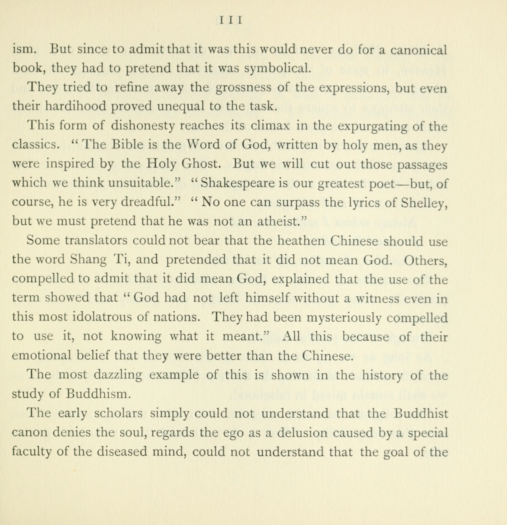
Highlights use the original PDF text layer. OCR-only matches may not be visible on the scan.
Transcription
Download text ↓raw extractionoriginal embedded textReview: unreviewed
Ill
ism.
But since to admit that it was this would
never do for a canonical
book,
they had to pretend
that it was
symbolical.
They tried to
refine
away the grossness of the expressions,
but even
their
hardihood
proved
unequal
to the task.
This form of dishonesty
reaches
its climax
in the expurgating
of the
classics.
" The Bible is the Word of God, written
by holy
men, as they
were inspired
by
the Holy Ghost.
But we will
cut
out those passages
which
we think unsuitable."
" Shakespeare
is our greatest poet — but, of
course, he is very dreadful."
" No one can surpass the lyrics of Shelley,
but we must pretend
that he was not an atheist."
Some translators
could not bear that the heathen
Chinese
should
use
the word
Shang Ti, and
pretended
that
it did not mean God.
Others,
compelled
to admit
that it did mean God, explained
that
the use of the
term showed
that " God had
not
left himself without
a witness
even in
this most idolatrous
of nations.
They had been mysteriously
compelled
to
use
it,
not
knowing
what
it
meant."
All
this
because
of
their
emotional
belief
that they were better than the Chinese.
The
most
dazzling
example
of this
is
shown
in
the
history
of the
study of Buddhism.
The
early
scholars
simply
could
not
understand
that
the Buddhist
canon
denies
the soul, regards the ego as
a
delusion
caused by
a
special
faculty of the diseased
mind,
could
not
understand
that
the goal of the
Page provenance & review flags
Stable page ID: c96b4a13199c68ca1345dc34:p00123
Line breaks are preserved. Reading order and OCR accuracy may need review.
Printed page label has not been verified.
- No automated review flags. This does not establish transcription accuracy.