1944 · CLOSE READING
The Book of Thoth
The Book of Thoth (1944), PDF p. 73
Original page
Enlarge ↗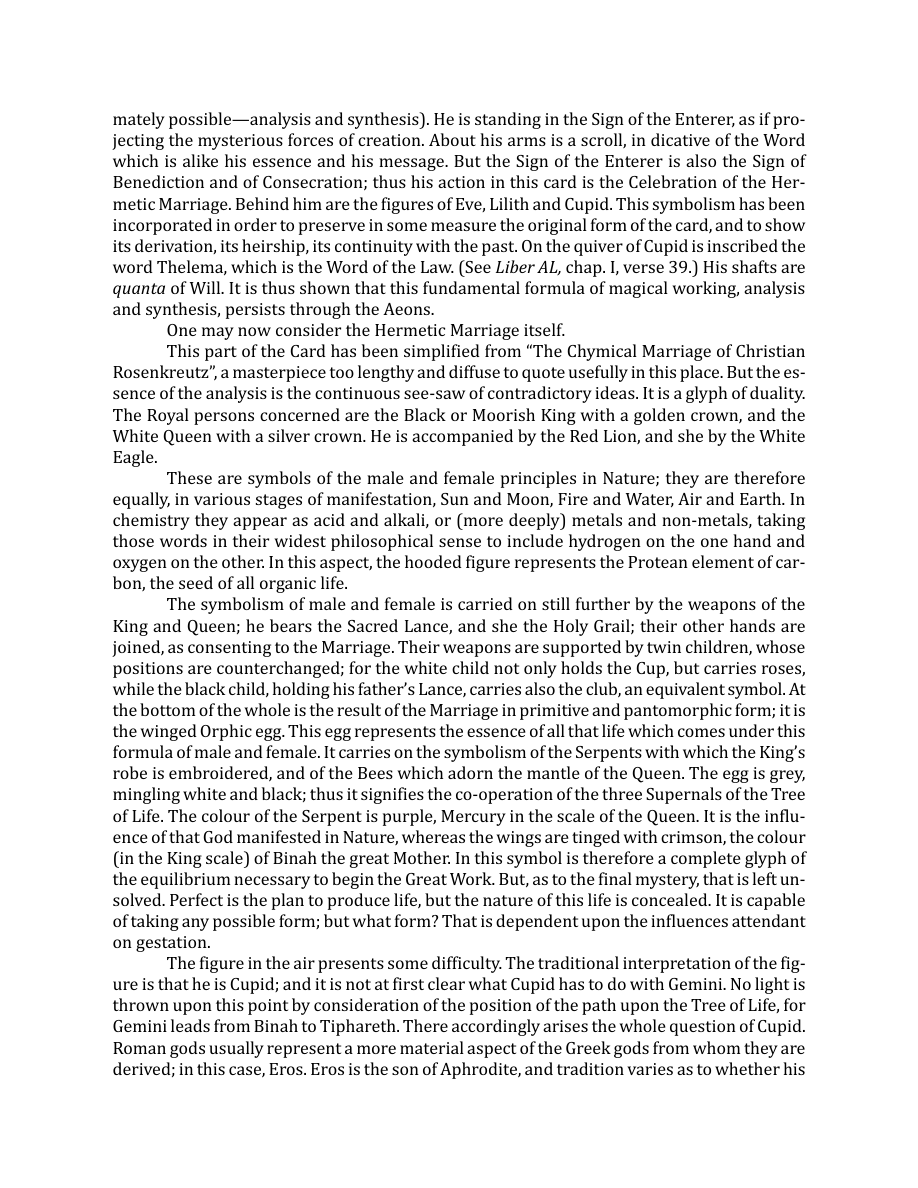
Highlights use the original PDF text layer. OCR-only matches may not be visible on the scan.
Transcription
Download text ↓raw extractionoriginal embedded textReview: unreviewed
mately possible—analysis and synthesis). He is standing in the Sign of the Enterer, as if pro‐
jecting the mysterious forces of creation. About his arms is a scroll, in dicative of the Word
which is alike his essence and his message. But the Sign of the Enterer is also the Sign of
Benediction and of Consecration; thus his action in this card is the Celebration of the Her‐
metic Marriage. Behind him are the figures of Eve, Lilith and Cupid. This symbolism has been
incorporated in order to preserve in some measure the original form of the card, and to show
its derivation, its heirship, its continuity with the past. On the quiver of Cupid is inscribed the
word Thelema, which is the Word of the Law. (See Liber AL, chap. I, verse 39.) His shafts are
quanta of Will. It is thus shown that this fundamental formula of magical working, analysis
and synthesis, persists through the Aeons.
One may now consider the Hermetic Marriage itself.
This part of the Card has been simplified from “The Chymical Marriage of Christian
Rosenkreutz”, a masterpiece too lengthy and diffuse to quote usefully in this place. But the es‐
sence of the analysis is the continuous see‐saw of contradictory ideas. It is a glyph of duality.
The Royal persons concerned are the Black or Moorish King with a golden crown, and the
White Queen with a silver crown. He is accompanied by the Red Lion, and she by the White
Eagle.
These are symbols of the male and female principles in Nature; they are therefore
equally, in various stages of manifestation, Sun and Moon, Fire and Water, Air and Earth. In
chemistry they appear as acid and alkali, or (more deeply) metals and non‐metals, taking
those words in their widest philosophical sense to include hydrogen on the one hand and
oxygen on the other. In this aspect, the hooded figure represents the Protean element of car‐
bon, the seed of all organic life.
The symbolism of male and female is carried on still further by the weapons of the
King and Queen; he bears the Sacred Lance, and she the Holy Grail; their other hands are
joined, as consenting to the Marriage. Their weapons are supported by twin children, whose
positions are counterchanged; for the white child not only holds the Cup, but carries roses,
while the black child, holding his father’s Lance, carries also the club, an equivalent symbol. At
the bottom of the whole is the result of the Marriage in primitive and pantomorphic form; it is
the winged Orphic egg. This egg represents the essence of all that life which comes under this
formula of male and female. It carries on the symbolism of the Serpents with which the King’s
robe is embroidered, and of the Bees which adorn the mantle of the Queen. The egg is grey,
mingling white and black; thus it signifies the co‐operation of the three Supernals of the Tree
of Life. The colour of the Serpent is purple, Mercury in the scale of the Queen. It is the influ‐
ence of that God manifested in Nature, whereas the wings are tinged with crimson, the colour
(in the King scale) of Binah the great Mother. In this symbol is therefore a complete glyph of
the equilibrium necessary to begin the Great Work. But, as to the final mystery, that is left un‐
solved. Perfect is the plan to produce life, but the nature of this life is concealed. It is capable
of taking any possible form; but what form? That is dependent upon the influences attendant
on gestation.
The figure in the air presents some difficulty. The traditional interpretation of the fig‐
ure is that he is Cupid; and it is not at first clear what Cupid has to do with Gemini. No light is
thrown upon this point by consideration of the position of the path upon the Tree of Life, for
Gemini leads from Binah to Tiphareth. There accordingly arises the whole question of Cupid.
Roman gods usually represent a more material aspect of the Greek gods from whom they are
derived; in this case, Eros. Eros is the son of Aphrodite, and tradition varies as to whether his
Page provenance & review flags
Stable page ID: c2293fa5b8d18e0cf1f666dc:p00073
Line breaks are preserved. Reading order and OCR accuracy may need review.
Printed page label has not been verified.
- No automated review flags. This does not establish transcription accuracy.